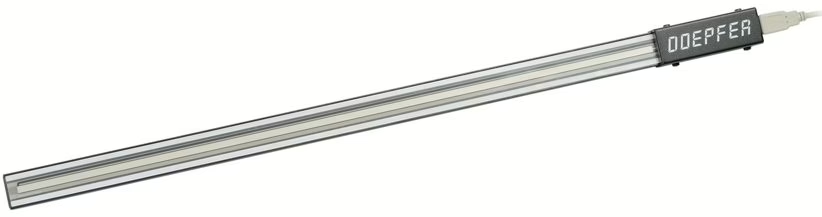
The ribbon controller is one of the oldest gestures in electronic music: rest a finger on a sensitive strip, slide it, and pitch follows your hand with no semitone grid in the way. That is the principle behind the 1930s Trautonium, which Doepfer has long kept alive in its A-100 system with the A-198-1 module. The new A-198-2 reuses exactly that 50 cm position/pressure sensor, but puts far smarter electronics behind it.
The core idea is unchanged: the module reads two things from the ribbon — finger position and pressure — and turns them into two control voltages (CV1 and CV2) plus two gate signals. Position usually drives pitch, pressure an expressive parameter such as level, filter cutoff or modulation depth. Every ribbon has always shared one flaw, though: with no reference marks, playing in tune is a feat. That is precisely what the A-198-2 sets out to fix.
Nine quantisation scales and a screen to finally play in tune
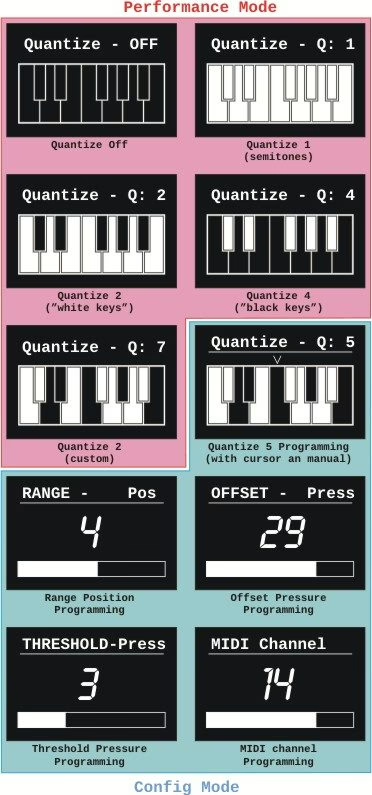
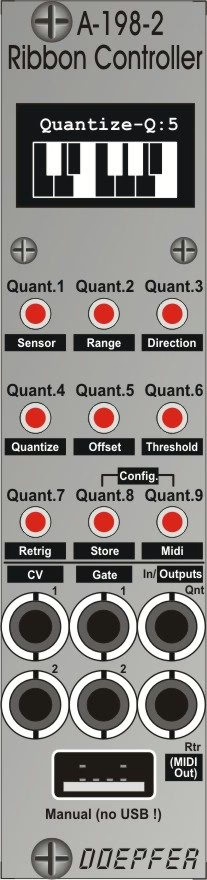
The headline addition is an OLED display ringed by nine red backlit buttons. It gives access to nine user-programmable quantisation scales, shown on screen as a one-octave keyboard on which you switch each note on or off. You build your own scales, store them, and the ribbon starts snapping to the degrees you chose instead of sweeping a continuum. A glissando gesture becomes a real melodic line.
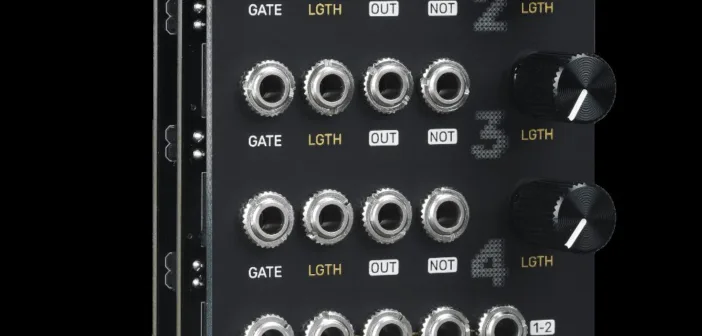
Better still, switching between quantised and free play is not confined to the module. A dedicated control input (Qnt) lets you do it live — say, with a dual footswitch like the Doepfer A-177-2. Play a quantised phrase, lift your foot, and slide freely for portamento or vibrato, all without leaving the instrument. A second input (Rtr) handles retrigger the same way: each jump to a new quantised note regenerates a gate, which cleanly fires an envelope. That one detail is what makes the ribbon genuinely percussive and articulate.
Finer control, and actual memory
The A-198-2 also opens up everything the A-198-1 kept fixed. The position voltage range (CV1) is adjustable in octave steps, from 1 to 5 octaves across the ribbon: choose between maximum precision over a single octave and a wide range. The pressure voltage range (CV2) is adjustable too, as is the trigger threshold for the pressure gate (Gate 2). Separate offset voltages for position and pressure set the starting point, and the manual’s orientation can be flipped for left-handers or an unusual rack placement.
Crucially, all of these parameters — including the nine quantisations — are stored non-volatile. Your setup is there at power-on, which on a stage instrument changes everything.
A MIDI output to escape the CV-only world
The module offers an optional MIDI output, in place of the second Rtr jack or via a small breakout module. The ribbon gesture then drives more than analog modules over CV: it can command any MIDI synthesiser, hardware or software. For a Eurorack system that often lives next to a MIDI instrument and an analog module, that is a welcome bridge.
| What the A-198-2 changes | A-198-1 | A-198-2 |
|---|---|---|
| Quantisation | None | 9 programmable scales, OLED screen |
| Quantised / free switching while playing | No | Yes (Qnt input, footswitch) |
| Switchable retrigger | No | Yes (Rtr input) |
| Position CV range | Fixed | 1 to 5 octaves |
| Settings storage | No | Non-volatile |
| MIDI output | No | Optional |
An old gesture, finally tamed
The ribbon has always been a thing apart: gorgeously expressive, thankless to play in tune. I have spent enough years running live sound and directing a studio to be wary of interfaces that promise emotion but discourage practice. What Doepfer does here is smart: it does not flatten the continuous gesture — glissando, hand vibrato, micro-intonation all survive — it simply layers a grid on top that you can switch in or out at will. That is the right way to digitise an analog instrument: keep the body of the gesture, just give it reference points. The ribbon becomes an instrument you can rehearse, recall and take on stage without praying you land in tune.
It remains a niche object, of course, aimed at Eurorack users and anyone drawn to expressive electronic lutherie. On price, expect around 380 € for the module-and-ribbon set, and roughly 185 € for the module alone if you already own a compatible sensor. The full spec sheet lives on the maker’s page.
To place the A-198-2 in a wider synth culture, our feature on subtractive synthesis explains how a single control voltage ends up shaping a sound. Details and documentation on the Doepfer product page.
Frequently asked questions
Does the A-198-2 replace the A-198-1?
No. It is an improved version that sits alongside the simple model rather than replacing it. Both use the same roughly 50 cm playing sensor; the A-198-2 adds the screen, quantisation, live switching and memory.
Can you still play freely, without quantisation?
Yes. Quantised play is an option you switch on or off, at the module or via the footswitchable Qnt input. The free glissando and micro-intonation that define the ribbon remain fully available.
How do you drive a MIDI synth from the ribbon?
The module offers an optional MIDI output, in place of the second Rtr jack or through a breakout module. Finger position and pressure are then converted to MIDI data, usable by any hardware or software instrument.
Can you change scale mid-song?
Yes. Switching between free and quantised play, like enabling retrigger, is controlled live through the Qnt and Rtr inputs, designed for a dual footswitch such as the A-177-2. The nine programmed scales are retained from one power-up to the next.