There are sounds no classic oscillator can make: a pad that seems built from luminous dust, a texture that breathes and drifts, an instrument stretched forever without changing pitch. Behind most of these textures hides the same technique: granular synthesis. Its principle is at once simple to state and dizzying to explore — chop a sound into tiny fragments, then replay them in a crowd. It is one of the most creative approaches in modern sound design, and it has never been more accessible.
The grain, the basic building block
A grain is a very short sound fragment, typically 1 to 100 milliseconds, taken from a sample or generated on the fly. On its own, a grain is almost nothing: a click, a puff of timbre. But stack dozens or hundreds per second, each with its own pitch, position and envelope, and you get a continuous, dense, moving material. That shift from fragment to mass is where the magic lies: you no longer play a waveform, you steer a cloud of sounds.
The idea is not new. Physicist Dennis Gabor theorised sound as a sum of acoustic “quanta” back in the 1940s; composer Iannis Xenakis and later researcher Curtis Roads carried it into music. Long confined to labs for lack of computing power, granulation became real-time with the personal computer — and has crept in everywhere since.
The controls that matter
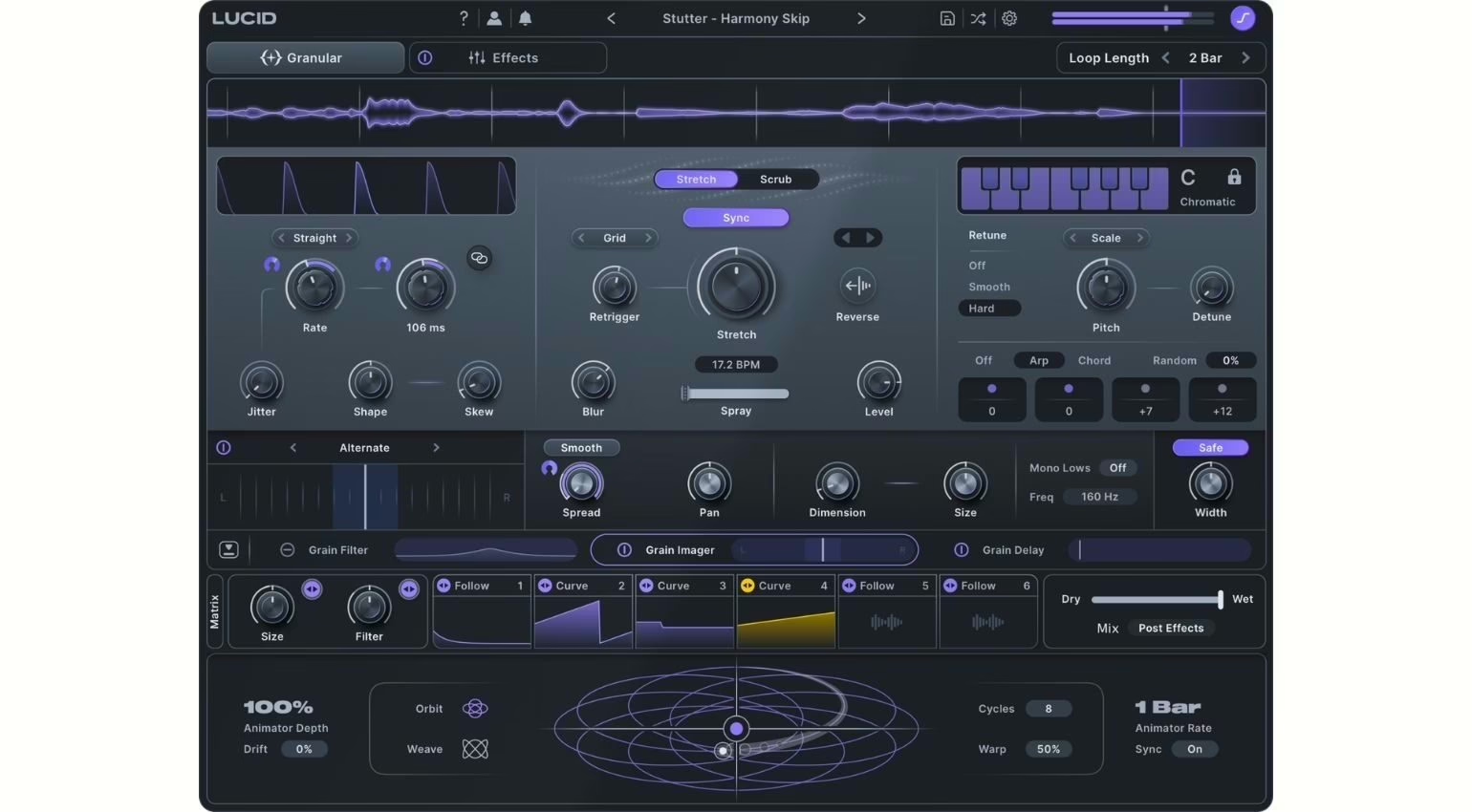
Not every granular engine looks the same, but the same fundamental parameters turn up everywhere. Understand them and you can drive any tool of the kind.
| Parameter | What it sets | What you hear |
|---|---|---|
| Grain size | Length of each fragment | Short = grainy, rhythmic; long = smooth, tonal |
| Density | Grains per second | Low = sparse, dotted; high = continuous pad |
| Position | Playback point in the sample | Freezes or scans where grains are taken from |
| Pitch | Grain transposition | Independent of speed: transpose without stretching |
| Envelope (window) | Grain attack/decay shape | Soft = no clicks; abrupt = harder texture |
| Spray | Randomness on position, pitch, pan | Adds thickness and life, avoids a mechanical feel |
Two behaviours follow. When grains come close together and regularly, you get a stream: a sustained material, almost an instrument. When they are more spaced out and scattered, you get a cloud: an airy, pointillist texture. Moving from one to the other often just means shifting density and spray — and that is where granulation becomes a playground.
A cousin of the sampler, different from wavetable
Granulation almost always starts from a recording: in that sense it is a direct cousin of sampling. The difference is the reading scale: a classic sampler replays the whole sample or a loop; the granular engine looks at it under a magnifying glass and takes only slivers. That also sets it apart from wavetable synthesis, which scans a table of fixed waveforms, and from subtractive and FM synthesis, which build sound from scratch. Granulation sculpts existing material.
What it’s actually for
The uses are broad. It builds evolving pads and textures from a simple sustained sound; it stretches time — lengthening a voice or a piano without changing pitch, since position and pitch are decoupled; it drives sound design for film and games (ambiences, drones, transformations); and it makes rhythmic and glitch effects when you step the position. Any sound — a voice, a pot lid, a field recording — becomes an infinite reserve of textures the moment you put it through the granular sieve.
Where to find it today
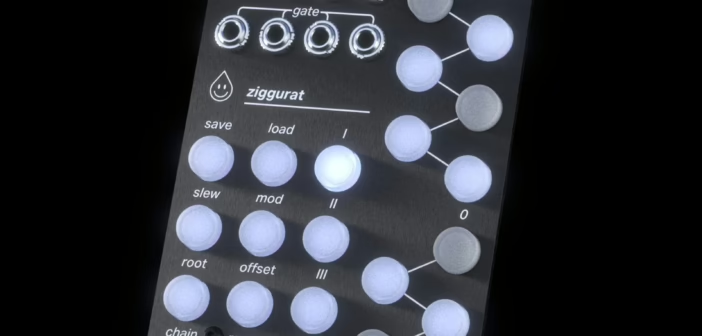
Granulation is everywhere. In software, it is baked into DAWs like Bitwig, whose Sampler went granular and spectral, and into dedicated instruments such as Dillon Bastan Iota II. You also find it as an effect processor, like Minimal Audio Lucid, which rebuilds sound grain by grain while keeping it in key. In hardware, Eurorack has made it a favourite playground, with whole modules dedicated to granular texture. In other words, no barrier to entry: a free plug-in is enough to start.
Three tips to get started
- Start from a single grain. Set a low density, listen to one grain alone, then raise density gradually: you will hear the texture form.
- Soften the envelope. Too abrupt a window generates clicks. A gentle attack and decay on each grain are enough for a clean material.
- Modulate position. A slow LFO scanning the playback point turns a frozen sound into a moving landscape — the move that makes granulation come alive.
My take
Granular synthesis is the fastest way to turn an ordinary sound into something you have never heard. Two minutes are enough to grasp the principle, yet you can spend years with it: a great discovery-to-depth ratio. The real trap is cranking everything — microscopic grains, maximum density, full spray — and ending up with mush. Texture comes from restraint and movement, not from excess. Start with a mundane field recording and one modulated parameter: that is often where the most personal sounds appear.