Behringer is stirring its fan base again, this time with a keyboard controller. The Polykeys 61 has been shown by the brand as a 61-key controller with polyphonic aftertouch and a target price of $199. A note of caution: as we write, the Polykeys 61 is still a teaser, with no announced release date and no full product page.
What Behringer has shown
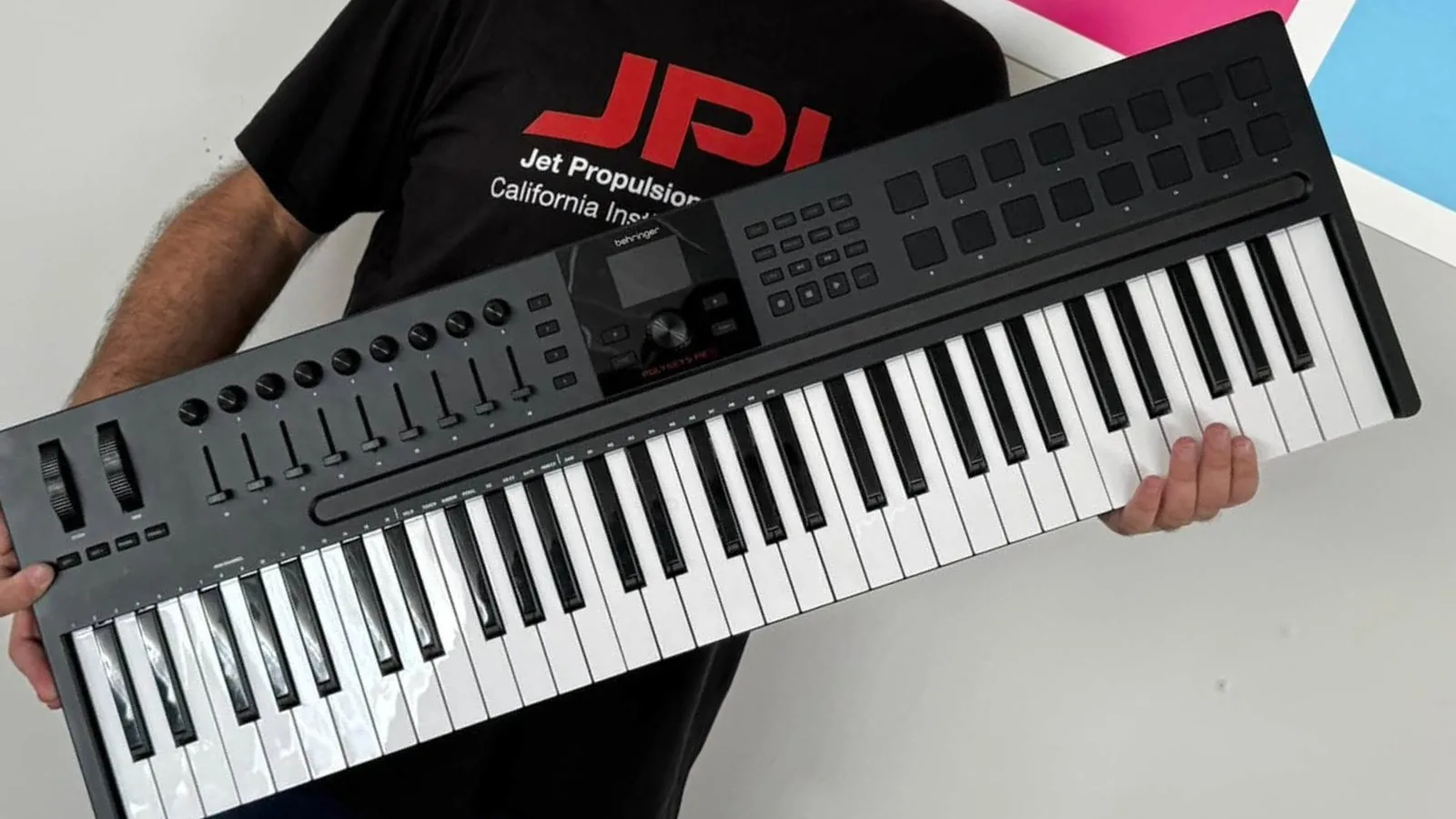
In the images released, the Polykeys 61 is more than a keyboard. There is a control ribbon sitting just above the keys, nine faders and nine knobs to drive parameters, a row of sixteen pads on the right, pitch and mod wheels on the left, and a central display ringed by buttons and transport controls. The whole thing clearly aims at players who drive virtual synths and hardware from a single master keyboard.
Polyphonic aftertouch, the real selling point
The headline feature is polyphonic aftertouch, meaning pressure sent key by key rather than globally as on most keyboards. Each note can carry its own pressure information, enough to animate a chord note by note. It still needs the target instrument or plugin to make use of it: this per-note expression fits the logic of MIDI Polyphonic Expression, MPE, which is exactly its home ground. On a controller announced at $199, finding polyphonic aftertouch is worth noticing, since the feature is usually reserved for far pricier keyboards.
Open-source firmware
A second notable promise is open-source firmware. Behringer has not yet said anything about the licence or where the code would be published, but the intent matches a recent trend from the brand, already seen with the Behringer Ignite sequencer. For a controller, opening the firmware would allow community-made control re-mappings and operating modes, familiar territory for owners of evolving controllers like the Electra One Mk3.
Plenty of open questions
At this stage, the essentials are still missing: the exact connectivity, the dimensions, the weight, whether there is an arpeggiator or sequencer, and above all a date. The $199 price is a target, not a confirmed retail figure. Behringer tends to show projects early, sometimes very early, with release then taking time. We will update this article as soon as an official announcement, with specs and availability, confirms the product.
My take
Putting polyphonic aftertouch on a $199 master keyboard is the claim that wakes up interest. The feature has long been a luxury, and bringing it down in price would genuinely serve the cause of MPE expression, still held back by the cost of compatible keyboards. The open question is the quality of the keybed and the reliability of per-note pressure, the two things that make all the difference and that a teaser never settles. We want a real date and a real keyboard under the fingers before getting carried away.