When you pick a power amplifier for a PA, you look at watts and impedance first. The operating class usually comes second, even though it governs three things every engineer feels on site: efficiency, the weight you have to carry, and the heat you have to pull out of a packed rack. Understanding these classes helps you read a spec sheet without being dazzled by the marketing.
The class is how the output stage conducts current
An amplifier takes a low-level signal and drives power transistors that copy it, scaled up, into the loudspeakers. The class describes how those transistors conduct current across the waveform. That choice drives efficiency (how much of the energy drawn from the wall actually reaches the driver rather than becoming heat), linearity and, as a knock-on effect, the size of the heatsink and transformer.
Class AB, the linear compromise that toured for thirty years
In Class A, the transistors conduct continuously. The signal stays very clean, but efficiency tops out around 15 to 25 %, the rest leaving as heat. Reserved for high-end hi-fi and some preamps, it never belonged in a stage power amplifier.
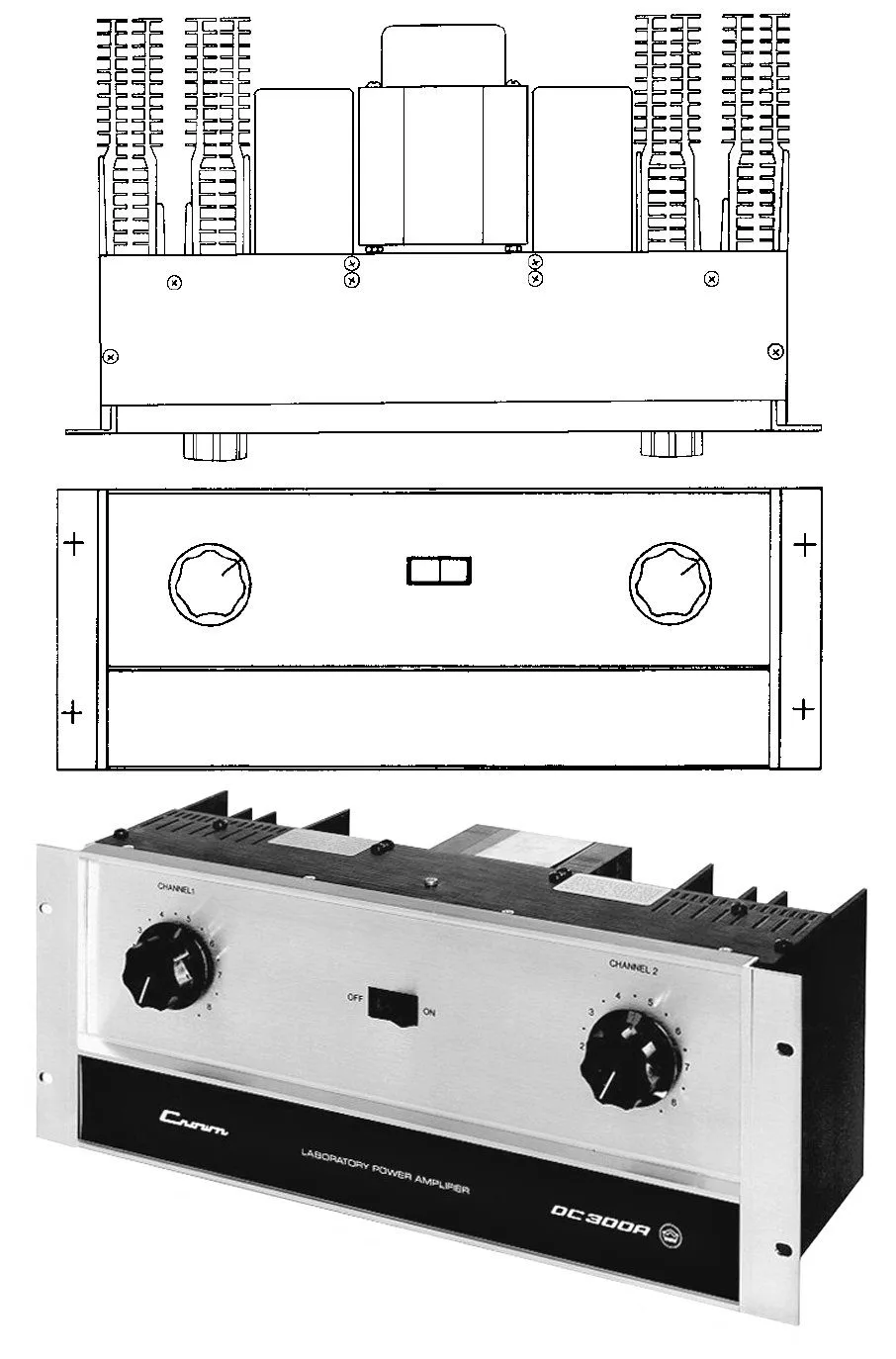
Class B splits the work: one transistor handles the positive half of the wave, the other the negative. Efficiency climbs, but distortion appears at the zero crossing, where the two transistors hand over. Class AB fixes that by keeping both transistors slightly on around zero. You get near-Class-A linearity for a theoretical 50 to 65 % efficiency. This is the class that equipped touring rigs for decades, with its downside: big heatsinks, a heavy toroidal transformer, and amps you lift with two people.
Class D, efficiency through switching
Class D changes the principle. Instead of copying the signal continuously, the output transistors switch fully, on or off, at a very high frequency. The width of those pulses tracks the audio amplitude (that is pulse-width modulation), and a low-pass filter at the output rebuilds the audible wave. Because a transistor wastes most heat when it sits half open, keeping it either off or fully on sends efficiency up to 85 to 95 %.
A stubborn myth says Class D is “digital”. It is not: the signal stays analogue throughout, only the output stage switching is at play. Paired with a switch-mode power supply, Class D gives light amps that run cool and hold huge power in 2U. Almost every current touring amp works this way, from Powersoft, Lab.gruppen, Lake or Crown.
Class H and Class TD, supplying only what is needed
Between the two worlds, Class H aims to cut the heat of an AB stage without changing its sound. The trick is in the supply: rather than one fixed, high voltage at all times, the amp has several voltage rails and jumps to the upper rail only on peaks. The rest of the time the stage works on a low voltage and dissipates less. You keep AB linearity with noticeably better efficiency, around 65 to 80 %.
Lab.gruppen pushed the idea with its Class TD, a supply that tracks the signal continuously and feeds a linear output stage as close as possible to the demand. Whatever the trade name, the principle is the same: never make the output stage dissipate a voltage it does not need at that instant.
On site, weight and efficiency decide
For a rental company, the class translates into kilos per flight case and amps at the power board. A Class D touring amp delivers several thousand watts for a few kilos and pulls less from the mains at the same output, a real comfort once you stack amp racks. These amps nearly all carry onboard DSP (filtering, delays, limiters, speaker presets), which ties into the way a system is tuned and simplifies cabling on site.
The class says nothing about final quality, though. A good AB stays faultless, and a bad Class D exists too. What counts is the power available into your load, a sound amplifier-to-speaker match, the headroom you keep for transients and how reliable the model is. The class mainly explains why the market swung toward light, cool amps, and why your back will thank you at the next load-in.
My take
Class D won, and that is good news for anyone carrying the racks. We now move in 2U what filled a wardrobe twenty years ago, with an efficiency that changes a festival’s power bill. The real debate is no longer analogue versus switching, but the quality of the supply and the onboard DSP, because that is where low-end control and limiter precision are decided. Just keep in mind that a cool, light amp does not excuse skipping a serious power budget and a proper PA system choice.