Matching an amplifier to a passive speaker is a bit like picking an engine for a car: too small and it strains and breaks; properly sized and it has reserve and lasts. Between the watts on the spec sheet, the ohms and the wiring modes, it is easy to get lost. Here are the few ideas that are enough to make the right calls in the field, whether you are rigging a small front-of-house or a large system.
Reading a power rating without being fooled
First trap: not all watts are equal. A speaker quotes a power handling figure, often given as a “program” value (what it takes in normal musical use) and a peak value (very brief transients). An amplifier quotes an output power, always tied to a specific impedance. Comparing a speaker number and an amp number without checking those conditions means nothing. The rule: match the speaker’s program power to the amp’s power at that speaker’s actual impedance.
Impedance in ohms: the heart of the pairing
Impedance, in ohms, describes the load the speaker presents to the amp. Common PA values are 8, 4 and sometimes 2 ohms. Key point: an amp delivers more power into a lower load. The same amp might put out 500 W into 8 ohms and 800 W into 4 ohms. But it has a minimum rated impedance: go below it and you make it overheat and trip its protection, or damage it outright.
The sensitive moment comes when you connect several cabinets to one channel. In parallel, impedance drops: two 8-ohm cabs in parallel present 4 ohms, three present 2.7. In series it adds up (two 8-ohm cabs make 16 ohms), with other trade-offs. So before wiring a channel, always work out the resulting impedance and check it stays above the amp’s minimum. That is exactly the logic you meet when connecting your speakers and building the power wiring.
Headroom: aim bigger, not exact
Here is what surprises people most: in live sound the danger is not an amp that is too powerful, but one that is underpowered. Pushed past its limits, an amp “clips”: its output flattens toward a square wave, rich in high-frequency harmonics. That extra energy up top is precisely what kills high drivers. A 500 W speaker shrugs off a clean 1,000 W amp; it dies under a saturated 300 W one.
So the field rule is to leave headroom: size the amp at roughly one and a half to two times the speaker’s program power, so transients (a snare hit, a kick) pass through without ever clipping. Then you keep a hand on the gain and, ideally, engage a limiter: the reserve is there for the peaks, not to listen louder all the time.
Bridged mode: double the power, halve the impedance
Many stereo amps offer a bridged mode: the two channels combine into one, far more powerful, handy for driving a big subwoofer. But there is a catch to never forget: when bridged, each half of the amp “sees” half the load’s impedance. An 8-ohm cabinet wired bridged behaves, to the amp, like a 4-ohm load. So you must check the minimum rated impedance in bridged mode, often higher than in stereo, or the amp goes straight into protection.
Sensitivity and SPL: what you will actually get
Power is not the whole story: loudness depends mostly on the speaker’s sensitivity, quoted in dB SPL for 1 watt at 1 metre. Two useful markers: doubling the power only buys 3 dB more, and you lose about 6 dB every time you double the distance in free field. In other words, sensitivity and the number of boxes, far more than raw watts, decide whether you cover the back of the room. Start from the target SPL at the listening distance, add the headroom you want, and derive the power and the number of cabinets needed. The choice of system — point source or line array — obviously feeds into that maths.
In practice
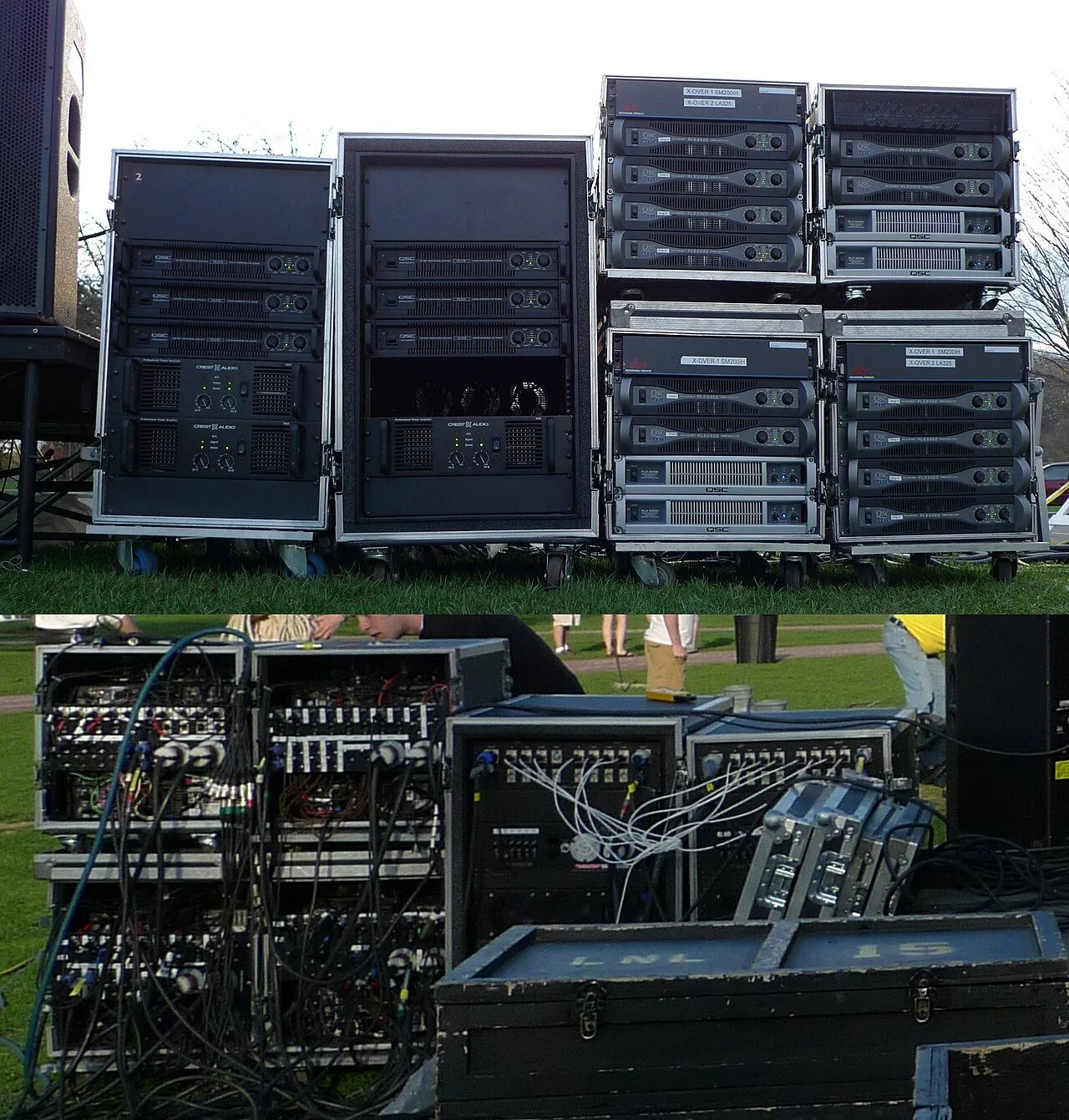
Modern Class D amps have lightened racks and often build in processing (filters, speaker presets, limiters and protection): a good part of this maths is then handled by the maker’s presets, provided you load them for the right speaker model. Mind the damping factor too, and a large enough cable gauge on long runs, both of which shape low-end control. And once the amp-speaker pairing is set, it is the system tuning and the system processing that do the rest of the job.
My take
The right instinct is not to hunt for the beefiest amp in the catalogue, but for the right balance between a speaker, its load and the reserve you keep. A calm system with headroom sounds cleaner and lasts longer than a small amp pushed into the red. Before a show, it all comes down to three numbers: how many ohms the amp sees, how many watts the speaker handles, and what SPL you need at the back of the room. Get those three right and you will never again wonder why a high driver let go mid-set.