In a live sound chain, everyone talks about the loudspeakers and the console, and rather little about what sits just before the drivers. Yet that is where the amplifier stage and its processing decide much of the sound, and above all the reliability, of a system. The modern amplifier is no longer a watt-pusher: it is a processor that shapes, protects and distributes. Here is how it works, and what you need to understand to run it properly.
The last link before the driver
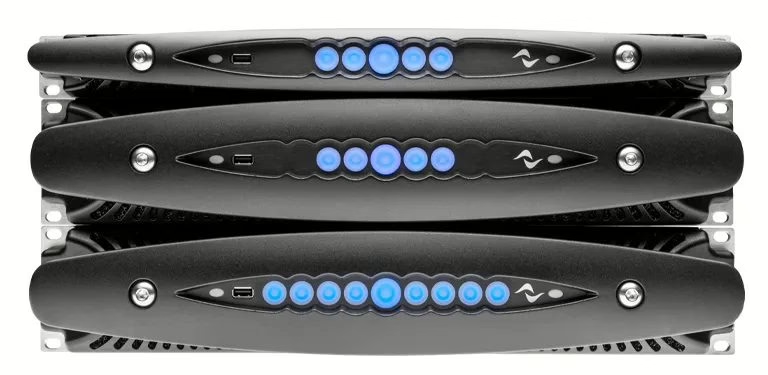
The amplifier takes a line-level signal and raises it to a level that can move cones. Its quality drives the low end, the dynamics and how the system holds up over time. For about fifteen years, Class D has taken over both touring and install: high efficiency, low heat dissipation, low weight. A rack that once weighed tens of kilos now fits in two rack units and delivers several thousand watts, which has transformed system logistics.
But the real revolution is not power: it is the integration of DSP inside the amplifier. The same box now amplifies, filters, aligns, protects and, increasingly, behaves as a networked audio node.
Sizing power without getting it wrong
The perennial question: how many watts for a given driver? The field logic is to give the speaker dynamic headroom. You generally aim for amplifier power above the loudspeaker’s AES rating, often by a factor of 1.5 to 2, precisely to reproduce peaks without clipping. Contrary to a common belief, it is not power that kills drivers, but the clipped signal of an undersized amp pushed past its limits.
You also have to think in impedance: the number of drivers per channel sets the load the amp sees, and therefore the power actually available. A channel loaded at 4 ohms delivers more than at 8 ohms, but exceeding the load limits drops the unit into protection. Always read the spec before paralleling several cabinets.
Passive, bi-amped, tri-amped
A passive speaker has its own crossover between low and high, downstream of the amp. A bi-amped or tri-amped system does the opposite: each way (low, mid, high) gets its own amplifier channel, and the split happens upstream, in the DSP, with an active crossover. The benefit is twofold: each transducer is driven by a dedicated amp, and the designer can align the ways precisely.
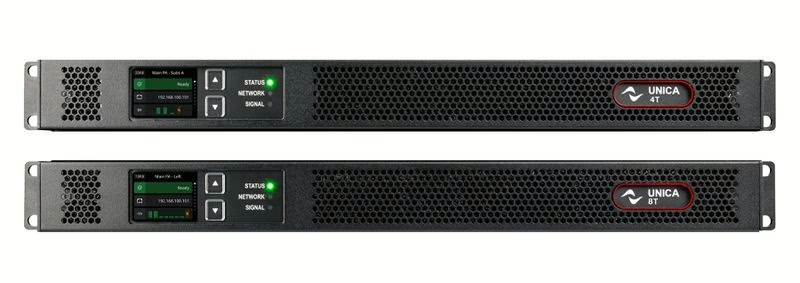
That is why professional systems, starting with line arrays, are driven by external amplification with factory presets: the manufacturer knows exactly how its transducers should be filtered, phase-aligned and limited.
Onboard processing: presets, filters and alignment
A modern amp’s DSP concentrates several essential functions:
- Speaker presets (voicing): frequency correction and filtering tailored to a specific model, usually supplied and validated by the loudspeaker maker.
- Active crossovers: the filters that split the spectrum between ways, as classic IIR or as FIR for tighter phase control.
- Phase alignment and delay: to time-align the ways within a cabinet, but also to align subs and tops, a topic we detail in our system tuning guide.
- EQ: parametric filters to fit the system to the room.
Using factory presets is not laziness: it is starting from the setting designed by the people who know the transducer better than anyone. You start there, then adapt to the room and the programme; you do not reinvent the filtering from scratch under soundcheck pressure.
Protection, or how not to cook a system
This is the quietest and most valuable function. The built-in limiters protect the drivers on several fronts at once:
- Peak limiter to prevent excessive mechanical excursion of the cone.
- RMS or thermal limiter to protect the voice coil from destructive heating over the long term.
- Excursion limiter in the low end, to keep the cone within its linear range.
Set correctly, these limiters are transparent most of the time and only step in at the extremes. Set badly or bypassed, they leave the door open to damage. It is another argument for validated presets: the protection thresholds are calculated for that specific amp/speaker pairing.
Distributing power: cabling and network
Between the amp and the speaker, the cable matters. Insufficient gauge over a long run drops voltage and wastes power; favour generous gauges and locking Speakon connectors. Upstream, recent amps include audio network inputs (Dante, AES67), turning the amp into a smart distribution point: it takes the signal over IP, applies its processing and feeds its ways. This architecture simplifies system cabling and centralises monitoring.
All of this draws current: sizing the mains supply and managing phases is part of the job, a subject we cover in our article on stage power. And to get the most from the PA, amp processing is planned with the rest of the system, whether cardioid subwoofers or delays and front fills.
My take
The amplifier is the link you notice least when everything is fine, and the only one you hear when things go wrong. The real shift of the last decade is not Class D or watts per kilo, it is onboard processing: an amp that knows the speaker it drives protects better and sounds better than a setting improvised on the fly. Start from the factory presets, understand your limiters instead of switching them off, and keep dynamic headroom. A well-amplified system holds up all night without flagging; that is all we ask of it.