Power is the thing you budget last and notice first — the day a breaker trips mid-show or a 50 Hz hum creeps into the mains. Yet clean distribution is the foundation everything else sits on: the safety of people, the reliability of the gear and the quality of the sound. This guide lays out how to reason about stage power without being a qualified electrician, and without playing with fire.
From the venue feed to the stage: distribution
It all starts at a supply point: a dedicated outlet, a stage panel, sometimes a three-phase power feed. The job of distribution — the “distro” — is to break that feed into protected circuits, each with its own breaker, feeding the zones that need it: front of house, monitors, backline, lighting. The golden rule is to keep the worlds apart: audio on one side, lighting and its dimmers on the other. Dimmers chop the sine wave and inject noise your preamps hate. If you must share a feed, at least isolate the circuits and never let a lighting dimmer and a mic input share the same socket.
This distribution logic mirrors the signal side: just as a patch and stagebox organise stage audio, a distro organises power. Both are prepared in advance, on paper, not in a panic on show day.
Balancing phases and sizing your power
On three-phase, you have three lives at 230 V to neutral (400 V between phases). The classic mistake is to plug everything into one phase: it saturates while the other two idle, and the neutral takes the imbalance. So spread the loads: FOH on one phase, monitors and backline on another, lighting on the third, for example. A crucial safety point: within one audio zone, keep all gear on the same phase. Two devices linked by audio but fed from different phases means 230 V of potential difference waiting for a fault to cause trouble.
The power maths fit in one formula: power = voltage × current. A 16 A circuit at 230 V gives roughly 3,680 W, and you keep a margin. Add up the real draw of the gear — not its theoretical peak rating — and leave headroom for the transients of power amps, which are hungry on peaks.
The usual suspect: ground loops
The hum that rises when you connect two devices almost always comes from a ground loop: two different earth paths create a small potential difference, and current flows through the shield of your audio cables. The right moves, in order:
- A single power source for the whole audio chain (star feeding from one distro).
- Balanced connections wherever possible: they reject common-mode noise.
- A DI box with a ground lift to isolate a troublesome source, exactly as you do when connecting powered speakers to a mixer.
One absolute no: never disconnect the mains protective earth to silence a hum. It may kill the noise… and turn a metal chassis into a lethal trap at the first fault. Safety earth is non-negotiable; you isolate on the signal side, never on the mains side.
Connectors and safety: what belongs on stage
Professional gear has its standards, built to survive the field and to lock.
| Connector | Typical use |
|---|---|
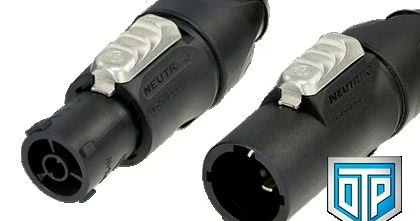
| powerCON TRUE1 | Locking device power, disconnectable under load, weather-resistant |
| CEE (P17) 16/32/63 A | Single- and three-phase power feeds, panels and distros |
| Domestic mains outlet | Service sockets and small devices |
Beyond connectors, three protections make the difference: an RCD (30 mA) that trips on an insulation fault, cable gauges matched to the run length to limit voltage drop, and a power-up sequence — you bring the PA amps up last and shut them down first, to avoid the thump that shoots into the speakers. These habits echo those of system tuning: a reliable rig is prepared, not improvised, and a good wiring diagram beats good intentions.
My take
Power is the least glamorous part of a stage and the least forgiving. A well-planned distro, balanced phases and star feeding solve 90% of hums before they even appear — and none of that is expensive, just a little method. The only red line is the protective earth: you never sacrifice it for comfort. The rest is quick to learn and best sorted on paper. Good distribution is like a good soundcheck: nobody notices it when it is done right.