In the mid-1960s the synthesizer was still a research-studio curiosity, a cabinet of cables reserved for experimental music. Three years later, one album put it at the top of Billboard‘s classical chart and into millions of homes. Between the two stood a composer, a producer and a barely-finished instrument: Wendy Carlos, Rachel Elkind and the Moog modular.
An album of Bach played on a patch-cord machine
Released in October 1968 by Columbia Records, Switched-On Bach is Wendy Carlos’s debut album, produced with Rachel Elkind. It features pieces by Johann Sebastian Bach, performed by Carlos and Benjamin Folkman on a Moog synthesizer. The idea looked absurd: handing the most rigorous counterpoint in history to an unstable electronic instrument that could not play more than one note at a time. The result won over classical listeners and electronic-music fans alike, and tied the Moog name to the sound of the synthesizer for good.
The Moog, a box of voltages
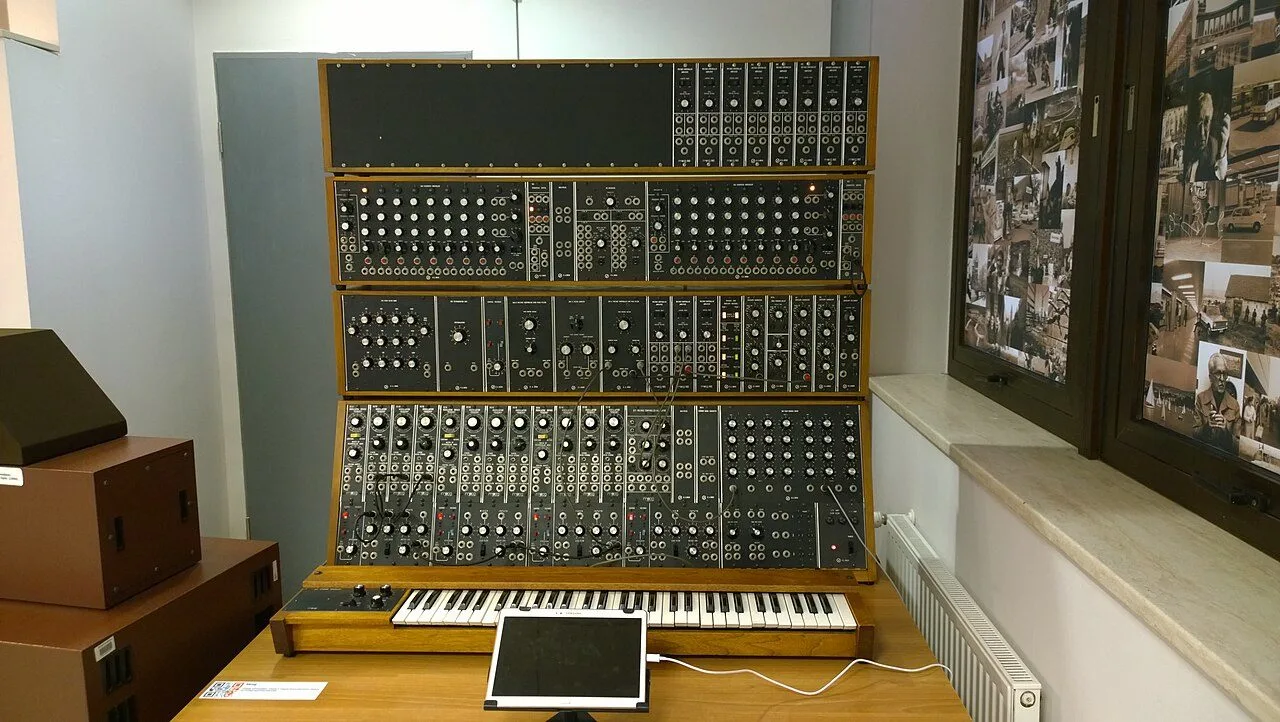
The Moog synthesizer is a modular instrument invented by the American engineer Robert Moog in 1964. It is built from separate modules, voltage-controlled oscillators, filters, amplifiers, envelope and noise generators, linked together by patch cords. Moog’s decisive innovation comes down to two words: voltage control. One voltage drives pitch, another the filter opening, a third the level, and that electrical grammar is what makes the instrument playable and repeatable. The principle is subtractive synthesis, a rich tone shaped with the filter.
A thousand hours, one note at a time
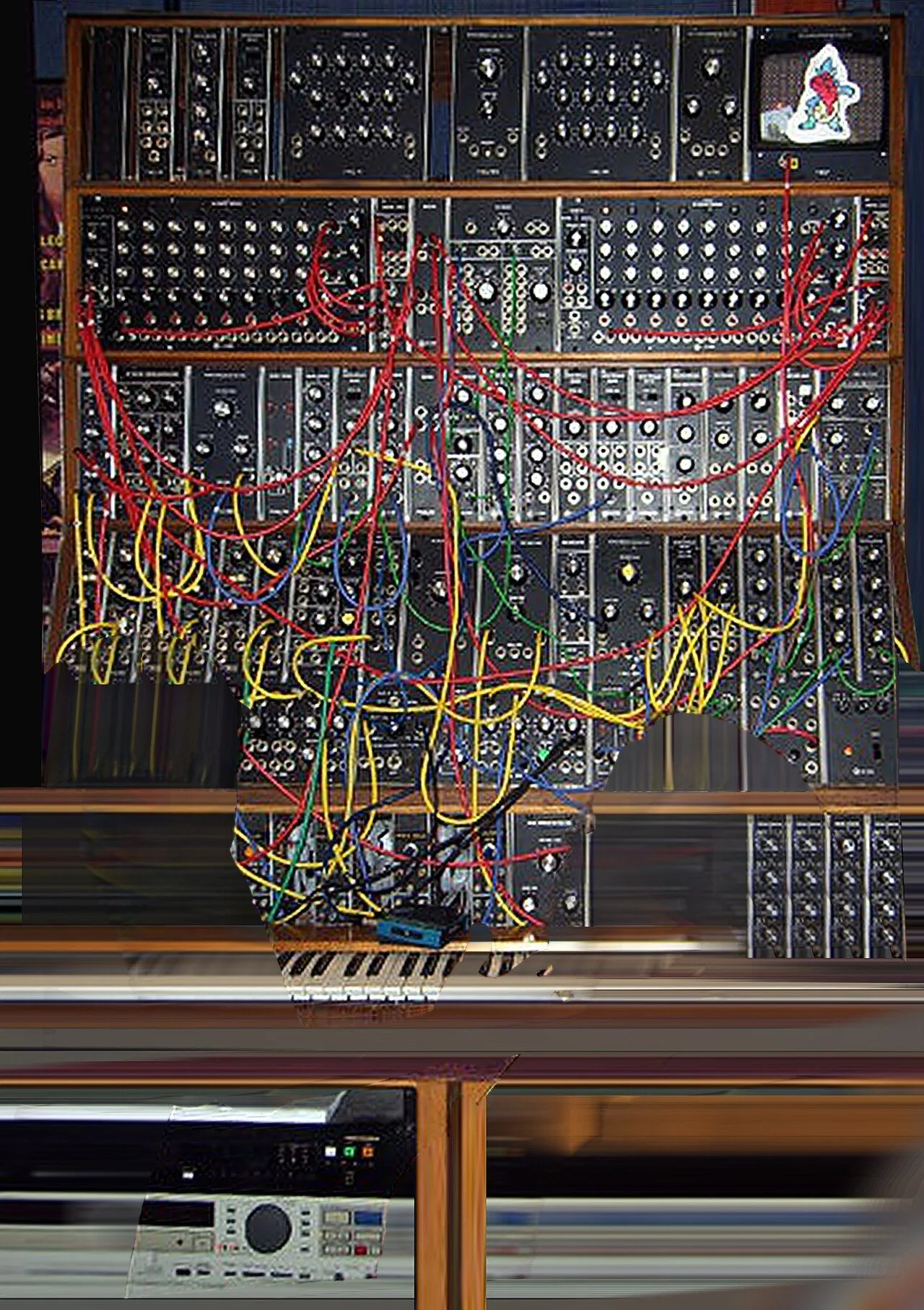
This is where the album’s technical feat lies. The Moog of the day was monophonic: it produced only one note at a time. To render Bach’s polyphony, Carlos recorded each voice separately, note after note, then stacked the lines on an eight-track recorder. Every layer meant reprogramming the sound at the patchbay and retuning the oscillators, whose pitch drifted with temperature. Carlos reckons she spent about a thousand hours, spread over some five months, building the album this way. Tuning stability became an obsession, and fed her exchanges with Robert Moog about improving the instrument.
That painstaking work explains the precision of the result. Every timbre was chosen, every articulation placed by hand, far from the image of a machine playing itself. The conversation in voltages between modules, now standardised as CV and Gate, was done by hand back then, patch after patch.
The shock of 1968
The success beat every forecast. Switched-On Bach climbed to number 10 on the Billboard 200, topped the classical albums chart from 1969 to 1972, and passed one million copies sold by June 1974. In 1986 it became the second classical album certified platinum. At the 1970 Grammy Awards it won three prizes: Best Classical Album, Best Classical Performance for an instrumental soloist, and Best Engineered Classical Recording. For a record made one note at a time on a stubborn prototype, that haul is still hard to match.
After Wendy Carlos came out as a transgender woman in 1979, reissues amended the artist credit to reflect her name, as with the rest of her discography.
A legacy that never stopped
The album set off a wave. Makers saw that a synthesizer could aim at the mainstream, and the 1970 Minimoog turned the cabinet of modules into a portable stage instrument. Fifty years on, the ripple has not settled: the sound is recreated in software such as the Martinic Prodigy, and in affordable hardware such as the Behringer D-Mini, a miniature of the Minimoog Model D. All of them descend, closely or distantly, from the box of voltages on which Wendy Carlos spent a thousand hours making Bach sing.