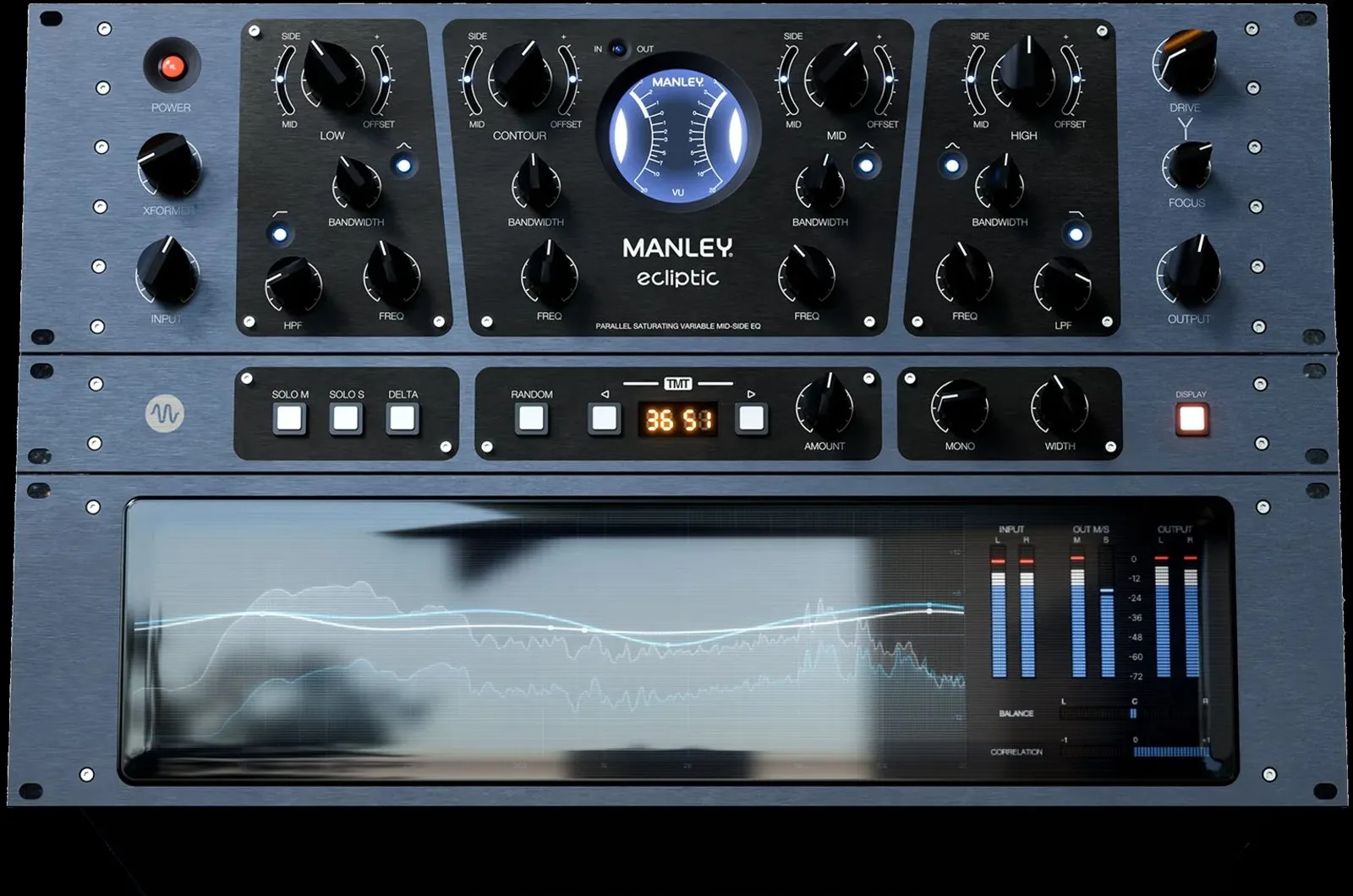
Manley ecliptic price: $99.99 as an intro, rising to $199 afterwards, in VST3, AU and AAX for Mac and PC. It is the first fully original Manley EQ built from the ground up as software, a parallel-band Mid/Side equalizer developed with the brand’s hardware designers and released through Plugin Alliance.
A Manley that models no Manley
The California shop is known for tube machines that became references, from the Massive Passive to the Vari-Mu compressor. Until now its plugins recreated those units down to the component. With ecliptic the logic flips: there is no hardware version to model. The team starts from a blank page and draws an equalizer that could not have existed in a rack, at least not at this price or in this form.
The project is also the first product under RCKFRC, the holding company that now sits above Plugin Alliance, Brainworx, Manley Labs and Apogee after founder Dirk Ulrich bought his brands back. We covered that return of Plugin Alliance and Brainworx to their founder; ecliptic is its first concrete product, bringing together Manley’s hardware designers, a software team in Canada and the US, and Brainworx’s TMT technology that recreates the tiny tolerance differences from one channel strip to the next.
Bands that sum in parallel
The heart of ecliptic is an architectural choice. Most digital equalizers chain their bands in series: the signal passes through the lows, then the mids, then the highs, and each stage acts on the result of the previous one. Here the low, mid and high bands work in parallel and sum at the end, like a classic passive mastering EQ. The curves interact instead of stacking, which gives smoother transitions and a color that stays consistent even when you push several bands at once.
The whole unit is billed as “100% based on analog transformer models, filters and EQs”. The transformers are not decoration: the harder you drive a band, the more body, air and harmonic distortion it adds. The equalizer behaves as a color tool as much as a level tool, familiar ground for Manley.
One set of controls for center and sides
ecliptic is built for Mid/Side work. You shape the center and the sides of the mix with a single set of controls, with no jumping between two pages or two instances. To keep an ear on the move, the Brainworx wrapper adds its usual tools: a Solo Mid/Side to audition each component on its own, a Delta mode that plays only the difference the EQ adds, a Mono button and a stereo width control. Those are valuable references when you treat a mix bus or a master, where a handful of misplaced decibels shows up across the whole track.
The approach clearly targets mastering and mix-bus duty, two jobs that ask for cohesion rather than surgical fixes. If you build your masters step by step, ecliptic fits into a wider thinking about the order of processors in a mastering chain, between color EQ and dynamics control.
From plugin to hardware, for once
The intriguing detail sits in Dirk Ulrich’s letter. Plugin Alliance spent nearly two decades bringing machines into the DAW; with ecliptic, the brand asks whether the road can run the other way. If enough users call for a rack version, the Manley designers say they are ready for the challenge. The idea stays conditional, but it says something about the moment: a circuit can now be born on screen before it joins, perhaps, a metal chassis.
For now ecliptic installs in VST3, AU and AAX on Mac and PC. Anyone who wants to compare with the brand’s hardware approach can revisit our hands-on with the tube Manley Dual Channel EQ, recently back in Mid Band and Main flavours.
My take
A color EQ at $99.99 with Manley on the badge is a hard one to pass up. The parallel-band bet is the right call: it is exactly what makes old passive units so pleasant on a master, that way of adding color without ever turning harsh. Single-control Mid/Side simplifies a task too many tools overcomplicate, and the Delta mode keeps you honest about what you are really adding. Whether the transformer saturation delivers at high drive remains to be heard, but the entry ticket invites a try without overthinking. And the hint of a rack version makes you want to vote with your keyboard.