For more than a decade, RC-20 Retro Color has been a go-to for producers who want to dirty, age or breathe life into a sound in a couple of moves. XLN Audio finally gives it a first major version: v2 does not overturn the formula, it adds what was missing and smooths out the rest. At the centre of the update is an Echo module that routes the plugin’s own effects through its feedback loop, plus the long-requested ability to reorder the modules.
An echo that contaminates itself
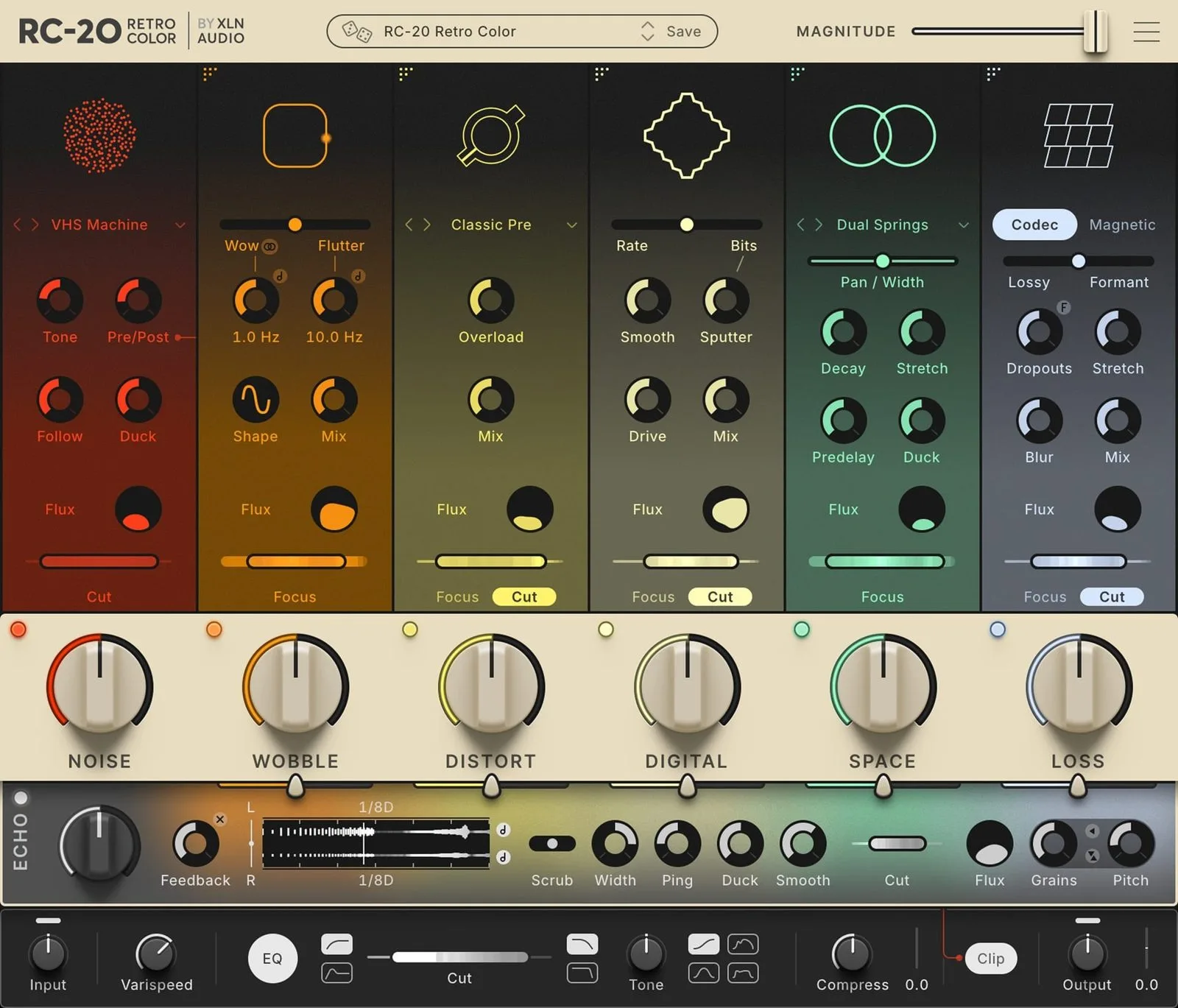
The new Echo is a clever idea: instead of a plain delay, it is a delay whose every repeat runs back through RC-20’s modules. Five of the six modules, all but Noise, can act on the repeats, each by its own amount, so the echo wobbles, distorts and degrades a little more with each pass. Add ducking, transient smoothing and a Grains section that drops in pitched or reversed grains for shimmer and atmosphere. It is a Space Echo-style delay, opened up to the plugin’s whole textural palette.
Six modules, now moveable
RC-20 keeps its six-module architecture: Noise, Wobble, Distort, Digital, Space and Loss. The big workflow change is that you can now drag the modules into any order (Wobble, Distort, Digital, Space and Loss) to find new interactions. Each module also grows: new distortion types (Tape, Classic Pre, Porta) and an Overload feature to push the signal to breaking point; a Space module gaining 32 new reverb types, from classic rooms and plates to stranger spaces; a Codec mode in Loss blending MP3-style compression, formant shifting and packet dropouts, smeared with Blur; and 17 new noise types.
Varispeed, workflow and browsing
v2 also adds Varispeed, tape-style playback slowed to half, quarter or eighth speed while staying locked to the track’s tempo. On the comfort side, XLN reworked the engine: full undo history, module locking, oversampling, master compression and snapshot comparisons. A new preset browser speeds up the search, with tags, custom collections, filtering and sharing. Enough to forget you are handling a tool designed a decade ago.
A v2 that breaks nothing
An important point: v2 installs as a separate plugin from v1. Your existing projects keep loading v1 exactly as before, with nothing changed behind your back. All of v1’s factory sounds and presets are included in v2, and your own v1 presets import in a few clicks, converted automatically to sound just as they did. The plugin stays available as VST3, AU and AAX on Windows and Mac. The launch price is 99 dollars, and the upgrade is 19 dollars for v1 owners.
| v2 addition | Detail |
|---|---|
| Echo module | feedback delay through 5 of 6 modules, ducking, Grains |
| Moveable modules | reorder the Wobble, Distort, Digital, Space, Loss chain |
| Spaces | 32 new reverb types |
| Loss / Codec | lossy compression, formant shifting, packet dropouts |
| Varispeed | slowed playback 1/2, 1/4, 1/8, tempo-locked |
| Price | $99 (launch), $19 v1 upgrade |
Frequently asked questions
Does v2 replace v1 in my projects?
No. RC-20 Retro Color v2 installs as a separate plugin. Your existing projects keep loading v1 exactly as before, with no changes. You decide when to move to v2, project by project.
Can I bring over my v1 presets?
Yes. All of v1’s factory sounds and presets are included in v2, and your own presets import in a few clicks. They are converted automatically and sound as they did in v1, so you never start from scratch.
What does the Echo module really add?
Echo is not a plain delay: every repeat runs back through RC-20’s modules, five of the six of which can process it. The echo distorts and degrades with each pass, with ducking, transient smoothing and a grains section on top. It is the addition that opens up the most creative avenues.
Which formats and what price?
The plugin is available as VST3, AU and AAX on Windows and Mac. The launch price is 99 dollars for new customers, and the upgrade is 19 dollars for existing v1 owners.
My take
A decade on, RC-20 had no real rival for instant vintage color, and this v2 does not try to reinvent itself: it adds what was missing. The Echo that feeds all six modules back into its loop is the real stroke of genius, turning a plain delay into a texture machine. Being able to reorder the modules also changes the day-to-day more than you would expect. And installing v2 beside v1 without touching existing projects avoids the classic update nasty surprise. At 99 dollars, or 19 for v1 owners, the bill stays light against the time the tool saves.
To dig into the textures RC-20 recreates, read our explainer on tape emulation and our piece on granular synthesis.