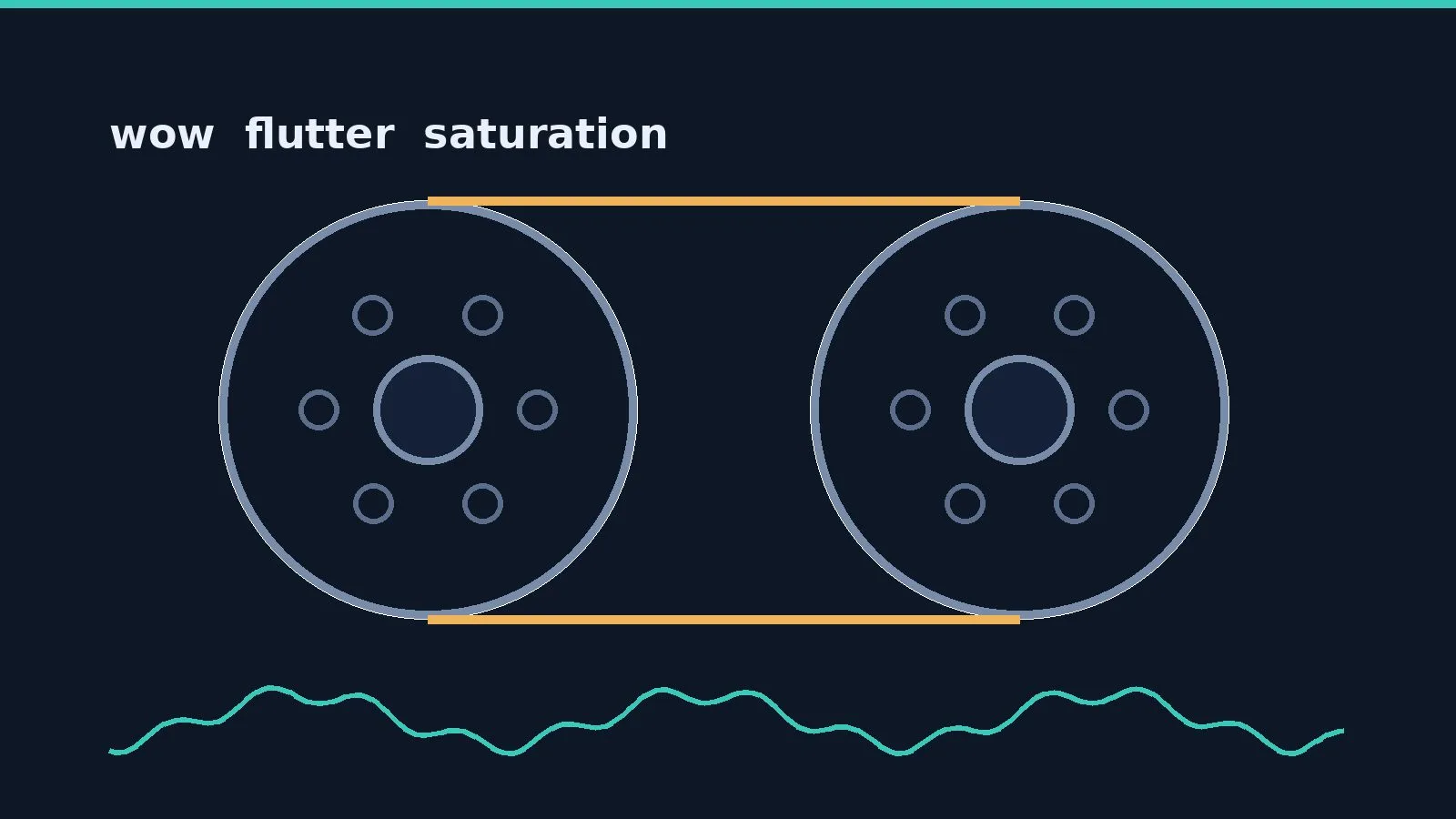
Magnetic tape recorded nearly every record of the twentieth century, and engineers ended up loving its flaws as much as its strengths. Tape plugins set out to reproduce that behaviour: a progressive saturation, a natural compression and a handful of imperfections that give a mix cohesion. Understanding each mechanism keeps you from turning a knob at random and degrading a signal instead of enriching it.
Saturation, the heart of the model
When you send a high level to tape, the medium no longer follows the input in a straight line: the peaks round off instead of rising cleanly. This non-linear magnetisation generates harmonics that were not in the original signal, and that is where the warmth associated with tape comes from.
{SVG}
Tape mostly produces odd-order harmonics, the third in particular, which thickens the sound without turning it harsh. It also adds a gentle compression, since the rounded peaks rise more slowly than the rest of the signal. A serious tape plugin models this curve, often called hysteresis, and its slope depends on the drive level and the input you hit it with. It is a close relative of the harmonic saturation you know from other plugins, with a signature of its own.
The flaws that matter
Beyond saturation, a good model reproduces several measurable imperfections.
- The head bump: a tape machine shows a slight rise in the low end, around the playback head resonance, which adds body to the bass. Its position depends on the tape speed.
- Wow and flutter: small speed variations, slow for wow, fast for flutter, that modulate pitch. In small amounts they animate the sound and widen the stereo a touch; in excess they sour it.
- High-frequency loss: tape reproduces the very top less well, especially at slow speed, which softens transients.
- Hiss and noise floor: present by nature, often adjustable, sometimes useful as a sign that a process is working.
Speed and calibration
Tape speed changes everything. At 7.5 inches per second the low bump is pronounced and the top more limited, a thick vintage sound. At 15 inches per second the balance tightens and the response is flatter. At 30 inches per second tape leans toward neutral, with a tighter low end and less bump. Most plugins offer these speeds as a setting in their own right.
Calibration matters just as much. On a real machine you set the reference level, given in nanowebers per metre, which fixes the point where tape starts to saturate. A plugin borrows that idea as an input level or a calibration reference: the more you push above that point, the more saturation you get. Treat this step as an extension of your gain structure, because a tape plugin reacts to the level you feed it, not to a magic knob.
How to use it in a mix
Two approaches sit side by side. As an insert on a track, a little tape rounds an over-clicky drum, settles a vocal, or thickens a bass. On a bus or the master it works as glue: the peaks settle slightly, the transients soften, and the whole gains cohesion. The effect then sits close to a very gentle compression, without the work of a real compressor.
Set the input level first to aim at the colour you want, then make up gain at the output so you compare at equal volume, otherwise the louder version always wins. Keep wow and flutter modest on sustained sources like a piano or a pad, where pitch modulation shows quickly. And check mono compatibility if you push the speed variations, because the modulation can create slight phase shifts between channels.
The traps to avoid
The first trap is disguised gain: a tape plugin that lifts the level gives the illusion of an improvement. Always match the output before you judge. The second is stacking: putting tape on every track and then again on the bus eventually softens the whole mix and eats the transients you need. The third is dogma. A tape model earns its place when the sonic result justifies it, not because the sleeve of a famous record showed a machine. As with the classic gear of that era, the setting matters more than the badge.
My take
A good tape plugin is still one of the most musical processors a mouse-click away, above all on a drum bus or a sum of vocals. Its strength is not audible distortion but everything that happens just before: the rounded peaks, the third harmonic that thickens, the slight settling that binds. Dialled by ear and gain-matched, it adds a coherence that is hard to get any other way. Pushed for the folklore, it blurs a mix in two minutes. Fifteen inches per second is a safe starting point when you are unsure.