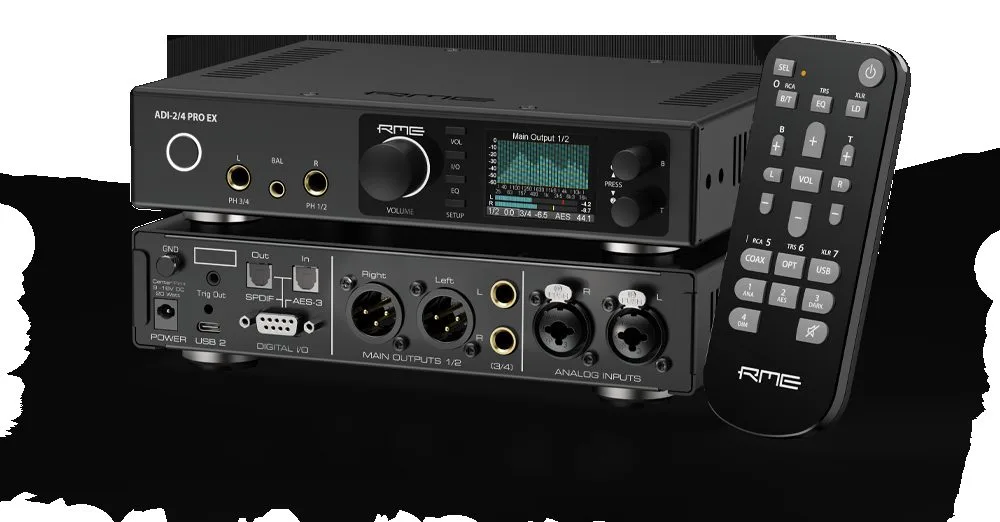
RME doesn’t refresh its converter range every other week, so the arrival of the ADI-2/4 Pro EX is an event. The German brand takes the architecture of the well-known ADI-2/4 Pro SE and moves it onto the latest ESS conversion stages, with a claimed 127 dBA dynamic range and sample rates reaching 768 kHz. It all still fits in a half-rack, 1U enclosure that lives on a desk or bolts into a studio rack.
A reference converter, not just an interface
The ADI-2/4 Pro EX isn’t an audio interface like the others. Its first job is conversion: two analog inputs to digital, four digital outputs to analog, at a quality built for mastering, measurement and critical listening. The input stage uses an ES9823Pro converter, the outputs an ES9039Q2M, both 32-bit. RME quotes a 125 dB (AES17) signal-to-noise ratio at the +24 dBu input, or 127 dBA, with distortion below -127 dB. These are lab figures, but they state the intent: aim for the very top.
Input sensitivity now reaches down to -35 dBu thanks to digital gain, and an RIAA phono mode appears directly on the line input, with deviation under ±0.05 dB across the band. In other words, you can digitize a turntable without an outboard preamp, at a level of precision that’s rare in this format.
Headphones: three states and a balanced mode
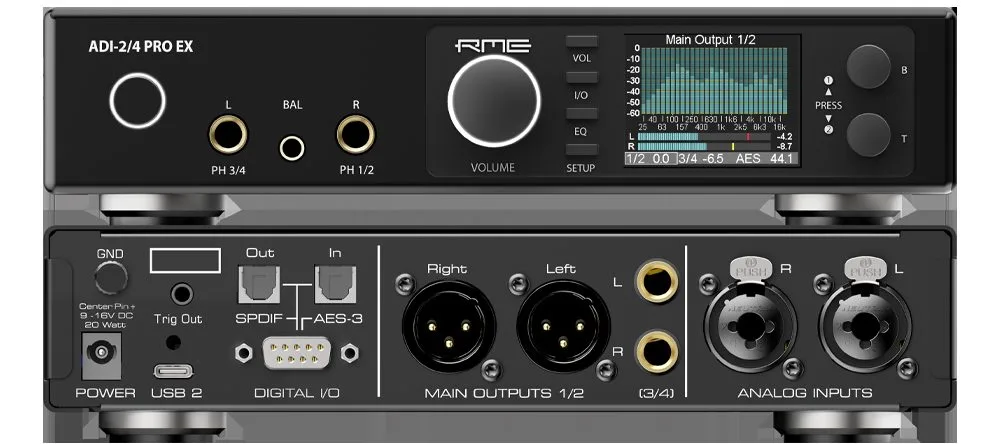
This is one of the EX’s headline features. Both headphone outputs (1/2 and 3/4) run in three states — IEM, Low Power and High Power — to suit everything from very sensitive in-ears to demanding headphones, with signal-to-noise holding between 120 and 124 dB. Balanced headphone mode uses DAC channels 3/4 and climbs to +25 dBu in High Power, with a 0.2-ohm output impedance. The rear outputs stay free to carry an independent signal, so you can drive monitoring and a headphone feed separately without compromise.
Clocking, DSP and remote
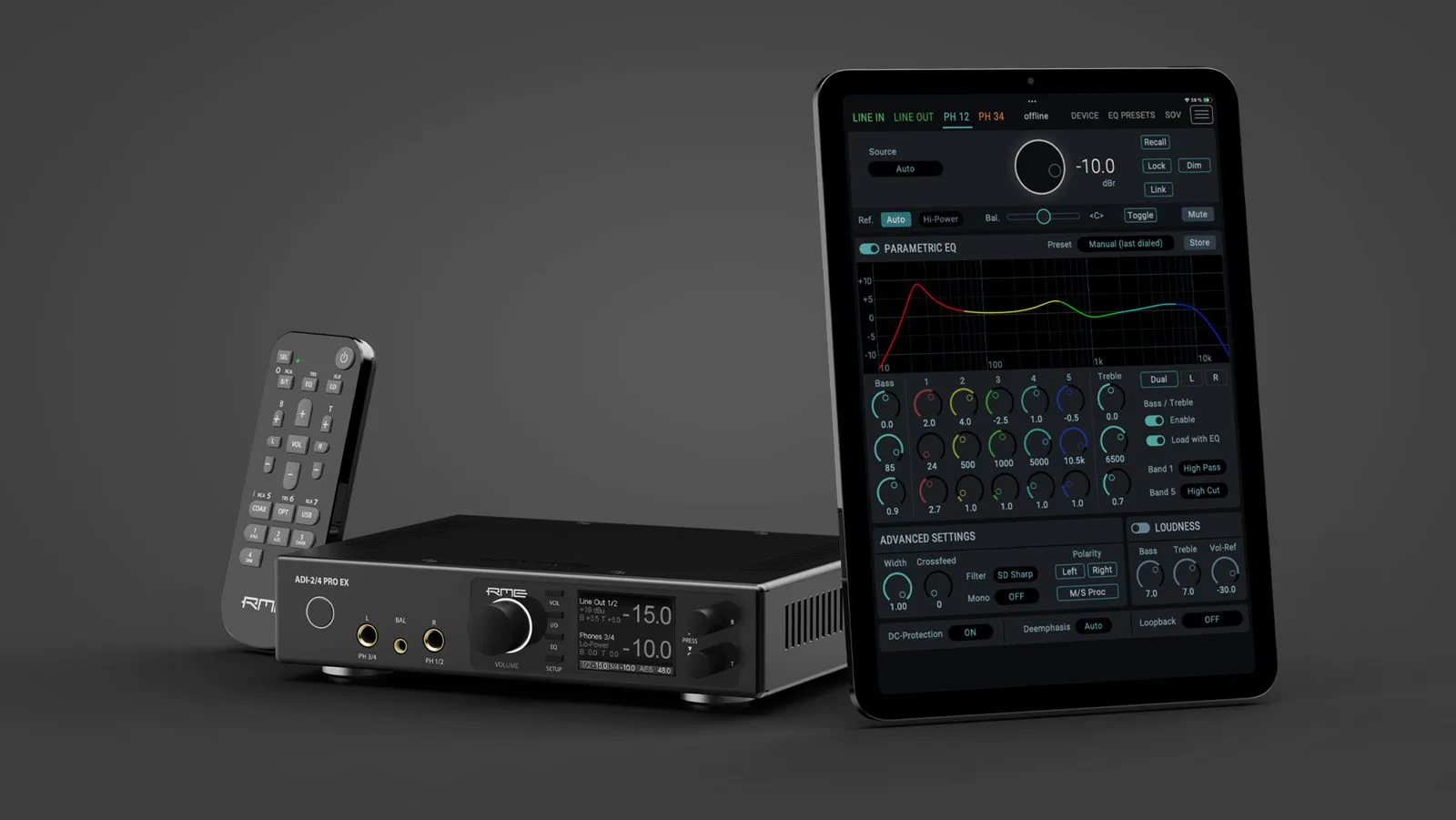
On clocking, SteadyClock EX is factory-calibrated to ±1 ppm, with jitter rejection above 50 dB. RME keeps its “Sync without Sync” approach: the internal clock adjusts in 0.1 ppm steps across ±50 ppm. The DSP carries a five-band parametric EQ, fast bass/treble, crossfeed and loudness control. The computer connection is a lockable USB-C port, fully class compliant (UAC 2.0), with a MADIface driver on Windows and driverless operation on macOS. The MRC remote handles volume, balance, source and EQ, plus four programmable buttons.
Price and availability
The ADI-2/4 Pro EX is announced at around $2,999 at US dealers, with an estimated November 2026 arrival. That places it at the top of the ADI-2 range, above the ADI-2 Pro EX and the ADI-2/4 Pro SE whose ergonomics it inherits. No surprise: this is a reference tool, not an entry-level interface.
| Specification | ADI-2/4 Pro EX |
|---|---|
| Conversion | ES9823Pro (A/D) · ES9039Q2M (D/A), 32-bit |
| Channels | 2 analog in / 4 analog out |
| Sample rates | 44.1 kHz to 768 kHz (PCM/DSD) |
| Dynamic range | up to 127 dBA |
| Headphones | 2 three-state outputs (IEM/Low/High), balanced mode |
| Clocking | SteadyClock EX, ±1 ppm factory |
| Connection | lockable USB-C, class compliant |
| Form factor | half-rack, 1U · 1.2 kg |
To place the EX in the digital chain, our explainers on sample rate, bit depth and conversion and on word clock and jitter spell out what these numbers really mean. And if you need something more multichannel, the MOTU OctaLite plays a different game, one built around preamp count.
My take
The ADI-2/4 Pro EX does exactly what you expect from RME: push measurement without gimmicks. The real progress isn’t the “768 kHz” line in the catalog, which nobody will track in production, but the three-state headphone section and balanced mode, which turn the unit into a serious listening station for mastering and verification. At $2,999, it clearly targets the engineer who wants a stable reference and a conversion stage beyond suspicion. The rest of the studio can change; this stays the fixed point. The honest question: do you have monitoring good enough to hear what this converter reveals?