Facing a source to record, the real question isn’t “which is the best mic?” but “which type of mic for this sound?”. A microphone is never neutral: the way it captures imposes a character, a tolerance to level, a sensitivity to transients. There are three main families, and each excels in a specific register. Knowing what separates them will save you plenty of disappointment at mixdown.
The dynamic microphone
The dynamic relies on a simple, bulletproof principle: a coil attached to a diaphragm moves within a magnetic field and generates the signal. No electronics to power, rugged mechanics, and a tolerance to high levels that lets it take a snare or a cranked guitar amp without flinching.
In return, that relatively heavy diaphragm reacts more slowly: the finest highs and the micro-detail of transients come through less than with a condenser. That’s not a flaw, it’s a signature. The dynamic excels on powerful sources and on vocals you want close and meaty: guitar amps, toms and snare, close brass, radio or podcast voice. The Shure SM57 is the archetype: put it in front of almost anything and it works.
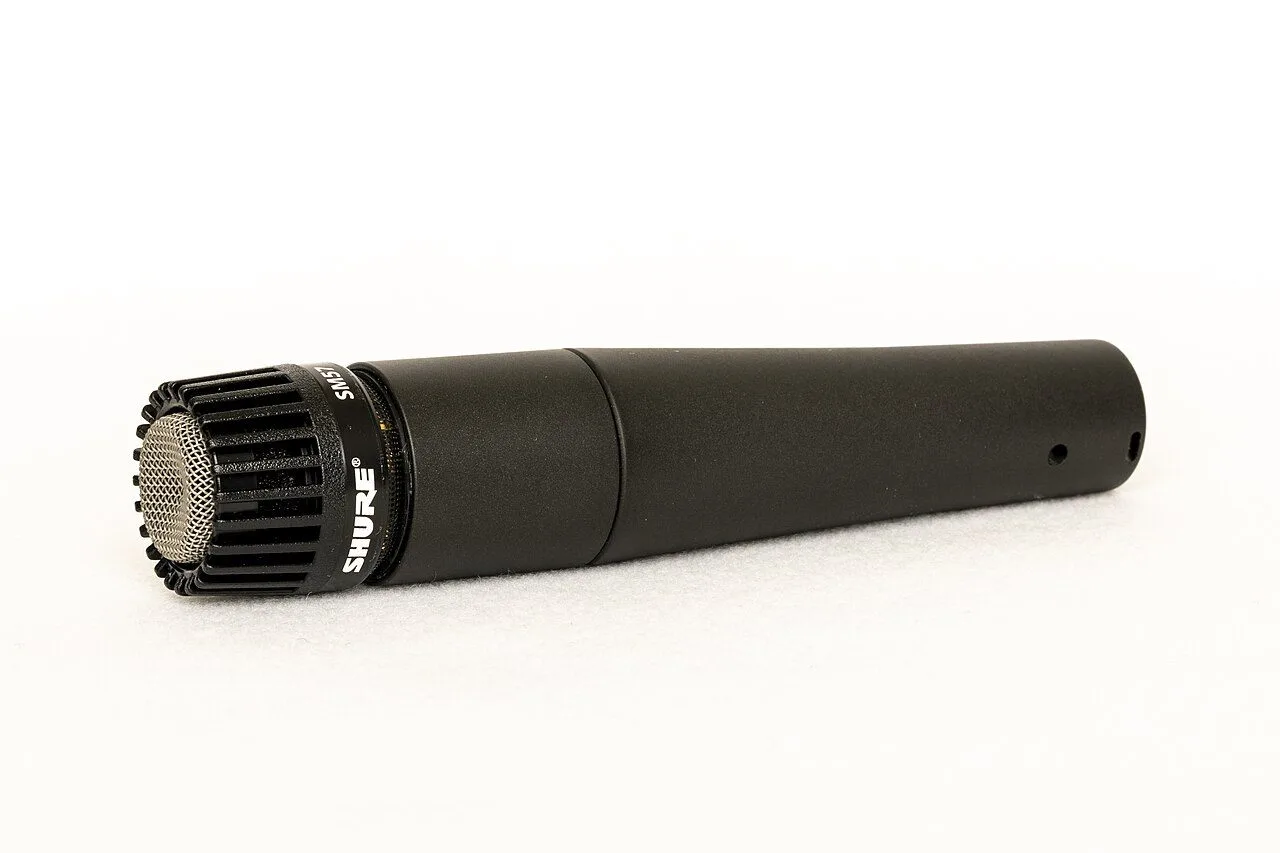
Another plus: the dynamic needs no phantom power. It’s also the stage mic par excellence, because it survives knocks and spills little of the rest of the stage: we covered that choice for live sound in our guide to the live vocal mic.
The condenser microphone
The condenser works quite differently. Its capsule is a capacitor, one of whose very light plates vibrates with the sound and varies the capacitance. That near-weightless diaphragm follows transients with a precision the dynamic can’t reach: detailed highs, crisp attack, an open sound image.
That finesse has a cost: the capsule must be polarised and the signal amplified on the spot, hence the need for power. That’s the job of 48 V phantom power, supplied by your preamp or interface — a subject we covered in detail in this guide to +48V. The condenser is also more sensitive to high levels and to its surroundings: it’s often kept to a treated booth.
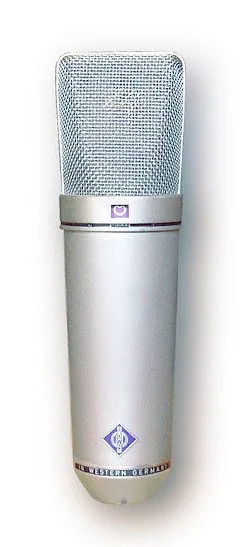
It’s the mic for lead vocals, acoustic guitar, drum overheads and room ambience. The Neumann U87 is its icon, but the family runs from very honest entry-level models to legendary references.
The ribbon microphone
The ribbon is a special case of the dynamic: a thin corrugated aluminium ribbon, suspended in a magnetic field, acts as both diaphragm and conductor. The result is a smooth, never harsh top end, and a natural figure-8 pattern that captures front and back alike.
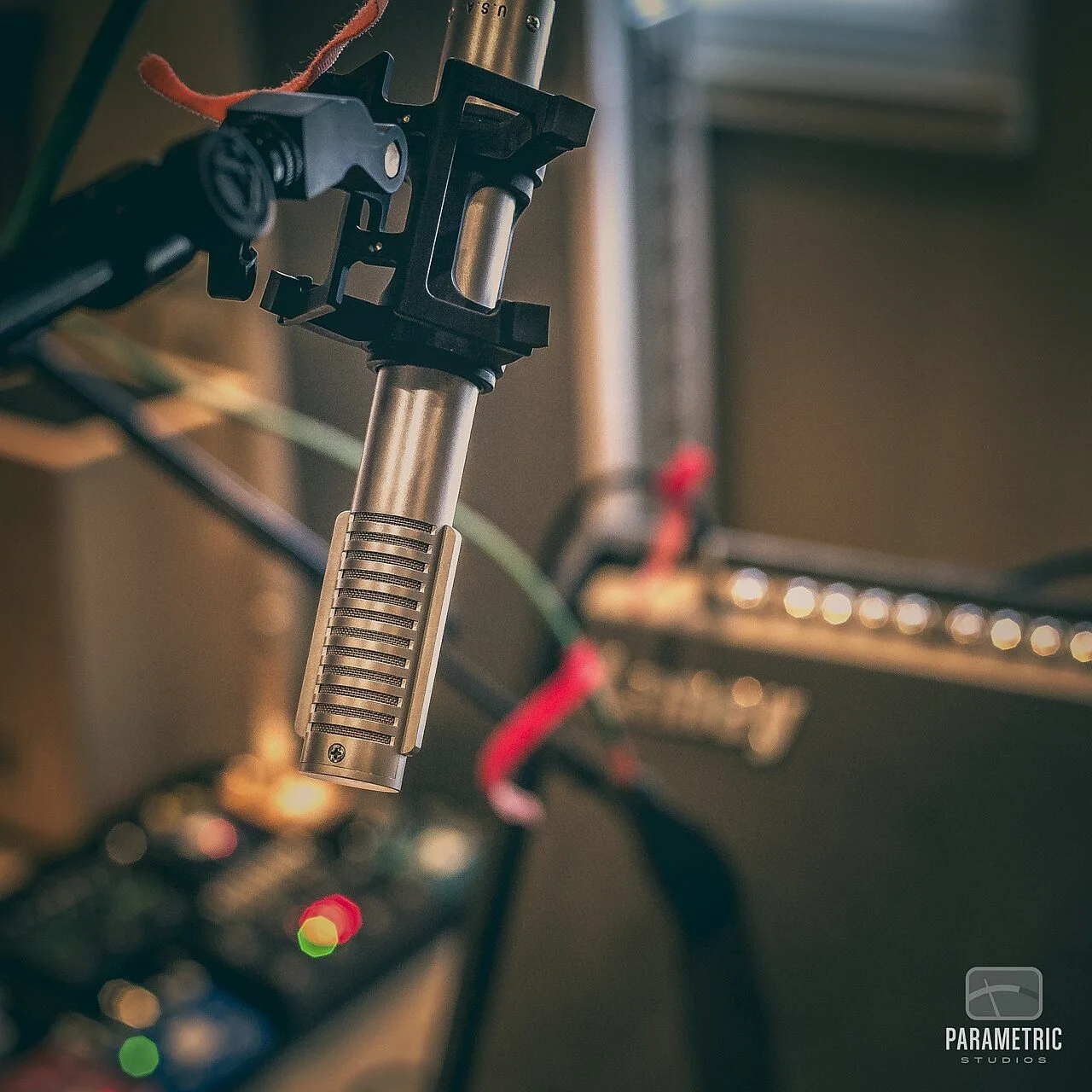
Historically fragile and low in output, the ribbon demanded a generous preamp and careful handling. Modern models, often active, have largely fixed those issues. It’s loved on brass, guitar amps, strings and anything you want to soften: where a condenser can sound brittle, the ribbon rounds the edges. One caution: on a passive ribbon, phantom power can be harmful if the cabling is dodgy — check before switching it on.
Large or small diaphragm?
Among condensers, there are two sub-families. The large diaphragm flatters the voice and adds body, with a slight proximity effect; it’s the star of vocal booths. The small diaphragm, more neutral and faster, excels on precise sources: acoustic guitar, hi-hat, overheads, strings. Many studios own both and choose by source.
Polar pattern, the other criterion
Beyond the technology, every mic has a polar pattern: cardioid (captures the front, rejects the back), omnidirectional (captures all around, very natural in a treated room) or figure-8 (front and back, ideal in Mid/Side stereo or for two singers on one mic). A multi-pattern model can offer several. The pattern shapes the result as much as the capsule type — and it interacts with placement and the phase between your mics as soon as you open more than one.
Choosing by source
In practice, you reason by source. This table sums up the starting reflexes, to refine by ear.
| Source | Recommended family | Why |
|---|---|---|
| Lead vocal | Large-diaphragm condenser | Detail, body, proximity effect |
| Radio / podcast voice | Dynamic | Room rejection, close grain |
| Acoustic guitar | Small-diaphragm condenser | Transients, precision |
| Guitar amp | Dynamic or ribbon | Takes the level, smooth grain |
| Snare / toms | Dynamic | SPL tolerance, attack |
| Brass | Ribbon | Softens harsh highs |
| Drum overheads | Small-diaphragm condenser | Speed, stereo image |
Choosing the mic is only half the job: placement does the rest. A few centimetres change everything, as we showed in our piece on placement techniques and, for vocals, in the one on how to position a vocal microphone.
My take
The “condenser = serious, dynamic = make-do” hierarchy dies hard, and it’s wrong. A well-placed SM57 on a snare beats a costly condenser badly set, every time. The real studio reflex is to own at least one good representative of each family and rotate them by source: a large diaphragm for voice, a pair of small diaphragms for acoustic and overheads, an all-rounder dynamic and, once the budget allows, a ribbon to round off brass and amps. The rest is listening.