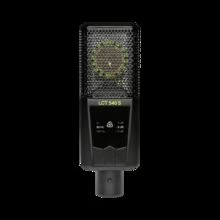
You plug in a condenser mic and nothing comes out. Nine times out of ten the answer is a single button: +48V, also known as phantom power. Behind the mysterious name sits a simple, elegant mechanism — but misunderstood, it leads to dead mics, thumps in the speakers and, more rarely, damaged gear. Let’s settle it once and for all.
What is phantom power?
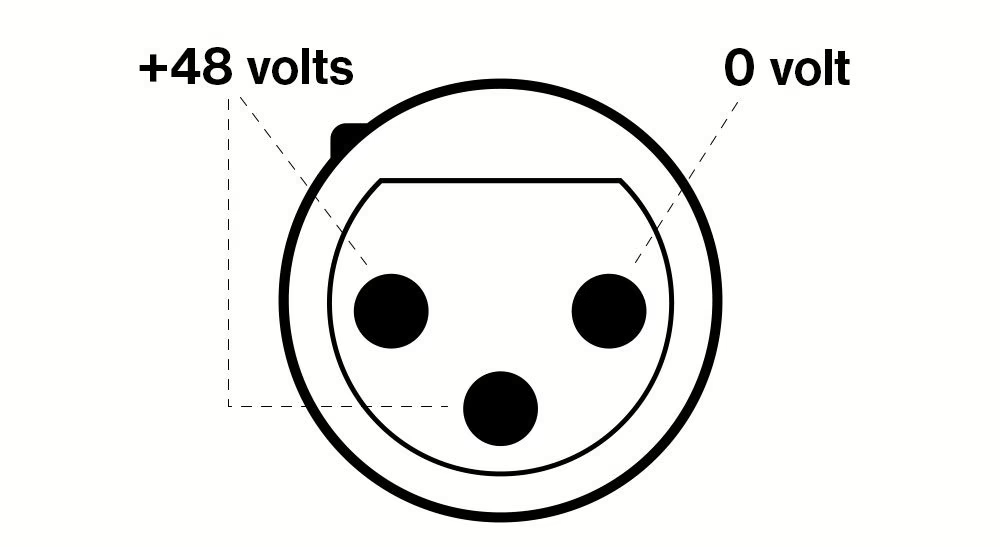
Phantom power is a DC voltage — most often 48 volts — sent from the mic input to the microphone over the same XLR cable that already carries the audio. That’s where “phantom” comes from: the voltage travels without needing an extra conductor. It is applied equally to both hot legs of the balanced connection (pins 2 and 3), returning through the shield (pin 1).
It is precisely the balanced nature of the link that makes the trick work. Because the same voltage sits on both signal conductors, an ordinary balanced dynamic mic “sees” no potential difference across its terminals: the DC cancels out for it while the audio passes normally. To understand why balancing is at the heart of all this, our article on the mic preamp fills in the picture.
Why condenser mics need it
A dynamic mic generates its own voltage: a diaphragm moves a coil through a magnetic field, and that’s it. A condenser mic works differently. Its capsule is a capacitor with one vibrating plate; you need to polarise that capsule and to power the internal electronics (a FET or tube impedance converter) that adapt the very fragile signal to the output. With no energy, nothing happens: the condenser stays silent. The +48V supplies that energy.
A few useful nuances. Electret mics carry a permanent charge on the capsule but still need to power their internal preamp — often via +48V, sometimes via a battery or low-voltage “plug-in power”. And some active DI boxes also need phantom power to run: our guide to the DI box covers that case.
A matter of standards
48V won the day, but it was never alone. The standard formalised what several makers were already doing on their own, and you still meet different voltages depending on the gear.
| System | Voltage | Where you meet it |
|---|---|---|
| P48 phantom power | 48 V | The standard: interfaces, consoles, preamps |
| P24 / P12 phantom | 24 V / 12 V | Older gear, portable, power saving |
| T-power (A-B powering) | 12 V | Older field mics; NOT compatible with P48 |
| Plug-in power | 3 to 5 V | Mini-jacks, consumer mics, cameras |
The thing to remember: T-power (or A-B powering) looks like phantom but works differently — the voltage is applied differentially between the two conductors. Plugging a mic built for one into the other can range from silence to damage. In practice, on modern gear, you’ll only deal with P48.
How to use it safely
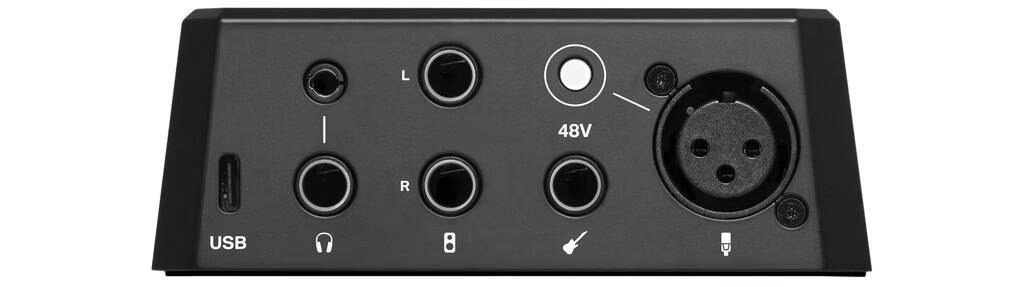
The golden rule fits in one sentence: mute the signal before touching +48V. Here’s the running order that keeps you out of trouble.
- Connect first, switch on second. Plug in the mic, build the link, then enable +48V. Conversely, switch +48V off and wait a few seconds before unplugging.
- Pull the faders down or mute the channel. Establishing the voltage causes a transient; if it hits a speaker or headphones at high level, it’s unpleasant and potentially harmful to drivers.
- Let the mic settle. A condenser can take a few seconds to charge and reach its best; don’t judge the sound in the instant after switching on.
What NOT to power
Not all mics are equal in the face of +48V.
- Passive ribbon mics: maximum caution. In normal operation over a correct link, phantom is meant to be neutral for them, but a miswired cable, a dodgy adapter or hot-plugging can send voltage to the ribbon and damage it. The safe rule: phantom off for a passive ribbon, unless it’s an active model that explicitly requires it.
- Dynamic mics: a modern balanced model is unharmed; phantom is simply useless to it. No need to switch it off every time, no need to switch it on either.
- Unbalanced sources: don’t rig a cable that breaks the balance on a live channel. It’s the surest way to apply 48V where it shouldn’t go.
These habits pair with the rest of clean recording: solid gain staging, the right mic choice — our notes on choosing a mic apply in the studio too — and, as soon as you go stereo, a well-handled miking technique.
My take
+48V is one of those topics where a minute of attention saves hours of troubleshooting. The habit that really matters is muting the level before flipping the switch: it costs nothing and protects your ears and your speakers alike. Beyond that, modern gear is robust and forgives a lot — the one real point of vigilance is the passive ribbon, to be treated with respect. Once those habits are in place, phantom power goes back to being what it should be: a button you switch on and forget.