Recording in stereo is not about slapping two mics side by side and hoping it “sounds wide.” Every stereo array has its own logic, its own spatial character and its own pitfalls. Understanding those differences is what lets you capture a piano, drum overheads, an acoustic guitar, a choir or a whole room with the image you had in mind — and keep it intact once the track folds down to mono.
Intensity, time, or both
Stereo relies on two cues your ears use to locate sound: the intensity difference between the two channels and the time-of-arrival difference. Every array plays on one, the other, or a blend of both.
- Coincident pairs (XY, Blumlein): both capsules sit at the same point, only intensity varies. Precise image, perfect mono compatibility.
- Spaced pairs (AB): mics are set apart, time-of-arrival does most of the work. Wide, enveloping image, but trickier in mono.
- Near-coincident pairs (ORTF, NOS): capsules close but slightly spaced and angled, combining intensity and time. The best of both worlds, more or less.
XY: the coincident safe bet
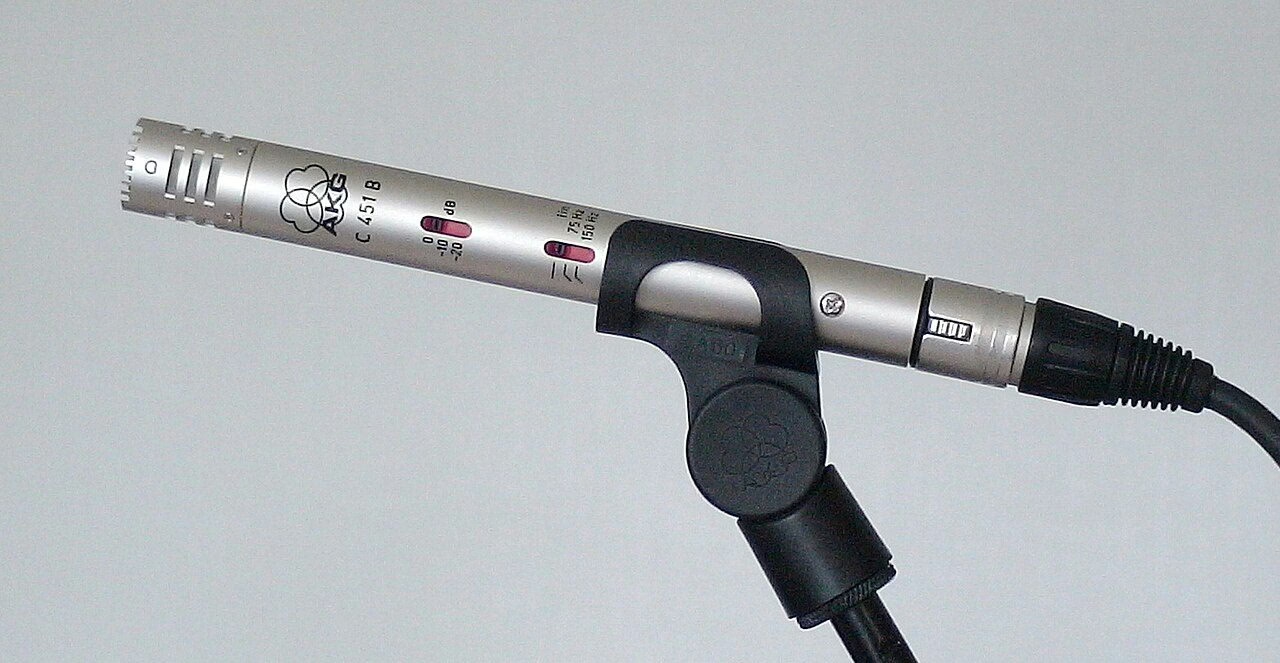
Two cardioid mics (often small-diaphragm condensers) with capsules stacked at the same spot, angled 90° or 110° apart. Since there’s no time difference, mono is flawless: nothing cancels. The trade-off is a slightly narrower image than you might expect. This is the do-anything technique, ideal whenever mono compatibility is non-negotiable — broadcast, podcast, reinforcement of a recording.
ORTF: the winning compromise
Developed by French broadcaster ORTF, this array places two cardioids 17 cm apart, opened to 110°. You get convincing width and a real sense of space while keeping a stable centre. It’s often the first move for acoustic guitar, a small ensemble or a room ambience: it sounds “natural” with no effort. Mono compatibility stays good, provided you check (see below).
AB: two spaced mics
Two mics (cardioid or, better still, omnidirectional) set tens of centimetres apart, sometimes much more. The result is spacious and airy, with generous lows when you use omnis. It’s gorgeous for capturing the depth of a room or the body of a piano. The downside: the wider the spacing, the greater the risk of comb filtering once the channels are summed to mono. Save it for situations where stereo will be preserved and where you can keep consistent spacing references.
Blumlein: stereo that breathes
Two bidirectional (figure-8) mics crossed at 90°, capsules coincident. It’s one of the most realistic images there is: sharp localisation, remarkable depth, faithful room reproduction — because the rear lobes pick up the room’s reverberation. That does require a good-sounding room, since everything behind is recorded too. On a treated space, a string quartet or drums in a fine room, Blumlein is hard to beat.
Mid/Side: adjustable width
A centre mic (usually cardioid) captures the “Mid,” a perpendicular figure-8 captures the “Side.” Simple matrixing rebuilds the stereo, and crucially you set the width after recording, from pure mono to ultra-wide. It’s the most flexible array, and its mono compatibility is total (just mute the Side). For more on M/S in mixing and mastering, see our dedicated guide on Mid/Side processing.
| Technique | Type | Character | Mono compatibility |
|---|---|---|---|
| XY | Coincident | Precise, narrower image | Excellent |
| ORTF | Near-coincident | Wide and natural | Good |
| AB | Spaced | Wide, enveloping | Watch out |
| Blumlein | Coincident (figure-8) | Realistic, deep | Excellent |
| Mid/Side | Matrixed | Adjustable width | Total |
The 3:1 rule, for multi-mic setups
As soon as you use several mics on one source (or several close sources), a simple rule limits phase problems: the 3:1 rule. The distance between two mics should be at least three times the distance from each mic to its source. A mic 20 cm from a guitar? The neighbouring mic should be at least 60 cm away. This lowers how much of one source bleeds into the wrong mic, and therefore the frequency cancellations when you sum the tracks.
Always check in mono
The habit that saves you: listen to your pair in mono before committing to placement. If the sound hollows out, turns metallic or loses low end, that’s comb filtering — too much spacing, or a phase mismatch between channels. Fix the position rather than trying to rescue it in the mix. The same discipline applies to polar-pattern choice, which we cover for the stage in our guide on mics and directivity. And remember the final result also depends on your digital chain: latency and monitoring shape how you track, just as capture quality shapes what your mics can render.
My take
The best stereo technique is the one that fits the room and the end use, not the one that ticks a box. In practice, ORTF handles 80% of situations with disarming naturalness, and XY stays the safety net whenever a mono fold-down looms. Blumlein deserves a fine-sounding room: that’s where it turns magical. The real luxury today is Mid/Side, which pushes the width decision to the mix — reassuring when you’re unsure at the take. One tip that costs nothing: a quick mono check before you hit record will save you a lot of regret.