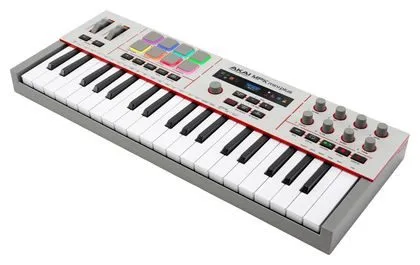
The MPK Mini has been the best-selling keyboard controller on the planet for over a decade. The Plus version, launched in 2022, widened its scope: three octaves instead of two, and above all a MIDI and CV/Gate I/O set that lifted it out of the plain USB-controller role. Akai now unveils the second generation, the MPK Mini Plus II, and the most visible change happens under your left hand.
What actually changes
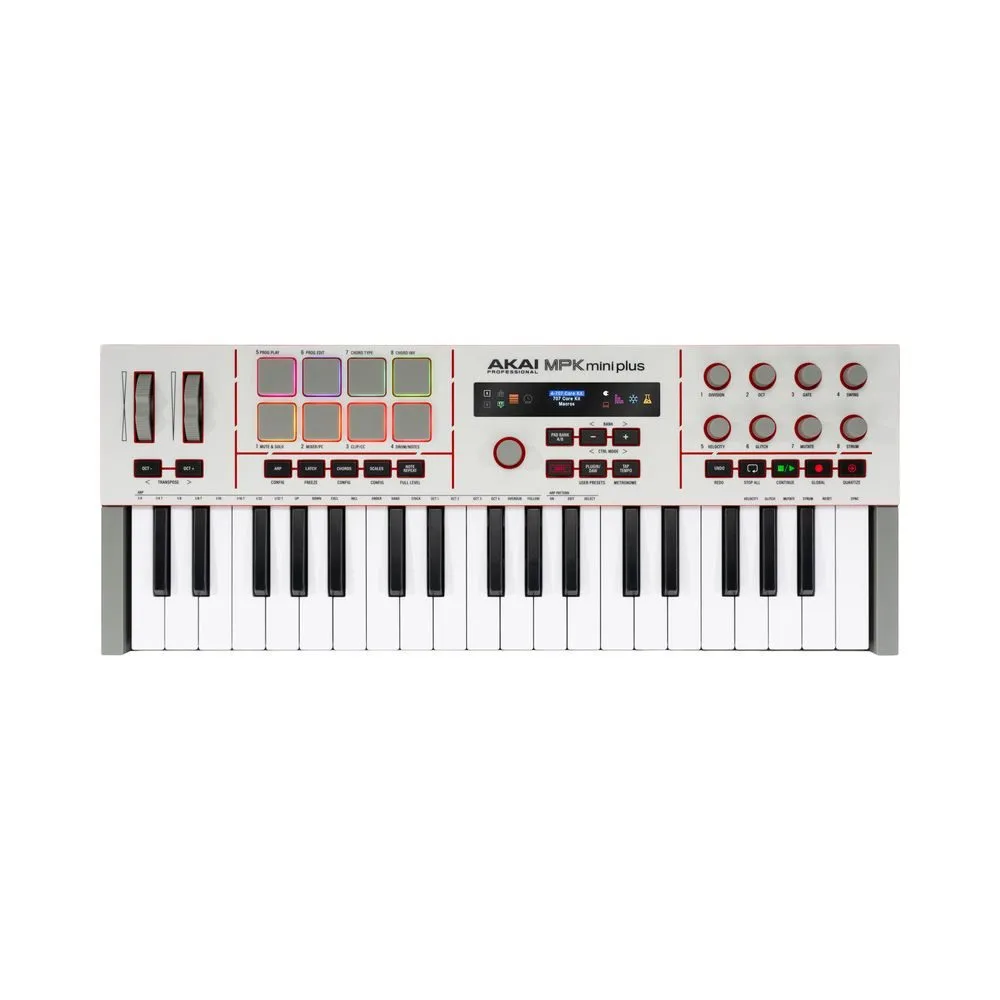
The first generation relied on a small Akai-style joystick for pitch and modulation. The Plus II replaces it with two dedicated wheels, pitch and modulation, alongside an octave selector. It’s the move players asked for: a wheel gives finer, more intuitive control than a sprung joystick, especially for expressive bends.
- Pitch and modulation wheels in place of the joystick.
- USB-C port for data and power.
- Eight assignable rotary controls, plus push encoders for navigation.
- Announced NKS support for more than 2,000 instruments and effects.
The keybed and controls
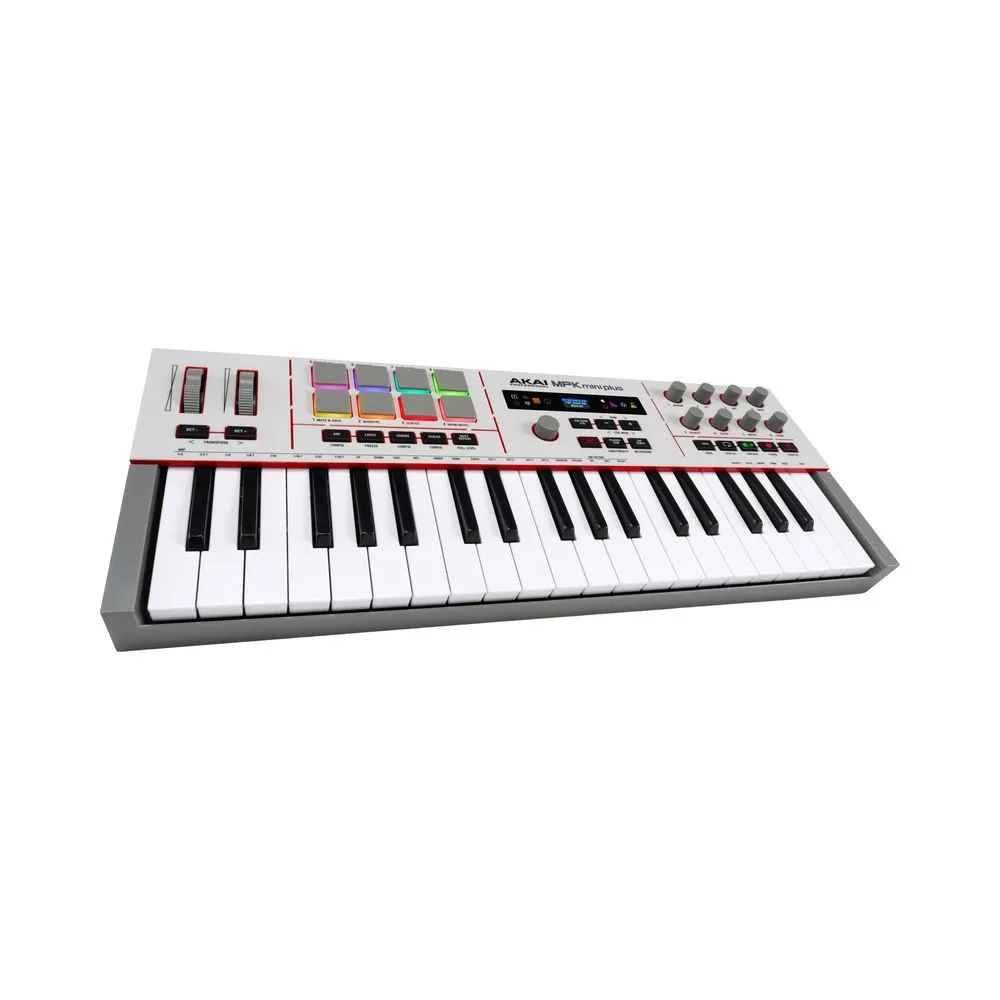
You still get 37 velocity-sensitive mini keys, a format that sits on a desk without giving up range. Above them, eight velocity-sensitive RGB-lit MPC pads with aftertouch, note repeat and full level: the classic trio for tapping out beats and triggering samples. The eight continuous encoders drive your instrument parameters, and a display handles visual feedback as you navigate.
For performance, the arpeggiator offers chord and random modes, swing and a pattern mode. The Chords and Scales mode keeps you in key and fires full chords from a single key, handy for sketching a progression without being a keyboard player. If you’d rather have a pure encoder box to drive synths and plugins, we compared seven rotary-encoder controllers in a dedicated feature.
The I/O that opens up modular
This is the Plus format’s real selling point. On the back, the MPK Mini Plus II lines up a 5-pin DIN MIDI output, a 6.35 mm sustain-pedal input and, crucially, three 3.5 mm CV/Gate outputs: pitch, gate and modulation. Enough to drive an analogue synth or a Eurorack module directly, with no separate MIDI-to-CV interface. That’s exactly the territory of a box like the Squarp Core, only here built into a playing keyboard.
USB-C handles both bus power and the computer link. The unit integrates with standalone MPCs, the MPC 3 desktop software and the usual DAWs, with feedback on the display and indicators.
Who it’s for, and in which ecosystem
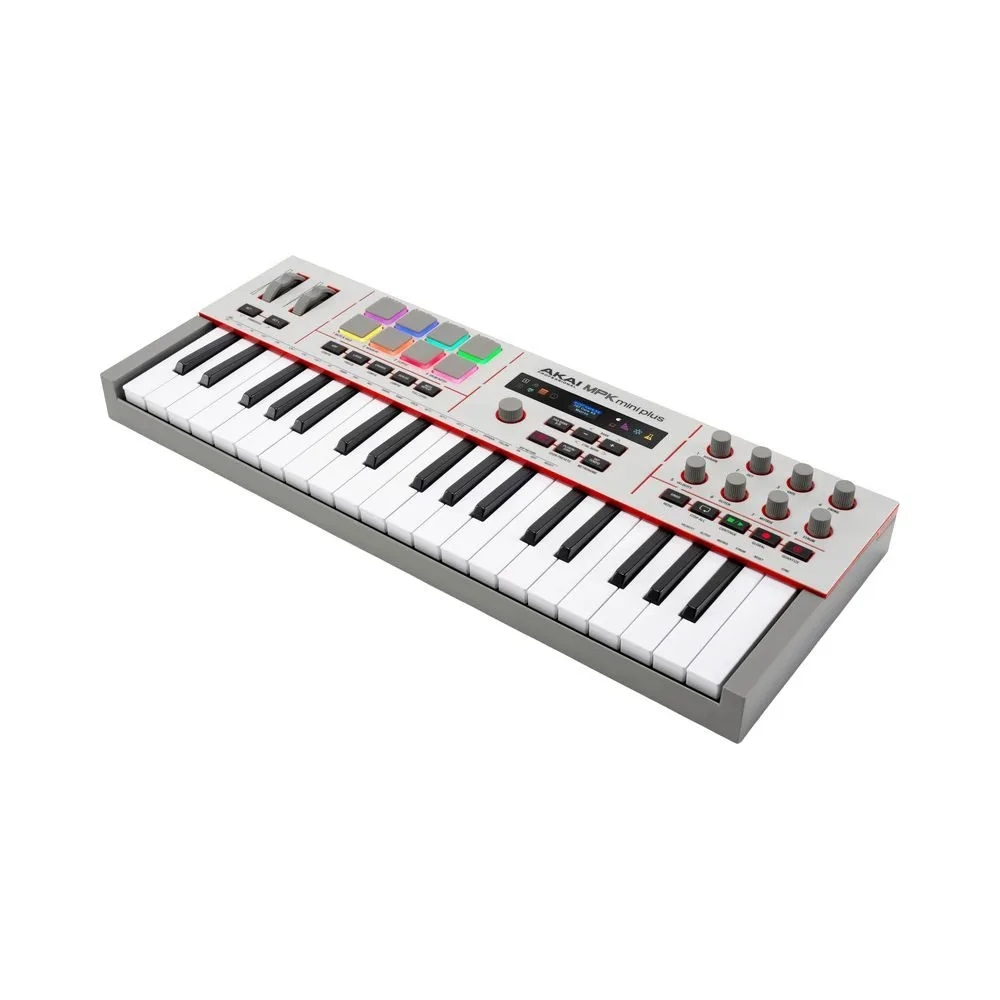
The Plus II targets the home studio that wants a single object to compose in the DAW, trigger samples and drive hardware. It ships with a generous software bundle: MPC Beats, a Komplete Select selection from Native Instruments in an Akai edition, and a Studio Instrument Collection of over a thousand sounds. For anyone already in the MPC world, it’s the natural bridge to a groovebox like Native Instruments Maschine+. Compact (493 x 192 x 54 mm, 1.46 kg), it slips into a bag. The product listing confirms availability since October 2026, around $140 / £127.
My take
Swapping the joystick for two wheels is Akai admitting that an old, trusted gesture beats a clever ergonomic idea. On the first Plus, the joystick split opinion; here, you get a pitch bend you can actually meter. The rest ticks the expected boxes — USB-C, CV/Gate, a loaded bundle — without reinventing the formula. The appeal is the same as it ever was: this is one of the few keyboards at this size and price that speaks to modular natively. To start making music, or to keep a travel controller that also drives analogue gear, the maths is hard to beat.