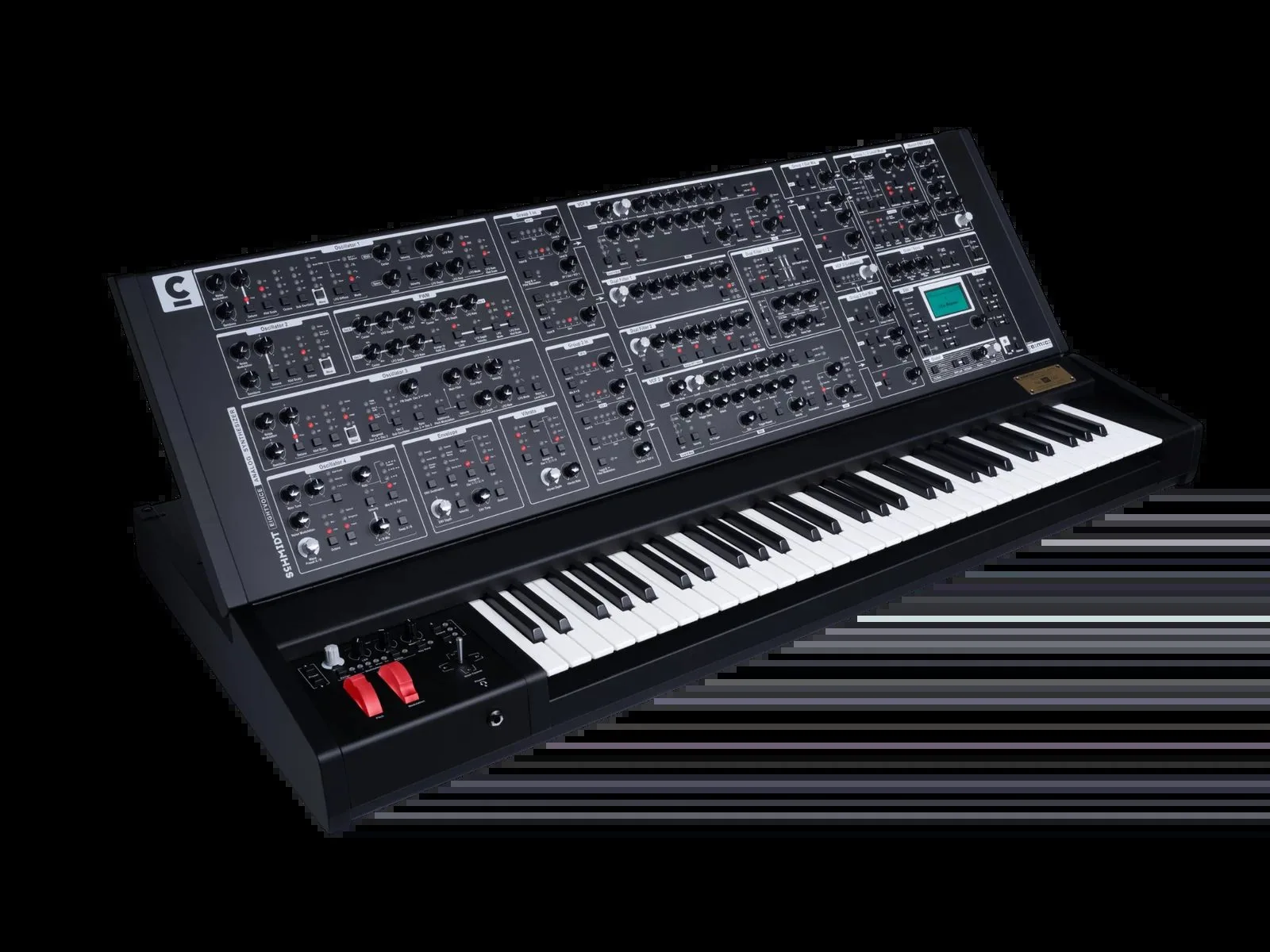
The Schmidt Eightvoice is one of those instruments you admire without ever touching: a fully discrete eight-voice analog synthesizer, hand-built in tiny runs, sold for around €25,000 and reserved for a handful of wealthy enthusiasts. With Schmidt Vi, the company does the unthinkable—it puts this monster into a plug-in, for €179. And it isn’t a loose tribute; it’s a model of the circuit, panel for panel.
A legend, finally playable
The Schmidt has always chased excess: four oscillators per voice, a chain of five ring modulators fed by six pulse waves, and above all a one-of-a-kind filter section. Its panel, bristling with knobs, puts people off as much as it draws them in. Seeing it reborn, unchanged, in a DAW window is faintly dizzying: what once took a bank transfer and a waiting list now lives in a plug-ins folder.
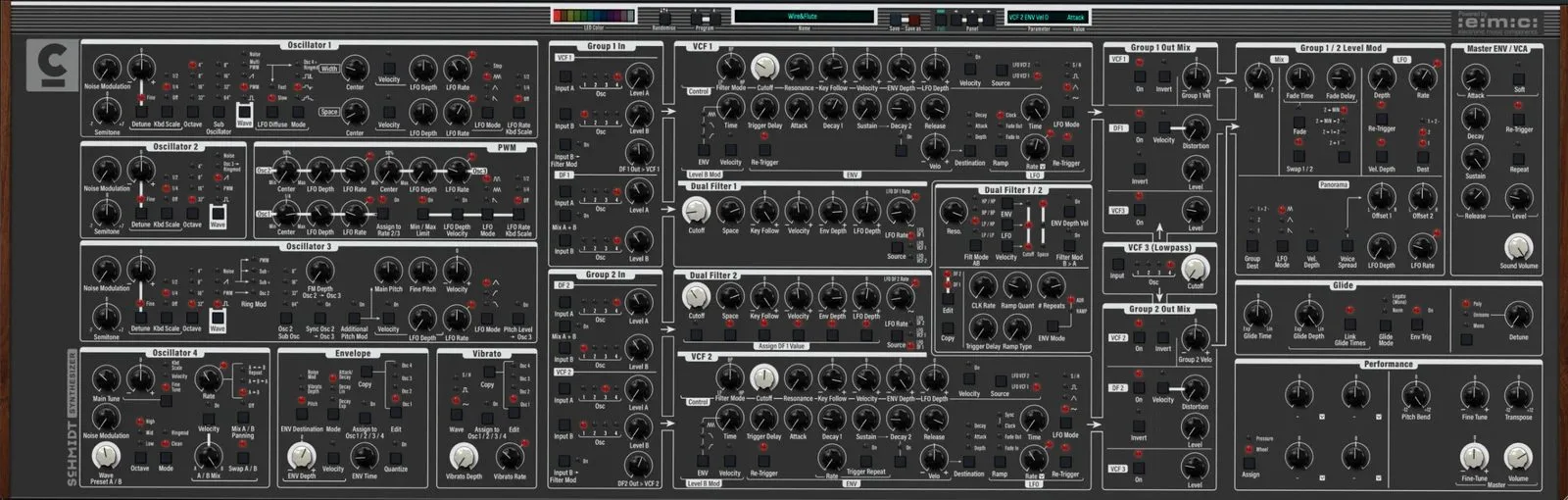
What’s inside the engine
Schmidt Vi reproduces the full structure of the hardware. Each voice stacks four multi-waveform oscillators, then passes through two Moog-style multi-filters and two Oberheim-style dual filters, before a 12 dB low-pass at the end of the chain—with filter FM on tap. Modulation is generous: sixteen multi-wave LFOs and nine envelopes, assignable per parameter. There is no modulation matrix as such; each destination is set directly, hardware-style. The plug-in supports full MPE, and both the pitch wheel and aftertouch can hit several destinations. Only the original’s multitimbral function is left out.
A model, not a sample
The key point is the method. Rather than sampling the Schmidt, the developer analysed the signal path down to the circuit and recreated it by modelling, in collaboration with UJAM—a year of work, per the company. So you get the living behaviour of an analog instrument: drift, interactions between stages, filter response. That’s also what sets this apart from yet another vintage-synth emulation: the target isn’t a common classic, but an instrument almost nobody has been able to try.
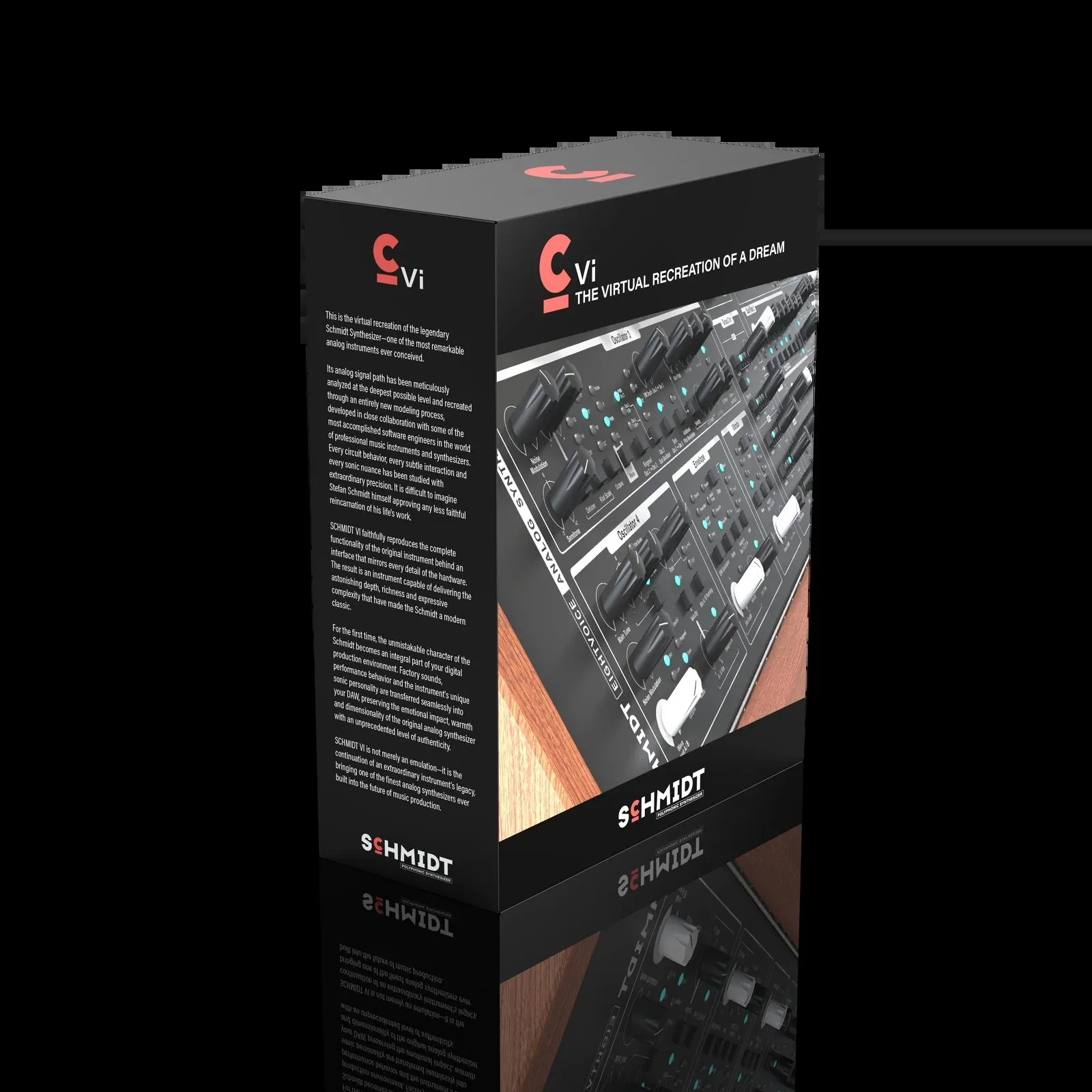
What about Schmidt deck?
The company ships a companion, Schmidt deck: a stripped-down player that replays sounds made in the Vi through a few Minimoog-style controls. The idea is pragmatic—do the heavy programming in the Vi, then load patches into a light interface to play live or stack tracks without opening the huge full panel. For anyone who finds the Vi intimidating, it’s a welcome way in.
Price, formats and availability
Schmidt Vi has been available since November 2026 at a launch price of €179 (€199 afterwards), sold directly from the Schmidt site and through the Waldorf shop. It installs as VST, VST3, AU and AAX, on macOS (Apple Silicon and Intel) and Windows, and needs an iLok account. Set against the €25,000 hardware, the maths is hard to ignore.
My take
Putting a €25,000 instrument into a €179 plug-in is the kind of move that lifts everyone. This isn’t another Juno clone: the Schmidt is a near-mythical object, and finally hearing its filter chain at home genuinely matters. Choosing modelling over sampling is the right call, and the deck shows the developer thought about use, not just the feat. The panel is still as dense as ever—but this time, getting it wrong costs nothing. For a sound designer after a colour no one else has, it’s a gift.
Frequently asked questions
Is Schmidt Vi a sample of the hardware synth?
No. The developer modelled the signal path from an analysis of the circuit, in collaboration with UJAM. The plug-in recreates the behaviour of the electronics rather than replaying recordings, which preserves the living interactions of an analog instrument.
What’s the difference between Schmidt Vi and Schmidt deck?
The Vi reproduces the instrument’s entire panel, with all its programming depth. The deck is a simplified player with Minimoog-style controls that replays sounds created in the Vi—handy for performing or stacking tracks without facing the large interface.
What formats and platforms does it run on?
Schmidt Vi comes as VST, VST3, AU and AAX, for macOS (Apple Silicon and Intel) and Windows. Authorisation runs through an iLok account, either software or dongle.
How does the price compare to the Schmidt hardware?
The plug-in launches at €179, then €199. The original hand-built hardware trades at around €25,000: the gap alone sums up the appeal of the software version.