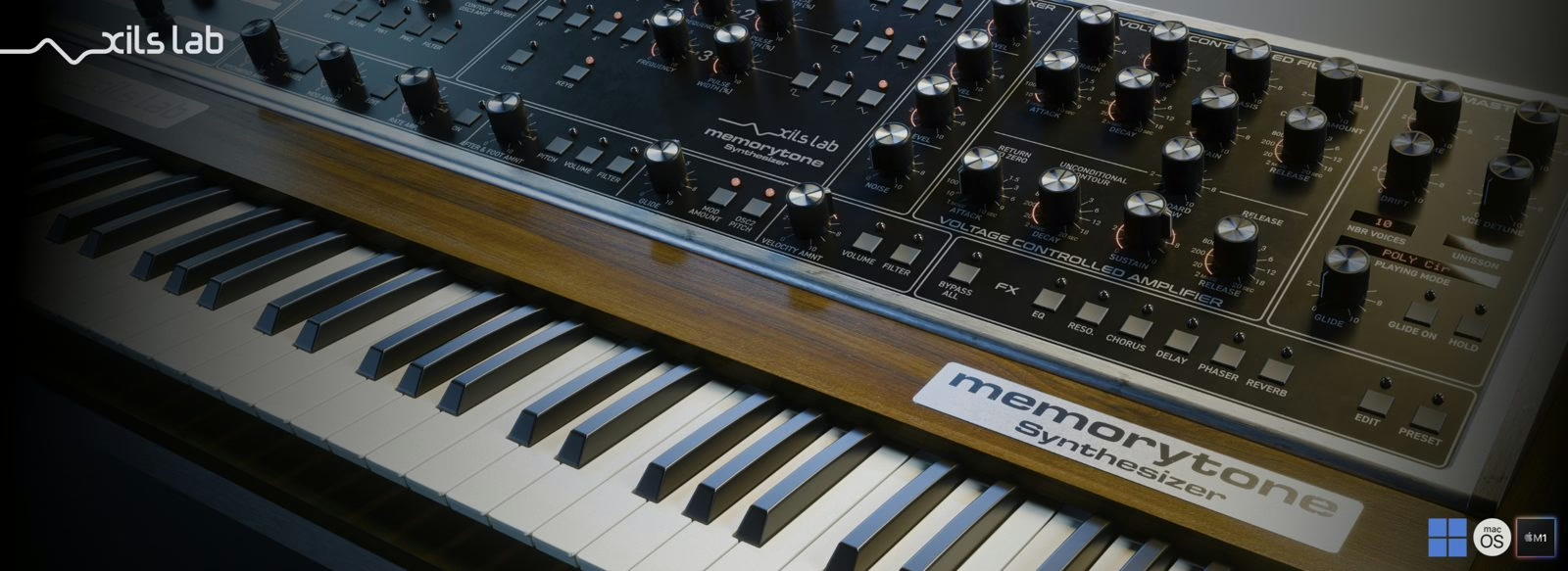
Grenoble developer XILS-lab, known for its recreations of cult synths, takes on one of the most ambitious analogue polysynths ever built. MemoryTone rebuilds the architecture of the 1982 Memorymoog inside the DAW, then pushes it well past its original brief. The timing is almost comic: the market has just seen other emulations of the same machine, but XILS-lab argues for a different approach — less about copying the signal path than modelling its interactions.
Three oscillators per voice, sixteen voices deep
The core follows the Memorymoog formula: three oscillators per voice, each offering pulse, sawtooth and triangle waveforms that combine freely, with variable pulse width and oscillator sync. Where the original ran six voices, MemoryTone climbs to sixteen-voice polyphony — up to eighteen oscillators in unison to fatten a sound. You get monophonic and circular polyphonic play modes, unison, mono and poly glide, and voice detuning that recreates the drift and micro-variation of an analogue instrument.
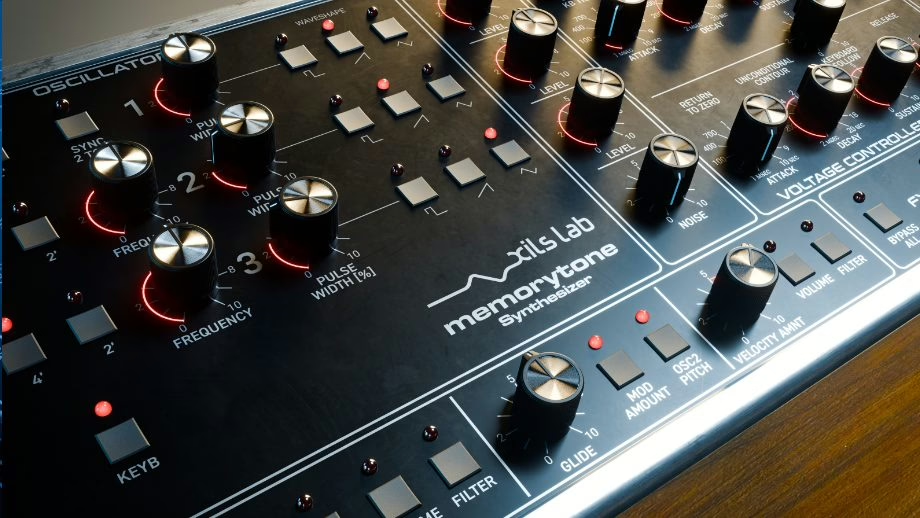
A ladder filter that self-oscillates
Below the oscillators, the 24 dB per octave ladder filter combines cutoff, Emphasis (resonance), keyboard tracking and a dedicated envelope contour. Push Emphasis far enough and the filter enters self-oscillation, becoming a sound source in its own right. That section, paired with the three oscillators, is what gives the Memorymoog its massive signature — and MemoryTone makes it the bedrock of its tone.
What the software adds to the myth
XILS-lab does not simply photocopy 1982. MemoryTone stacks expanded modulation — a 0.1 to 100 Hz LFO (triangle, saw up, saw down, square and sample & hold) with plenty of destinations — MPE support with velocity and aftertouch, an advanced arpeggiator, six built-in effects (EQ, resonator, chorus, delay, phaser, reverb) and preset management. It runs as VST2, VST3, AU and AAX, on Windows 7 and above and macOS 10.13 and later, with a native build for Apple Silicon. Against the Cherry Audio Memorymode 2, another software take on the Memorymoog, MemoryTone leans less on a voice-count race than on finely modelling how oscillators, mixer levels and the filter interact.
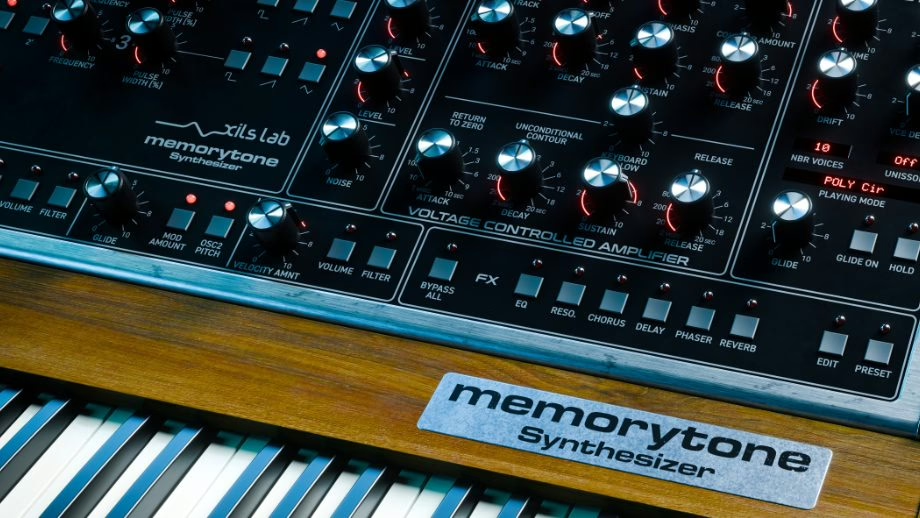
Positioning and price
MemoryTone is available now at an introductory $79, running until 1 November 2026 before it reaches its $199 list price. That is aggressive for an instrument this deep, in the vein of vintage recreations found among today’s software synths: enough to drop a huge analogue-style polyphonic texture into the DAW without wiring up a hardware rack.
My take
The Memorymoog is an emulation white whale, yet MemoryTone finds a credible angle: mind what actually reaches the ear — the way three oscillators per voice gently fight, the voice drift, the filter tipping into self-oscillation. Sixteen voices and eighteen-oscillator unison promise huge pads, and adding MPE and an arpeggiator opens playing styles the original never allowed. The launch price makes trying it easy. The real question is tone: on this crowded ground, ears will settle it between the contenders. A good excuse for a serious shootout.
Frequently asked questions
Which instrument does MemoryTone recreate?
It recreates the architecture of the Memorymoog, the 1982 analogue polysynth that combined six voices, three oscillators per voice and a 24 dB/octave filter per voice — eighteen oscillators in all. MemoryTone takes that principle and extends it to sixteen-voice polyphony.
Which formats and systems are supported?
MemoryTone ships as VST2, VST3, AU and AAX. It runs on Windows 7 and later, and macOS 10.13 and later, with native support for Apple Silicon Macs.
Can the filter act as a sound source?
Yes. The 24 dB/octave ladder filter has an Emphasis control that, pushed far enough, sends the filter into self-oscillation: it then produces its own sine tone, usable as an extra voice.
What does it add over the original?
Expanded modulation with a full LFO, MPE support with velocity and aftertouch, an advanced arpeggiator, six built-in effects (EQ, resonator, chorus, delay, phaser, reverb) and a preset manager — all absent from the 1982 hardware.
How much does it cost?
The list price is $199. XILS-lab is running a $79 introductory price until 1 November 2026.