Behringer likes to test its ideas in public, and the Vibe Matrix is the latest example. The company shared a render of a large pad-grid groovebox it frames as an open platform, built so anyone can configure and modify it at will. The phrase it uses, vibe coding, sums up the intent: an instrument the community would shape itself. Behringer stresses one point, this is a concept, not a product announcement, and the machine will only happen if the interest is there.
What the render shows
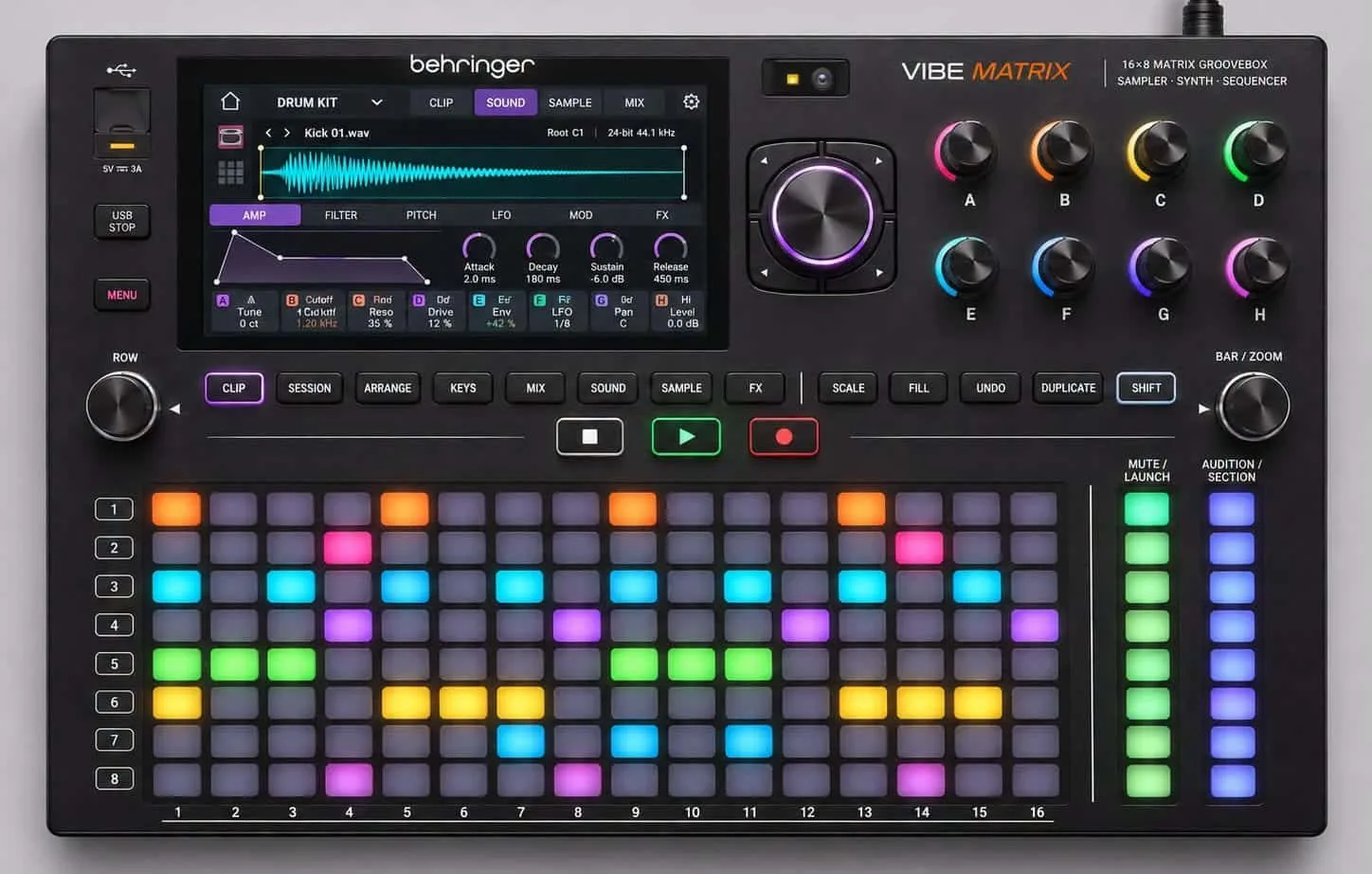
The official image is detailed, even though no spec sheet comes with it. You can read the object’s signature: a 16 by 8 groovebox, a grid of 64 RGB pads, flanked by eight endless encoders labelled A to H and a large navigation wheel ringed by a directional pad. A central colour screen shows Clip, Session, Arrange, Keys, Mix, Sound, Sample and FX tabs, a 24-bit 44.1 kHz sample waveform and an ADSR-style envelope. You also spot play, stop and record transports, two Row and Bar/Zoom encoders, two pad columns for mute, clip launch and audition, a USB port marked 5V 3A, and, the detail that drew reactions, a small camera at the top of the panel.
On features, Behringer lists polyphonic sequencing, sampling, synthesis, live looping, clip launching and a customizable control interface. Together they sketch a clip workstation with session logic, in the spirit of modern grooveboxes that fold a sequencer, a sampler and a synth into one box.
An open platform, in line with the brand’s recent bets
The central pitch is not the spec sheet but the openness. Behringer talks about an affordable hardware platform anyone could adapt and re-code, and mentions a hackathon with a few prototypes at the 2027 NAMM Show in Anaheim. The move extends a recent turn toward open source, seen on the Behringer AQ64L grid controller and its open firmware. It adds to an already dense run of clones and recreations, from the Polyeight to the Polivoks, that feed very strong reader demand around the brand.
A split reception
The concept divided opinion as soon as it appeared. In the comments relayed by the specialist press, many point to a strong resemblance to the Synthstrom Deluge, down to the screen and the general layout. Others criticise the ergonomics, the transports placed in the middle of the panel in particular, or find the layout too machine-made. The built-in camera raised privacy questions, to which one reader replied that the claimed openness would let owners disable it. Concrete requests are piling up too, from a larger display to MIDI DIN connectors and no internal battery.
None of this is settled, which is the nature of a concept. Behringer tests a reaction before committing to development, a method the brand uses regularly for its synths. If you are after a hardware alternative to an established machine, keep in mind that the Vibe Matrix has no price, no date and no final spec, and that part of its promise rests on a software ecosystem still to be built. In the meantime, our roundup of analog polysynth clones covers the options already on sale.
My take
The idea of an open groovebox, re-codable by its owners, is the most interesting part of the Vibe Matrix, far more than the pad grid itself. A platform you adapt, whose controls you remap and whose camera you disable at will, genuinely changes your relationship with the instrument. The known risk with Behringer: the concept charms, the software rarely follows as far as the promise. The Deluge resemblance does not help it stand out either. It stays a bet worth watching, provided the brand ships a customization environment that lives up to the slogan.