A small Dante network runs fine on Dante Controller: everyone sees every device, anyone routes the flows they need. That simplicity turns into a problem as soon as the install grows. In a radio station, a TV facility or a large rental company, dozens of devices share the network, several operators work at once, and letting anyone route any flow is no longer tenable. Dante Domain Manager, usually shortened to DDM, answers exactly that need.
The problem DDM solves
A basic Dante network is flat. Every device on a subnet discovers the others automatically, there is no notion of a user, no password, no record of changes. For a small venue, that is ideal. For a critical install, it is a weakness: any machine plugged in sees everything, one routing mistake can drop a broadcast, and nothing logs who did what.
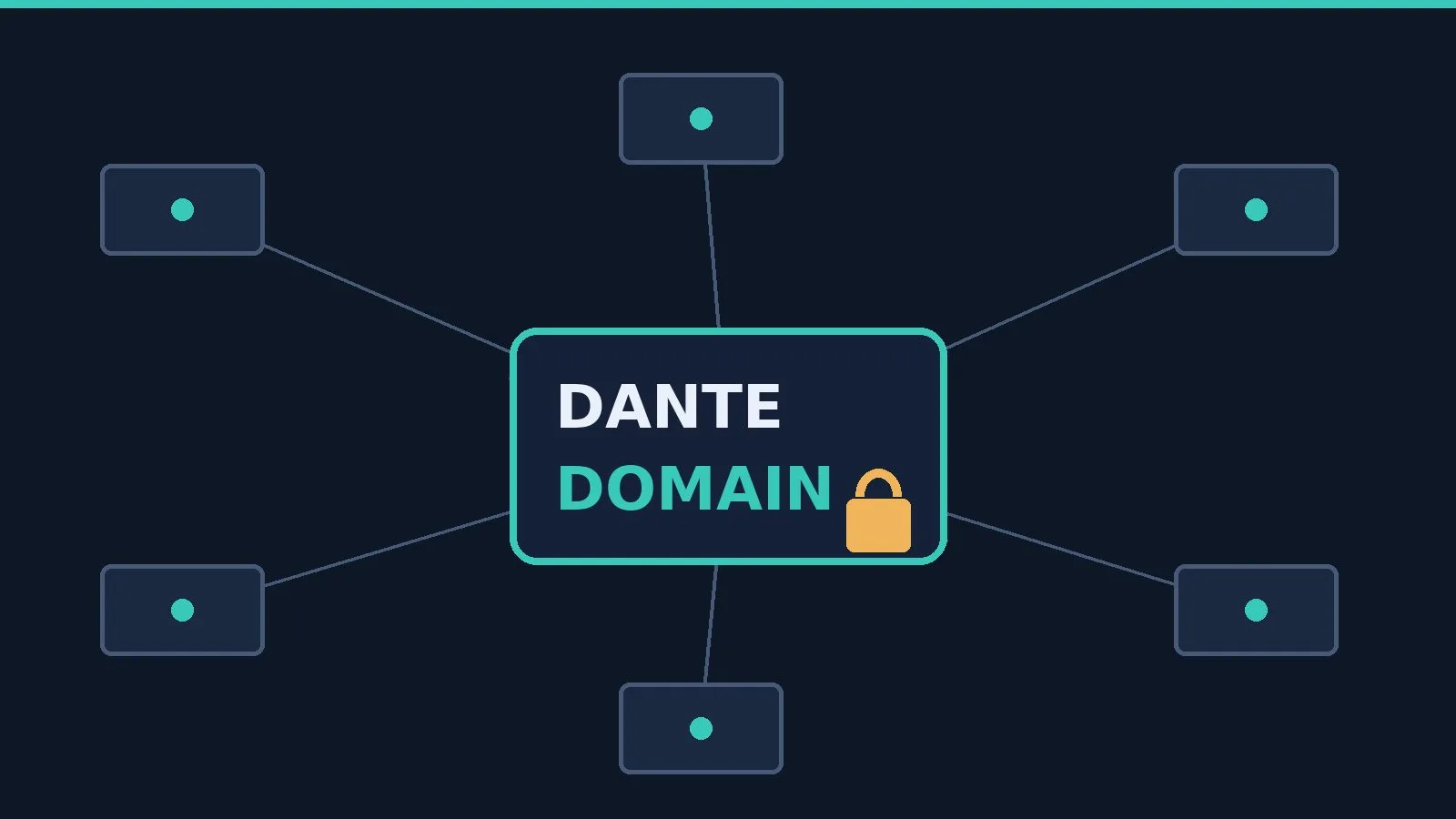
DDM is server software, installed on a dedicated machine or a virtual machine, that takes over network management. Devices enrol with it, and it then decides who sees what, who can route what, and who keeps a record of operations. The audio routing itself still flows directly between devices; DDM does not sit in the audio path: it orchestrates, it does not carry the sound.
{SVG}
The domain, the central building block
The key idea is the domain. A domain groups a set of devices that work together, regardless of their network location. You can place a studio console, its stageboxes and its recorders in a single domain, even if some sit on a different subnet. The other way, two neighbouring studios can stay in two separate domains so that one operator never touches the other’s gear by mistake.
This split brings two immediate benefits. First, isolation: flows and discovery stay confined to the domain, which cuts the risk of a wrong move. Second, network reach: a domain can span several routed subnets, where a classic Dante network is limited to a single segment for discovery. For a whole building, that difference is decisive.
Access control, clocking and traceability
DDM introduces real user accounts with roles. An administrator configures domains, an operator routes flows within their domain without altering the rest, a guest only watches. Every enrolled device requires authentication, and the control traffic between DDM and devices is encrypted. For an install under security requirements, this carries weight.
Clocking follows the same split. Each domain has its own synchronisation, with its own leader clock, which keeps a clock conflict in one studio from spreading elsewhere. The subject is the same as for any audio-over-IP network, where PTP synchronisation governs overall stability. Finally, DDM keeps an event log: a device added, a routing change, a user login. In operation, that traceability helps with troubleshooting as much as with auditing.
Where DDM fits
DDM targets installs of serious size. A multi-studio radio station, an OB truck, a TV facility, a theatre or a large event venue gain the central management and security a plain Dante Controller does not provide. It fits into an ecosystem already rich in standards, alongside MADI for legacy links and ST 2022-7 redundancy for on-air continuity. It belongs to the same drive to professionalise audio networks as the other standards covered in our audio over IP guide.
What to check before adopting DDM
DDM is not free and is licensed, usually by the number of managed devices, in tiers. Enrolling a device removes it from unmanaged use: it no longer answers a classic Dante Controller while it belongs to a domain, which means planning the switch. The DDM server itself becomes something to secure and, ideally, to make redundant, because it holds the configuration and the authentication. Finally, like any added layer, it asks for real training. For a small network the investment does not pay off; for a critical install, it changes operations.
My take
Dante Domain Manager answers a real limit of Dante, the flat network that knows neither user nor permission. As soon as an install runs several studios or several teams on the same cabling, central management and the event log earn their keep, above all when the broadcast must not drop. The real subject is not the feature set, which holds up, but the switch: enrolling devices and making the server redundant need serious planning. For a single studio, Dante Controller is plenty.