At the back of a room, the audience always hears less than the front row. Pushing the level at front of house fixes nothing: the people near the speakers then take an unbearable pressure while the back stays timid. Behind this daily problem for the sound engineer sits a simple physical law, the inverse square law, and a well-known workaround, the line source.
The inverse square law, 6 decibels per doubling
A point source radiates its energy in every direction, over a sphere. When the distance doubles, that sphere has twice the radius and four times the surface area: the energy spreads over four times the area. The sound pressure is halved, a drop of 6 decibels. With each new doubling of distance, you lose another 6 decibels, and the calculation repeats.
An example makes it concrete. A speaker rated at 94 decibels at one metre produces about 88 decibels at two metres, 82 at four, 76 at eight, and so on. By thirty-two metres, little is left of the starting level. The law depends on neither brand nor power: it follows from the geometry of space, and no electronics can cancel it.
Why a line source changes things
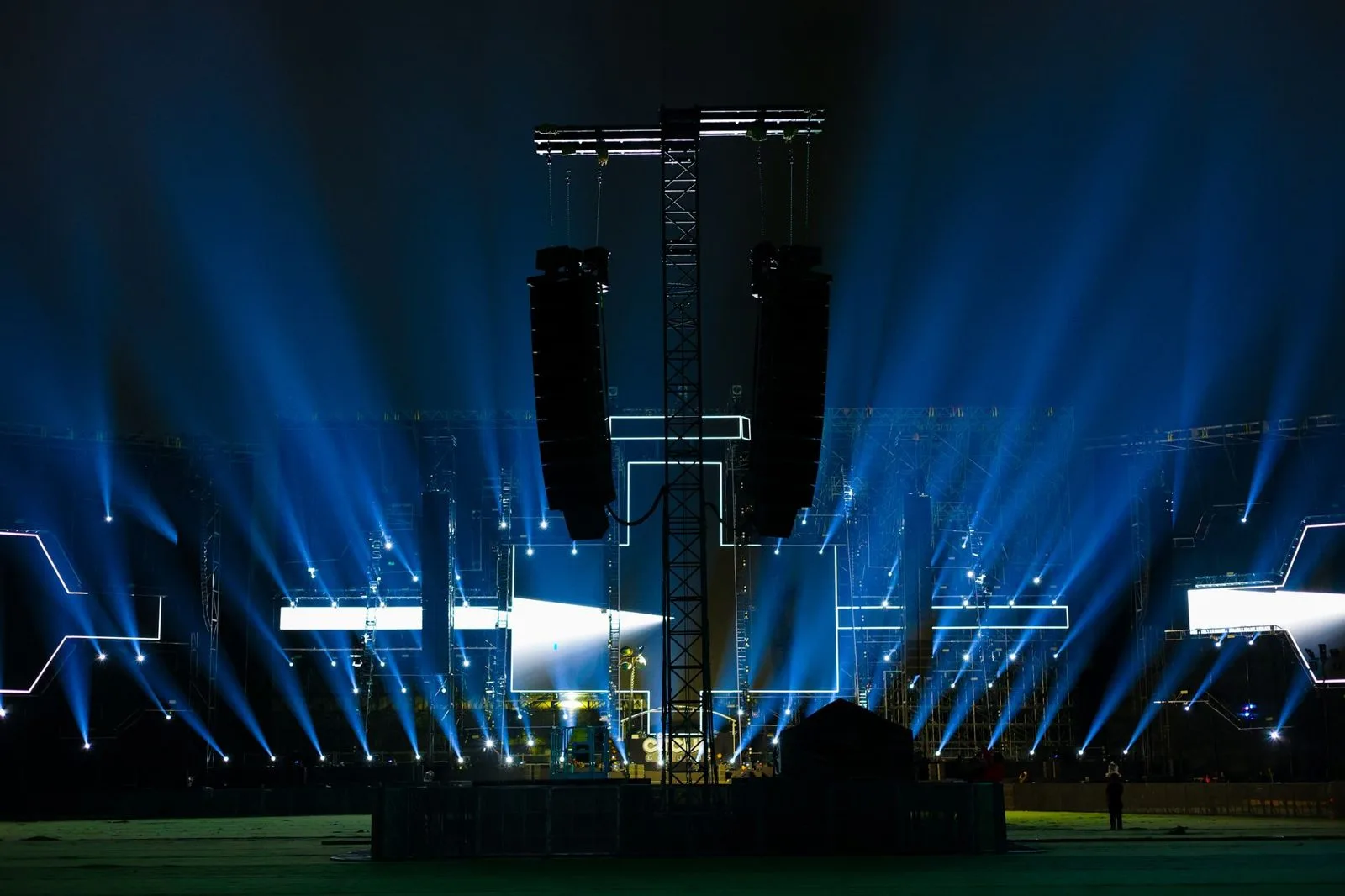
A line array is not a point source. By stacking boxes over enough height, it behaves in the near field like a cylindrical source: the energy no longer spreads over a sphere but over a cylinder, whose surface grows only in proportion to distance, not to its square. The drop then falls to about 3 decibels per doubling, half as fast. A listener twice as far loses 3 decibels instead of 6, and the back of the room stays workable.
This advantage does not last forever. Beyond a transition distance, which depends on the array length and the frequency, the line source becomes a point source again and gets its 6 decibels per doubling back. Low frequencies, with their long wavelengths, drop out earlier than highs. We detailed this behaviour in our comparison of point source versus line array and in the full explanation of how a line source works.
From maths to real room coverage
Knowing the drop per doubling lets you anticipate coverage before measuring anything. You aim for a level at the last row, you walk the distances back up, and you know what level the front row needs to reach it. If the gap between the first and last row exceeds what the ear tolerates, no gain setting will save the day: you have to split the room into zones.
That is the job of delay speakers, those cabinets placed further into the room and delayed to stay coherent with the main system. They lift the level at the back without touching the front. The alignment and delays of these zones are driven from the console outputs, a topic covered in our guide to matrix outputs in live sound, and from the system’s loudspeaker management processor.
The reverberant field trap indoors
The inverse square law describes direct sound in the free field. Indoors, the walls, ceiling and floor return the energy, and beyond a certain distance the reverberant field dominates the direct field. Past that point, the level stops dropping steadily and plateaus, but intelligibility worsens because reflections blur the direct sound. The theoretical calculation then gives an optimistic limit: on-site transfer function measurement remains the only reliable judge. The doubling rule is for predicting and sizing, measurement for confirming.
Keep the order of magnitude rather than the decimal. Six decibels per doubling for a point source, three for a line source in the near field: with these two figures in mind, you read a room at a glance and place your delays in the right spot, before you even pull out the measurement mic.
My take
This is the physics every system tech ends up knowing in their legs, from walking rooms during soundcheck. The useful reflex is to stop trying to cover everything with the main system alone: as soon as the front-to-back gap becomes unbearable, one well-tuned delay does more for the audience than three extra decibels at the mains. The inverse square law is not up for negotiation, but you can work around it intelligently, zone by zone.