Modular drum sequencing has long been pulled between two camps: the step grid, precise but tedious, and algorithmic generators, lively but hard to pin down. With the Beat Designer, Sweden’s small Noise Lab workshop takes a third route, inherited from Mutable Instruments’ much-missed Grids. You no longer place steps one by one, you move around a map of patterns.
A sequencer that thinks in a map, not in steps
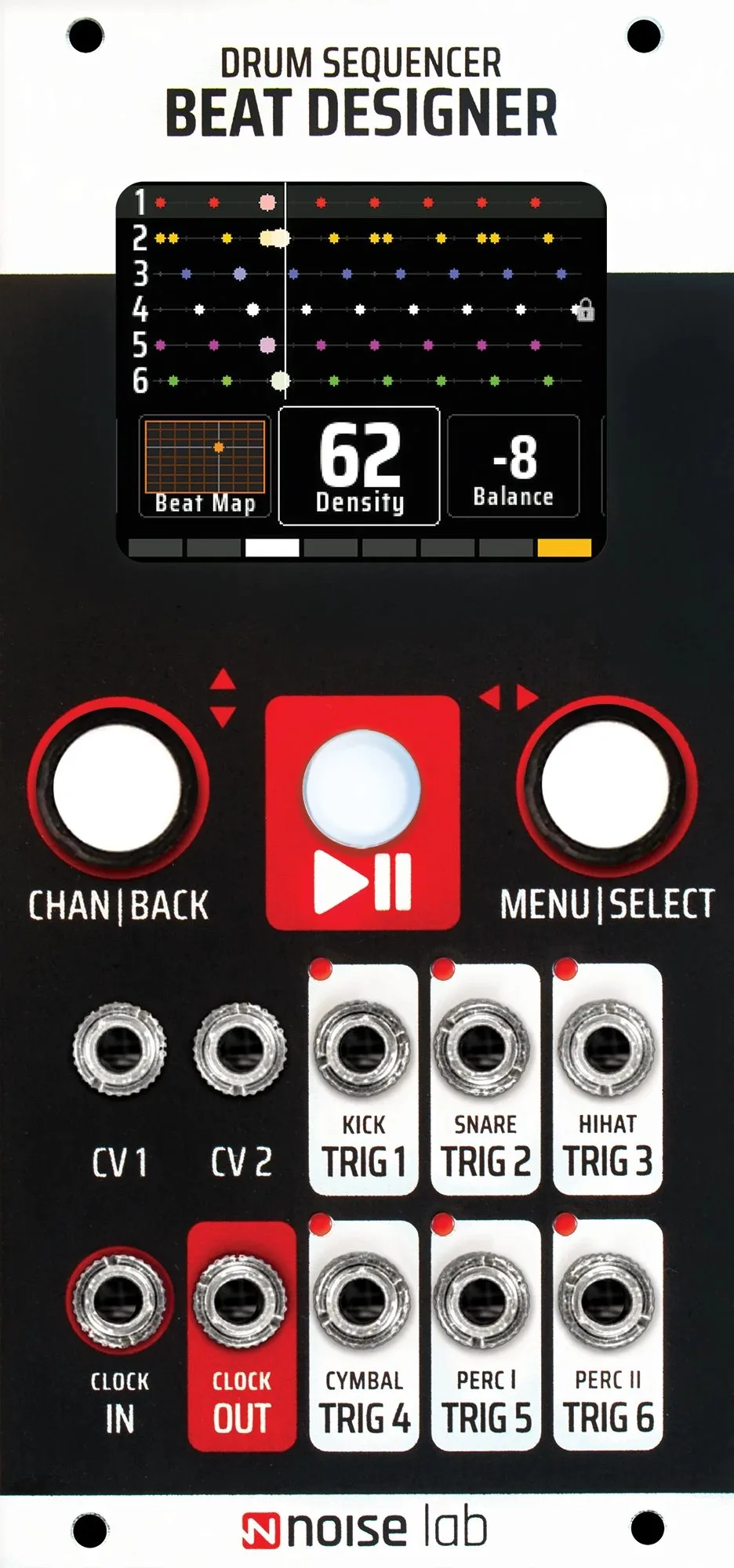
At the heart of the Beat Designer sits a 17-by-17 map. Each position on that map holds a rhythmic variation, and moving the playhead morphs the pattern continuously, from a sparse groove to a flood of triggers. Noise Lab openly claims the Grids lineage, the module that popularised this two-dimensional approach, but adds a colour screen that makes the map readable instead of leaving it abstract.
The gap with a classic step sequencer is about how you work. On a grid you decide every hit; on a map you hunt for a zone that sounds right, then modulate it. If you like building a beat by feel rather than by notation, the logic sits closer to improvising than to programming. It pairs nicely with purely mathematical approaches such as Euclidean rhythms, which space hits out by calculation.
Six triggers, two CV inputs and a colour screen
Inside its 12HP, the module lays out six trigger outputs named kick, snare, hihat, cymbal, perc I and perc II. That is enough to drive a full modular drum rack, for instance a bank of synthesised voices that build kick, snare and hats without a single sample. Clock runs in and out through two dedicated jacks, so the Beat Designer can be the tempo master or a slave to a main sequencer.
Two CV inputs animate the machine in real time. They act on ratchets (the rolls that subdivide a trigger), on the overall density of the pattern and on the variation rate, among other parameters. Patch a slow LFO or an envelope into those inputs and the pattern breathes instead of repeating identically. The interface comes down to two push encoders and a two-inch, 320-by-240-pixel display, sharp enough to show the map and the state of each track.
Memory, chaining and live play
Noise Lab built in headroom: 260 pattern slots and 40 chain slots of 32 cells each. Chains string patterns together to build a song structure, verse, chorus and breaks, without leaving the modular. Each track is set independently, pattern length included, so a hat in 7 can run under a kick in 4 to create phasing shifts. All of these settings stay reachable during playback, which makes the module a genuine stage tool rather than a studio programmer.
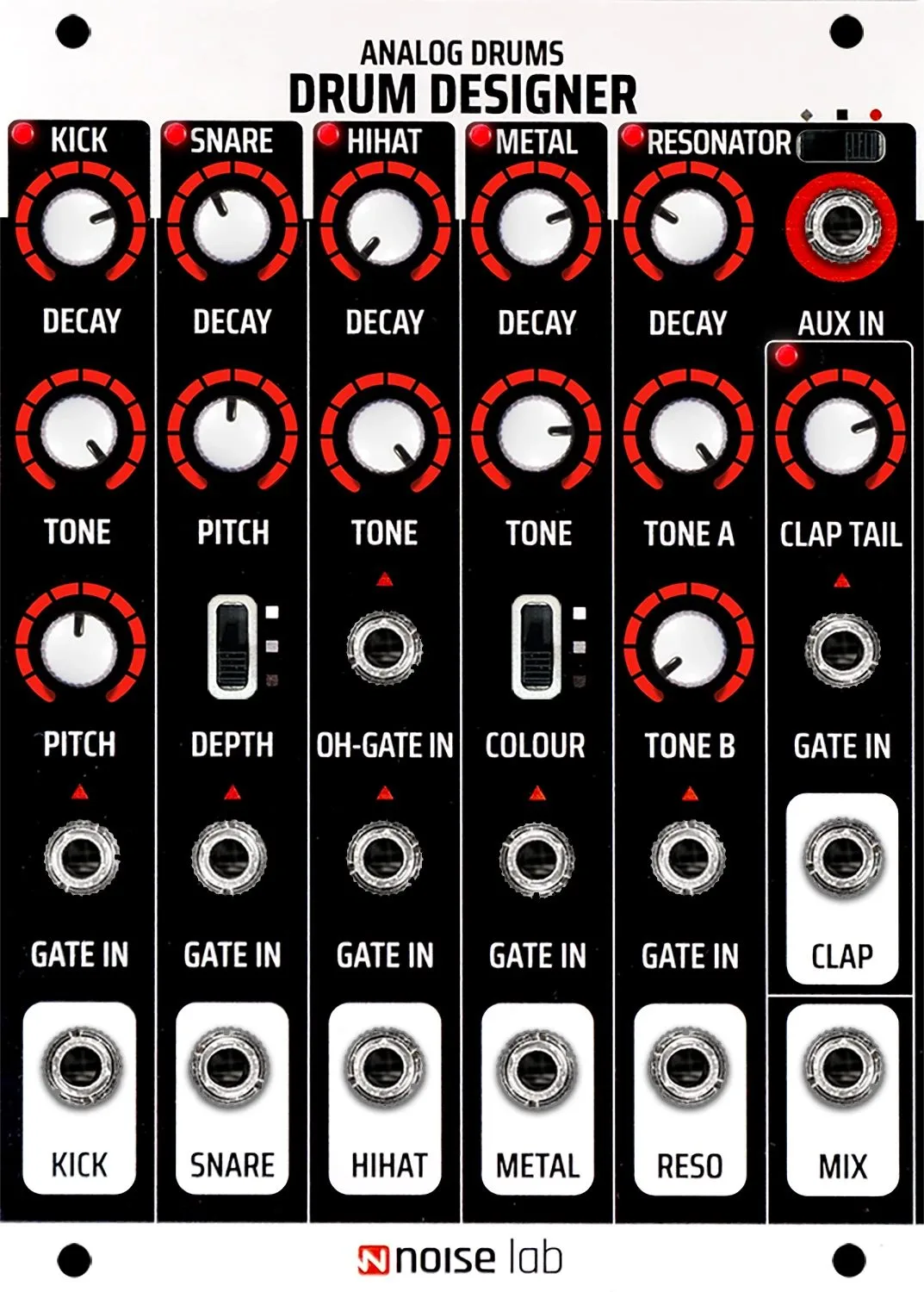
The Beat Designer is not a sound module: it produces no percussion on its own. It is a conductor that triggers other modules, starting with the Drum Designer that Noise Lab released earlier in the year, an 18HP analog voice built to receive exactly this kind of signal. The two form a coherent pair, one giving the tempo and the pattern, the other the raw sound.
Price and availability
The Beat Designer is listed at €221 plus VAT and available now from Noise Lab and its dealers. At that price it undercuts most screen-equipped Eurorack drum sequencers, which makes it tempting for anyone after an expressive rhythmic brain that won’t eat half the rack. How you play it matters as much as the spec here: the beat map rewards the gesture, not the data entry. To work on the feel of a pattern once it is down, our notes on groove, swing and quantization still apply, map or no map.
My take
The beat map is still one of the most musical ideas in modular, and seeing it return with a readable colour screen is a treat. Grids asked for a little faith about where you were; here you see the zone you are navigating, and patching CV into ratchets or density opens an immediate playground. At €221 the bet is fair for a module that lives better under the fingers than under a mouse. The real catch with a voiceless sequencer remains: you still need the drums to trigger behind it.