Launchpad-style 8×8 pad grids are a well-established market, led by Novation and Akai. Behringer enters it its own way with the AQ64L: an RGB grid that looks ordinary on paper, but whose firmware is fully open source, published on GitHub. That’s the detail that changes everything—and sets this controller apart from the rest.
An unremarkable pad grid… on the surface
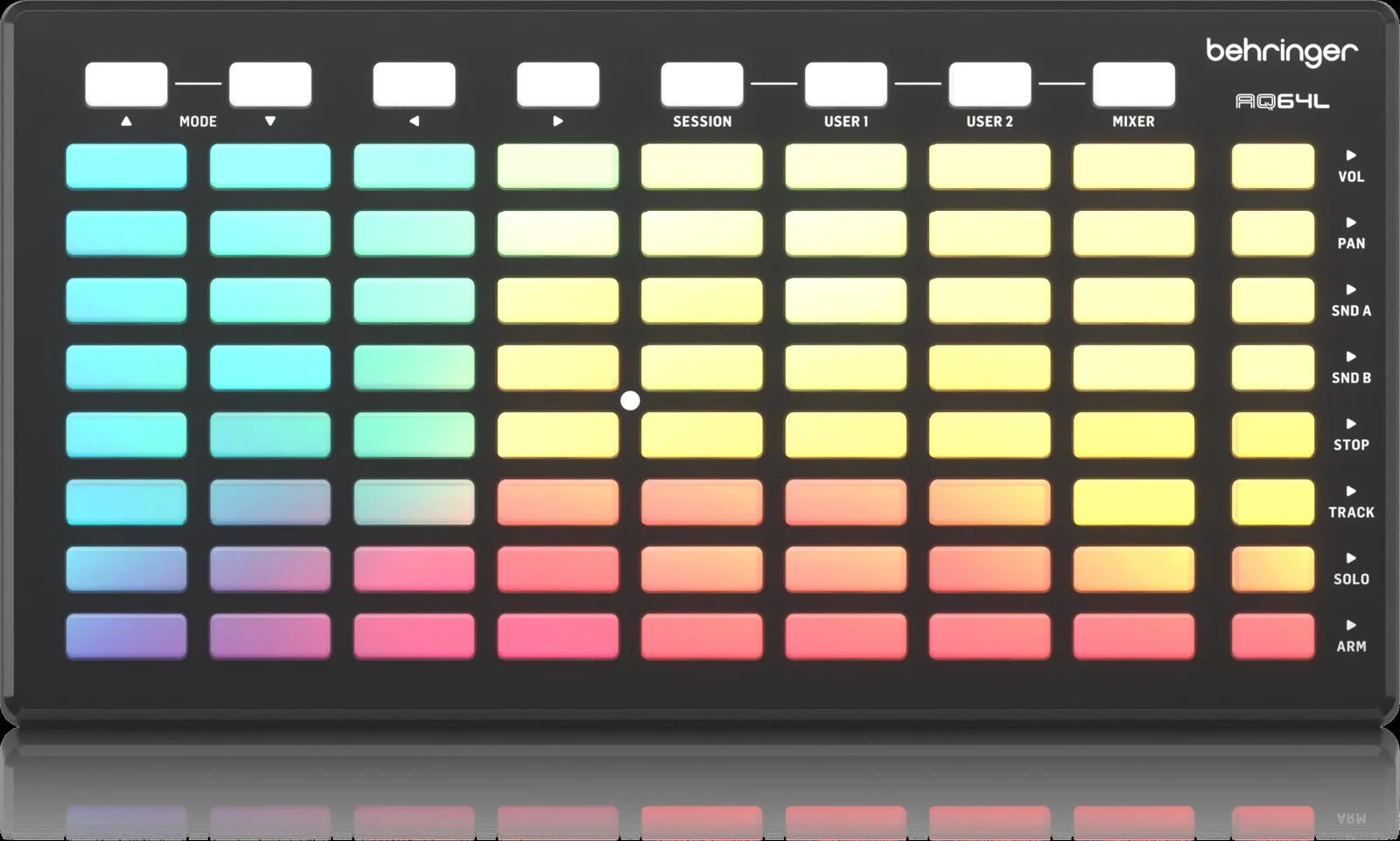
Up top, the AQ64L ticks the expected boxes: 64 RGB pads in an 8×8 layout, a touch longer and narrower than most, topped by a row of function keys (navigation, Session, User 1, User 2 and Mixer modes) and flanked on the right by a column for mixing—volume, pan, FX sends, stop, mute, solo, arm. It’s the logic of a controller built first for Ableton Live, which it ships preconfigured for, along with FL Studio.
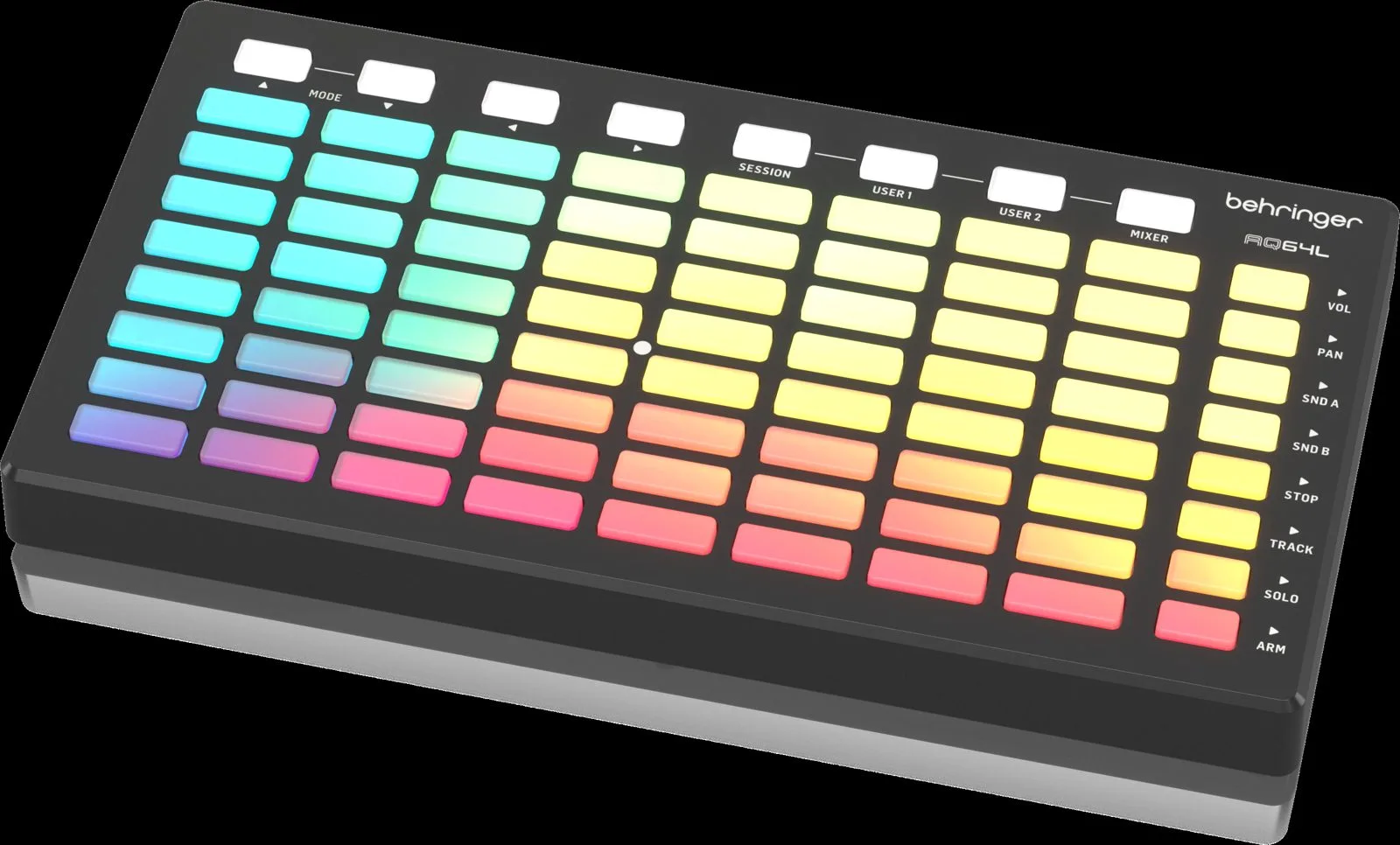
Plugged in, full stop: USB-C and nothing else
Connectivity comes down to one port: a USB-C that carries both power and data. No DIN MIDI, no adapter. The unit is class-compliant, so it’s recognised with no driver on macOS, Windows, Linux, iOS and Android—plug it in and it works. Beyond Session mode, the AQ64L offers a drum mode, a multi-octave keyboard mode and a mixer page, plus user modes you set up yourself.

The one thing that sets it apart: open firmware
This is where the AQ64L breaks away. Its firmware is published as open source on Music Tribe’s GitHub repo (0715-AAX), with its GD32F350 microcontroller (Cortex-M4 core, 128 KB flash, 16 KB RAM) documented. In practice, a developer can fix a behaviour, add a missing feature, or repurpose the unit entirely—sequencer, step sequencer, bespoke control surface. It’s the same philosophy Behringer applies to other recent products, from the Polykeys 61 to the SP1200X. On a consumer controller, that openness is still rare—and it’s a guarantee of longevity: hardware you can repair and modify doesn’t go obsolete the first time the software changes.
Up against the Akai APC Mini
The most direct comparison is the Akai APC Mini MkII, sold at around €80, which adds nine physical faders the AQ64L lacks. If you ride levels by hand, those faders matter. If you want a light-up grid you can hack deeply, Behringer’s open firmware tips the other way. Both clearly target the same crowd: the home studio and the Ableton-based electronic stage.
Price and availability
Behringer hasn’t yet announced the AQ64L’s price or on-sale date; the product is shown on its site and its firmware is already online. Given the brand’s positioning and the price of its direct rival, expect it at the low end of the market. For fans of open hardware, it’s a release worth watching.
My take
The real draw of the AQ64L isn’t its grid—they’re all much of a muchness—but its open firmware. Being able to rewrite a controller’s behaviour means it lives as long as you’re willing to code for it, well after the brand stops supporting it. The lack of faders leaves it a step behind the APC Mini for pure hands-on mixing, and the price is still unconfirmed. But the idea of consumer hardware you can repair and repurpose deserves encouragement: it’s exactly what most pad controllers are missing.
Frequently asked questions
What does the AQ64L’s open-source firmware mean in practice?
The code that runs the unit is published on GitHub, with the microcontroller it uses documented. A developer can modify it to fix a bug, add a feature or reassign the pads entirely to another use, then recompile and reinstall their own version.
Does the AQ64L have faders like the Akai APC Mini?
No. The AQ64L sticks to the 64-pad grid and function keys. Mixing is handled through the dedicated column and the Mixer page, but without physical faders. The similarly priced APC Mini MkII adds nine.
Do I need a driver or a separate power supply?
No. The AQ64L is class-compliant and powered by its single USB-C port: it’s recognised with no driver on macOS, Windows, Linux, iOS and Android, and needs no external power.
Which software does it work with out of the box?
It ships preconfigured for Ableton Live and FL Studio, with session, drum, multi-octave keyboard and mixer modes. You can also create your own user modes.