The word “live” reassures the listener: what they hear is happening now. In reality, most live radio and TV runs through a broadcast delay — a deliberate few-second offset slipped between the studio and the transmitter. This short reprieve, invisible to the audience, is one of the most useful tools in on-air operations. It lets you pull a word, an incident or a problem segment off the air before it’s transmitted.
Why delay a live show?
The broadcast delay — often called a “profanity delay” in radio — answers a simple need: keeping control of what goes to air when you don’t control the source. The typical cases are many:
- listener call-ins on air, where no one knows what the person on the line will say;
- talk shows and open-mic segments, ripe for slip-ups;
- the coverage of live events (sport, awards) where a swear word or incident can happen at any moment;
- regulatory decency obligations, which expose the broadcaster to penalties.
In all of these, the delay turns an unmanageable risk into a manageable incident: instead of being at the mercy of the live feed, the operator has a few seconds to react.
How it works: a buffer of a few seconds
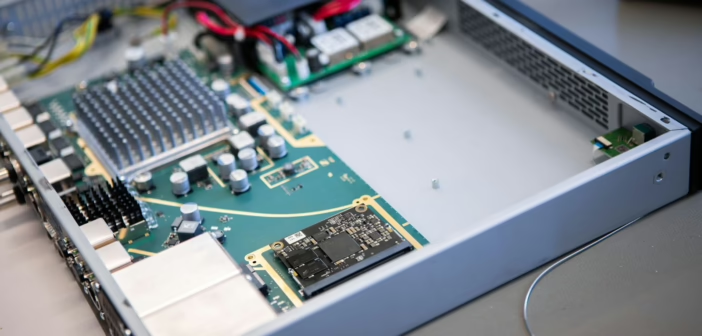
Technically, a digital delay processor continuously stores the audio (and video, on TV) in a memory buffer, then plays it back with a fixed lag — typically around 6 to 10 seconds in radio, sometimes more on television. Everything that comes in comes out a few seconds later: from the transmitter’s point of view, the studio is working “in the immediate past”.
The subtlety is building the delay. You can’t create 8 seconds of lag in a snap without cutting the sound. So the unit “grows” the delay gradually at start-up, by very slightly slowing the audio or inserting imperceptible micro-silences until it reaches the desired depth. The voice stays intelligible, pitch is preserved, and the listener hears nothing.
The button that saves you: “dump” (or cough)
When something goes wrong — a swear word, an insult, information that must not air — the operator hits the dump button. The unit then instantly discards the chunk of sound waiting in the buffer (the window of the last few seconds) and splices cleanly: the offending passage never reaches the transmitter. The price: the delay is spent. The system then starts from zero and rebuilds its buffer gradually, as at start-up, before it’s operational again. During those few rebuild seconds, protection is reduced — hence the importance of a measured, non-compulsive reaction.
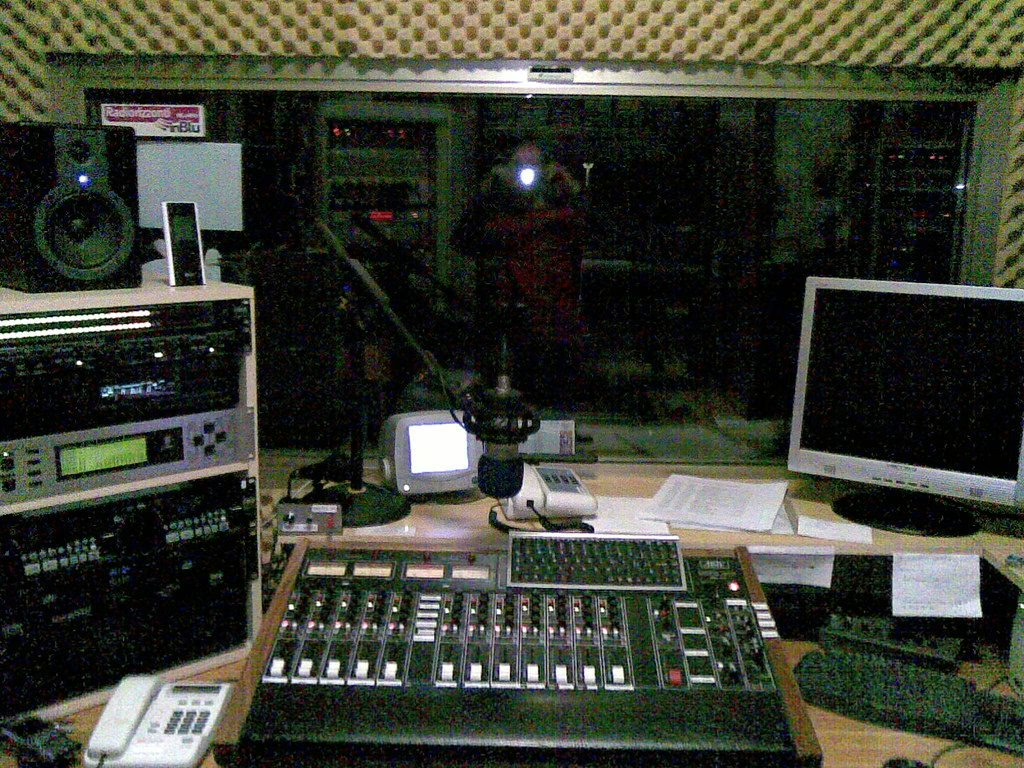
The move takes practice and good coordination with the host: press too early and you cut a useful phrase, too late and the word slips through. Many control rooms provide a visual indicator of the delay’s state (full, rebuilding, empty).
Where it sits in the chain
The broadcast delay lives at the end of the on-air chain, just before transmission, generally ahead of the broadcast processing or built into it depending on the gear. It acts on the signal that actually goes to air, not on the studio monitoring: the host hears themselves in real time, without the lag, while the listener gets the delayed version. That distinction is essential so as not to disrupt the flow of the show or the playout.
Broadcast delay, latency, streaming lag: don’t mix them up
The broadcast delay is intentional and controlled. Don’t confuse it with the technical latency of the chain (encoding, transmission) or with the streaming lag, often far longer, that separates the over-the-air feed from the online version. On DAB+, HD Radio and IP delivery, these lags add up: the same programme can arrive several seconds apart depending on the channel. That raises concrete issues — FM/DAB sync, phone-in contests where “the first caller” depends on the channel you’re listening to — but they’re separate from the safety delay.
In the streaming and social era
The dump remains a tool designed for over-the-air delivery, where you control a single feed. On online platforms the lag is much larger, and live social (networks, chat) largely escapes this logic: dumping a word from the FM feed doesn’t stop an instant capture elsewhere. The broadcast delay doesn’t become pointless, though: it’s still the best guarantee on the main feed, the one that carries the broadcaster’s editorial and legal responsibility. Modern codecs and links, by contrast, aim to reduce contribution latency — two opposite goals coexisting in the same control room.
Key points
| Question | Short answer |
|---|---|
| Purpose | Remove problem content before air |
| Typical depth | About 6 to 10 s in radio, variable on TV |
| Building it | Imperceptible slow-down/silences at start-up |
| Dumping | “Dump” button: empties the buffer, then rebuilds |
| Not to be confused with | Technical latency and streaming lag |
Finally, like any link in on-air operations, the delay sits in a chain where level matters: it’s no substitute for real loudness and tonal consistency downstream.
My take
The broadcast delay is the insurance you hope never to use — and the one that, on the day things go sideways, saves a station from a fine or a bad-buzz storm. What’s striking is how much the human move matters more than the box: a well-set delay is worthless without an operator trained to hit the button at the right instant, neither too early nor in the heat of the moment. The real issue today is coexisting with live social, where nothing can be dumped. The delay protects the official feed, not the ecosystem around it; you have to know that and not ask it for the impossible. Within that scope, though, it remains irreplaceable.