Behind every radio signal sits a playout system that decides, to the second, what goes to air. Automation, cart walls, the log, redundancy: here is how the invisible heart of a station works.
What is playout?
Playout is the software — and the server running it — in charge of playing and chaining the audio bound for air: music, adverts, jingles, beds, imaging, news. It runs a log, the timed rundown that tells the station what to broadcast and when. You never hear it as a listener, but it is what guarantees there is no gap between two elements and that the right spot airs at the right time.
Where loudness handling and broadcast processing shape the sound, playout manages content and pace: it is to the schedule what a floor manager is to a TV show.
Automation, live assist and voice-tracking
A playout system runs in three main modes, often combined across a single day:
- Full automation. The station runs itself from the log, with nobody in the studio — typically overnight or at weekends. Playout chains music, imaging and adverts by the programmed rules.
- Live assist. A presenter is in charge and fires elements manually, but playout queues the file and secures the transitions. This is the mode of live shows and breakfast programmes.
- Voice-tracking. The presenter records their links in advance, timed between two specific songs. On air, everything flows like a live show, even though the voice was laid down the day before. It is the trick that gives a human presence to a largely automated schedule.
The log, rotations and cart walls
The log is built upstream from two blocks: music scheduling, which handles rotations and song categories to avoid repetition and respect the format, and traffic (ad scheduling), which inserts spots into the sold slots. Playout merges the two into a single, coherent rundown.
Alongside that linear log, every playout system offers a cart wall: a grid of buttons to fire jingles, stingers, beds and effects on the fly during a live show. It is the presenter’s and producer’s tool, the modern equivalent of the old tape cartridges, now loaded with files and driven from a touchscreen or keyboard.
Playout and console: who controls what
Playout does not live alone: it talks constantly to the studio console. Historically that dialogue ran over dry contacts, the familiar GPIO — opening a fader starts playback, the end of a song lights a lamp. Today it increasingly all speaks audio over IP: audio and control ride the same network.
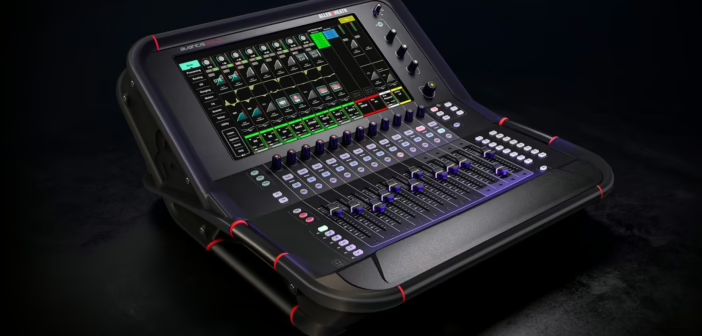
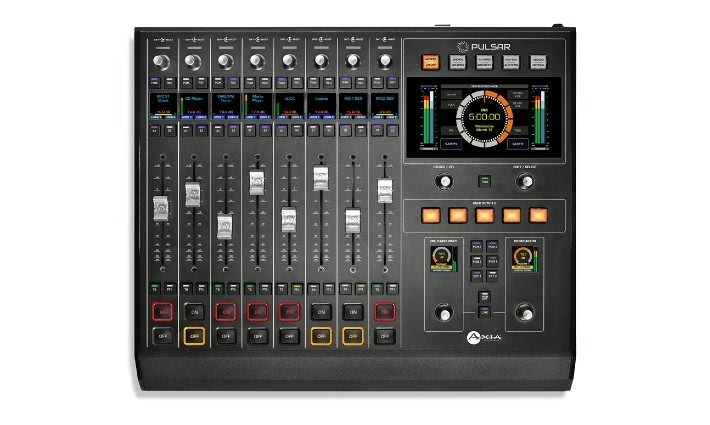
Modern radio surfaces are built for this integration. A Lawo Ruby, an AEQ Arena or a DHD Series 52 carry playout control logic, source management and network routing in the same architecture. The result: opening a channel fires the right file, mutes the mic at the right moment and switches the on-air lights without a second thought.
Redundancy: never fall silent
Dead air is the unforgivable fault. A serious playout chain is therefore doubled: two synchronised servers, main and backup, ready to switch automatically. A silence detector watches the signal at all times; if it hears nothing for a few seconds, it triggers the failover to the backup server, or to an emergency source loaded with music.
That culture of redundancy echoes the big event control rooms, as shown by the redundant all-IP setup Radio France built for the Concert de Paris: every critical link exists twice, and the switchover must be invisible to the listener.
Loudness, recording and replay
Playout sends, processing normalises. Since files come from mixed sources, hitting the target loudness (LUFS, EBU R128) happens at two levels: file normalisation in the library, then broadcast processing on the way out. A well-set playout already delivers a consistent level, which takes load off the on-air chain.
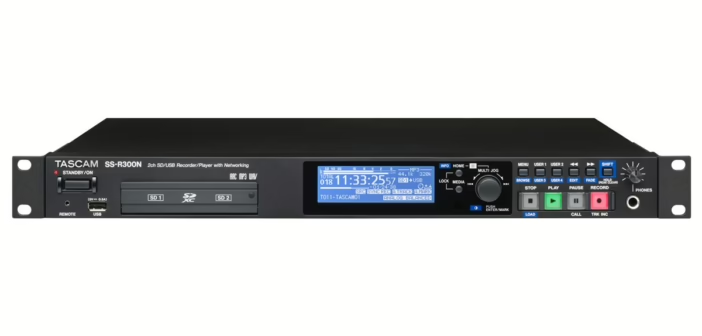
Finally, playout often comes paired with a broadcast recorder that captures the output for legal archiving, replay or podcast extraction. Networked machines such as the Tascam SS-R300N slot naturally into this chain, for both playback and recording.
My take
Playout is the link you only notice when it fails, and that is exactly why it deserves care. Voice-tracking was a quiet revolution: it lets a station keep a voice, a colour, a sense of closeness, without a studio staffed around the clock. The real question today is no longer whether to automate, but where to set the cursor between human and machine — and how far to push redundancy, because a backup server that never had to kick in is still the best investment a station can make.