Mixing a concert means preparing one night for one band. Mixing a festival means preparing ten nights in a row, without ever stopping the machine. The audience only sees artists following one another, but backstage, every minute counts. Success rests less on the gear than on an organisation built for speed and repetition. Here is how a big festival stage is set up to swallow a new band every half hour.
The real challenge: time, not volume
On a standard date, the crew has the whole afternoon to rig, patch and tune. At a festival, the changeover window often runs between fifteen and thirty minutes. In that span, you have to clear the previous band, set up the next one, check every input and start the first song without a hitch. So the whole technical architecture aims at one goal: cut that dead time to the minimum, while keeping a reliable sound from one band to the next.
The festival patch, backbone of the stage
At the heart of the setup is the festival patch, an input plan frozen for the whole day. Rather than rewiring for each band, the crew plans a generous set of inputs, numbered once and for all: drums on the first lines, bass, guitars, keys, vocals, then spare lines for larger line-ups. Each incoming artist plugs into this shared plan, and the FOH and monitor engineers always know what sits on any given input.
This patch starts from one or more stageboxes on the deck. A splitter sends each signal to at least two destinations: the FOH console and the monitor console. Historically, that split used transformers and analogue multicores. Today, audio-over-IP has changed things: a network carries dozens of channels on a single network cable, and the same stream feeds FOH, monitors and recording. Our guide to the patch and stagebox details this shift from the snake to the network.
Two consoles, as many guest engineers
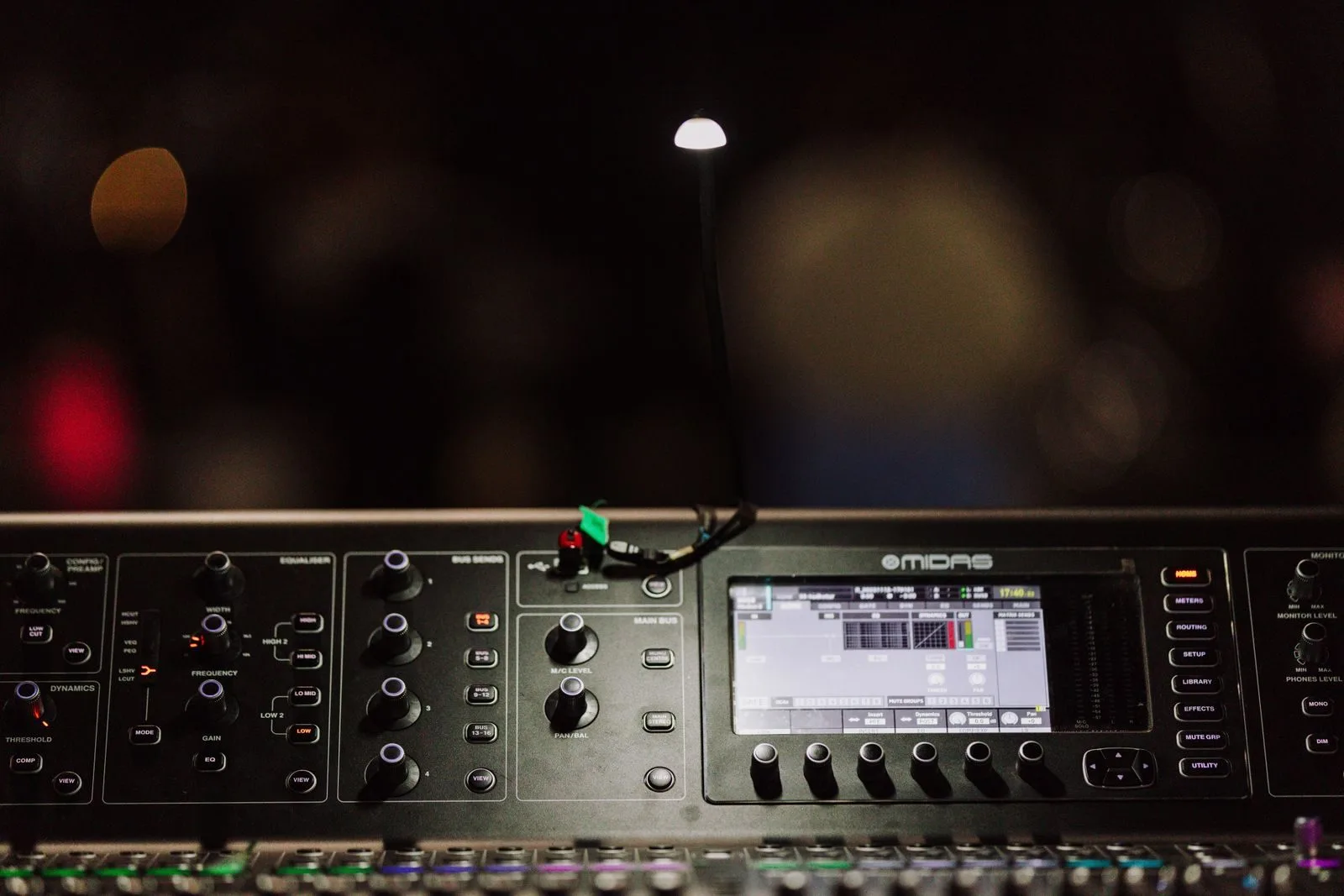
A big stage almost always runs two digital consoles: one at FOH, one at monitors, tied to the same network. Headline bands travel with their own engineer, who arrives with a USB stick and a show file. In a few minutes, they load their session, find their input settings, groups and effects, and sit on the shared patch. Bands without a dedicated engineer are handled by the stage crew, starting from a neutral template prepared in advance.
This switch from one show to the next relies on two habits. First, offline prep: build your session ahead of time, name your channels, program your scenes, so you arrive ready. Our article on how to prepare a console offline covers the method. Second, a clear surface layout, with well-thought-out groups and VCAs to run the mix with one hand while the other tweaks a detail.
The line check, safety net of the changeover
As soon as the next band is patched, the crew runs a line check: confirm that each patch input gets the right instrument, in the right order, with no swap or dead cable. At a festival, this step replaces the full soundcheck, impossible to run in fifteen minutes. The goal is not to mix, but to make sure nothing is missing for the first song. Our guide to the line check details this routine, too often rushed for lack of time.
To gain more, many crews record a band’s multitrack during its set, then replay those tracks to refine settings during the next changeover, with no one on stage. This virtual soundcheck has transformed festival prep: you work your mix on the band’s real music, on headphones, without tying up the artists. The principle matches the one described for multitrack recording on a live console.
The PA, tuned once for the whole day
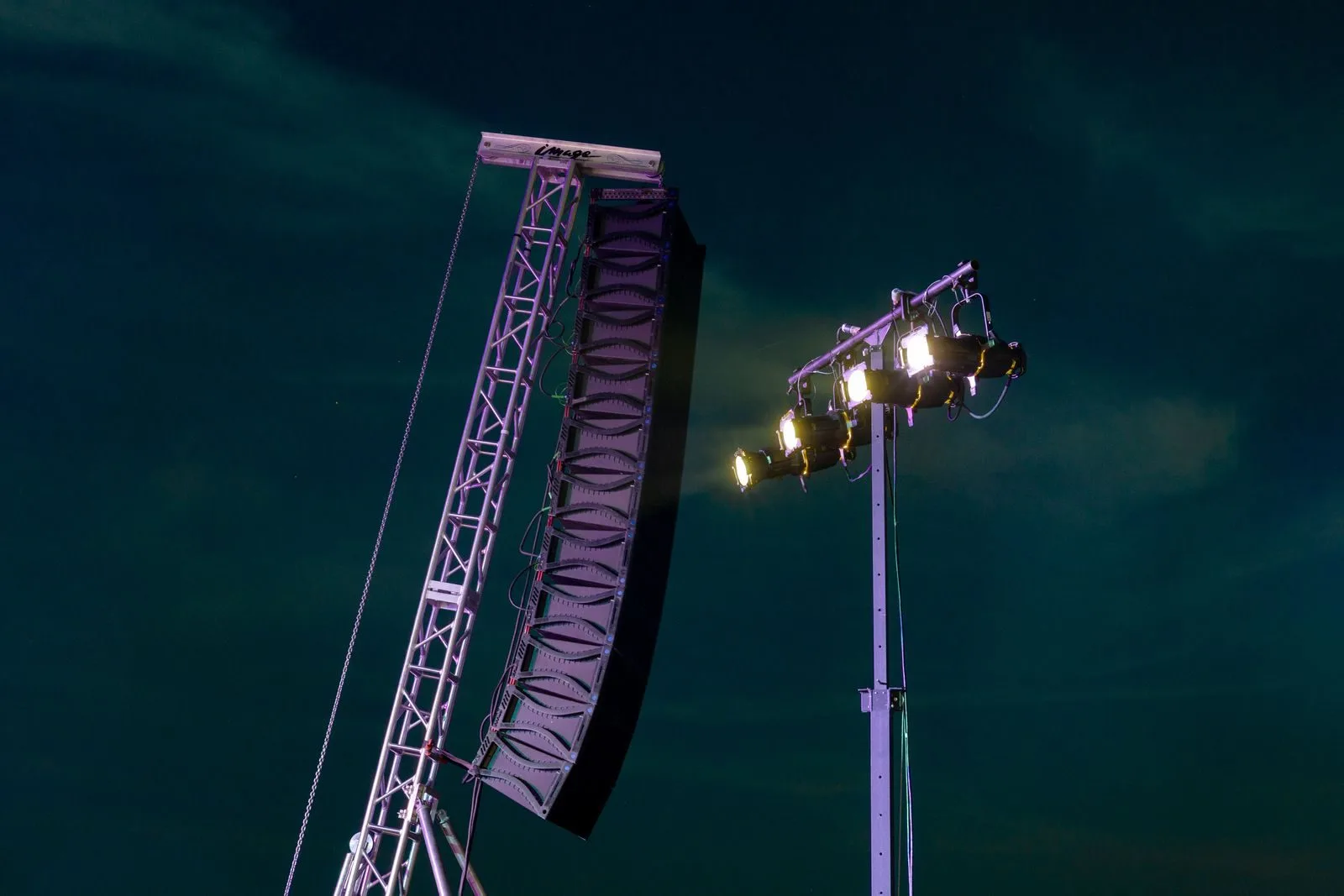
Unlike the consoles, the PA does not change from band to band. The line array, subs and any delays are flown, aligned and tuned in the morning, then stay put all day. The system crew aims for even coverage across the whole audience area, from the front row to the back of the field. On large crowds, delay towers reinforce the sound far off without killing intelligibility, as our article on delay towers explains. The choice between a true line array and point-source coverage depends on the site size, a call detailed in point source vs line array.
Wireless and intercom, the shared nerve
One last point, often underrated: the coexistence of wireless links. Wireless mics, in-ear systems, stage monitors and sometimes cameras all fight for the same radio spectrum. At a festival, a coordinator builds a global frequency plan, assigns clean channels to each band and avoids intermodulation. A good RF plan is prepared the day before, never in the panic of a changeover. To understand what happens behind a mic link, see our feature on how a wireless mic works. Intercom, finally, ties FOH, monitors, stage and show caller together to sync each changeover to the second.
My take
Festival sound rewards organised crews over the biggest systems. A well-numbered patch, sessions prepped the night before and a flawless line check beat a hundred-thousand-euro console used in a rush. The real skill shows at the changeover: fifteen minutes to make ten strangers sound right is a craft of rigour and anticipation. If you are starting out on big stages, polish your show file and your line-check routine first. The rest follows.