
Behringer keeps working through the studio classics, and this time the target gets a reaction: the BE-1B is a recreation of the Tube-Tech CL 1B, the Danish tube-based optical compressor that has been a near-mandatory reference on vocals since 1991. Where the original trades for several thousand dollars, Behringer pitches its take under 500. Enough to reopen the usual debate about the brand, but also, for once, to widen access to a very established studio sound.
A tube opto, line for line
The blue front panel makes no secret of its lineage. It carries the CL 1B layout: Gain, Ratio from 2:1 to 10:1, Threshold, then Attack and Release constants, backed by a Fixed/Manual switch that either lets the unit set its own program-dependent times or hands them to you. A large moving-coil VU meter, switchable between input, gain reduction and output, rounds things out with a calibration control, and a sidechain bus lets you link two units. Behringer quotes its own low-distortion optical cell and a push-pull tube make-up gain stage — the recipe behind this type of compressor’s particular grain: a soft, breathing compression and that way of seating a vocal in the mix without crushing it.
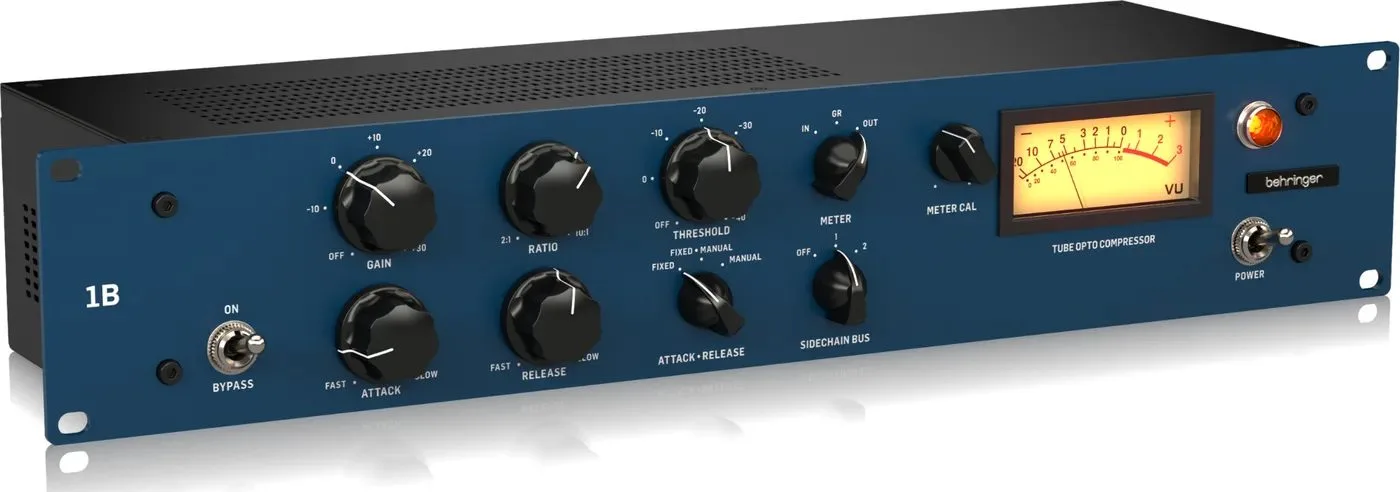
Connectivity and format
The BE-1B takes up two rack units. At the back, inputs and outputs are offered on both XLR and jack, with an accessible sidechain insert and a universal 100-to-240-volt supply. Nothing exotic, but everything you need to drop it into a serious outboard rack or a tracking chain. In the same vein of character dynamics, neighbouring approaches come to mind, such as the tube channel strip Tegeler VTRC or, in 500 format, the HLabs CL089, each with its own take on compression.

One channel, linked for stereo
Like the original, the BE-1B is a mono unit. To treat a stereo bus or a subgroup you need two of them, linked via the sidechain bus so both channels react together and keep the stereo image intact. That’s the classic constraint of this kind of box, embraced here for fidelity to the model. The big unknown of any clone remains: the actual grain, which only a side-by-side listen will settle. The product is announced for pre-order, with delivery in the coming months.
My take
An affordable CL 1B is small news that matters, because this compressor is one of those tools you hear on thousands of records without ever affording one at home. Behringer’s bet comes down to a single word: grain. The layout is right, the optical cell and the tube stage are there, but the softness of the curve and the behaviour of the tube will decide whether this is a successful homage or a plain photocopy. If the sound follows, a tube opto under 500 genuinely shifts a line, and it will be worth patching two units across a bus to hear what it does on a lead vocal before anyone talks budget.
Frequently asked questions
Is it really a clone of the Tube-Tech CL 1B?
Behringer carries over the tube-based optical compressor architecture and the CL 1B control layout, Fixed/Manual modes included. The brand quotes its own low-distortion optical cell and a push-pull tube gain stage. How close it really sounds is a matter for a side-by-side listen.
Is it mono or stereo?
The BE-1B is a single-channel unit. For a stereo bus you need two, linked via the sidechain bus so both channels compress together and preserve the stereo image.
What’s the connectivity?
Inputs and outputs are available on both XLR and jack, with a sidechain insert at the rear and a universal 100-to-240-volt supply.
What do the Fixed and Manual modes do?
As on the original, the Attack/Release switch toggles between fixed, program-dependent time constants and a manual setting of attack and release times, for tighter control.
What’s the price and availability?
Behringer announces the BE-1B under 500, for pre-order, with delivery expected in the months following the announcement.