Getting a mix louder without crushing it is an old problem, and clipping, long treated as a flaw to avoid, has become an accepted tool in mixing and mastering. The trick is understanding what it really does to the signal, how it differs from a limiter, and where its traps hide. This guide walks through it, without dogma.
What clipping is
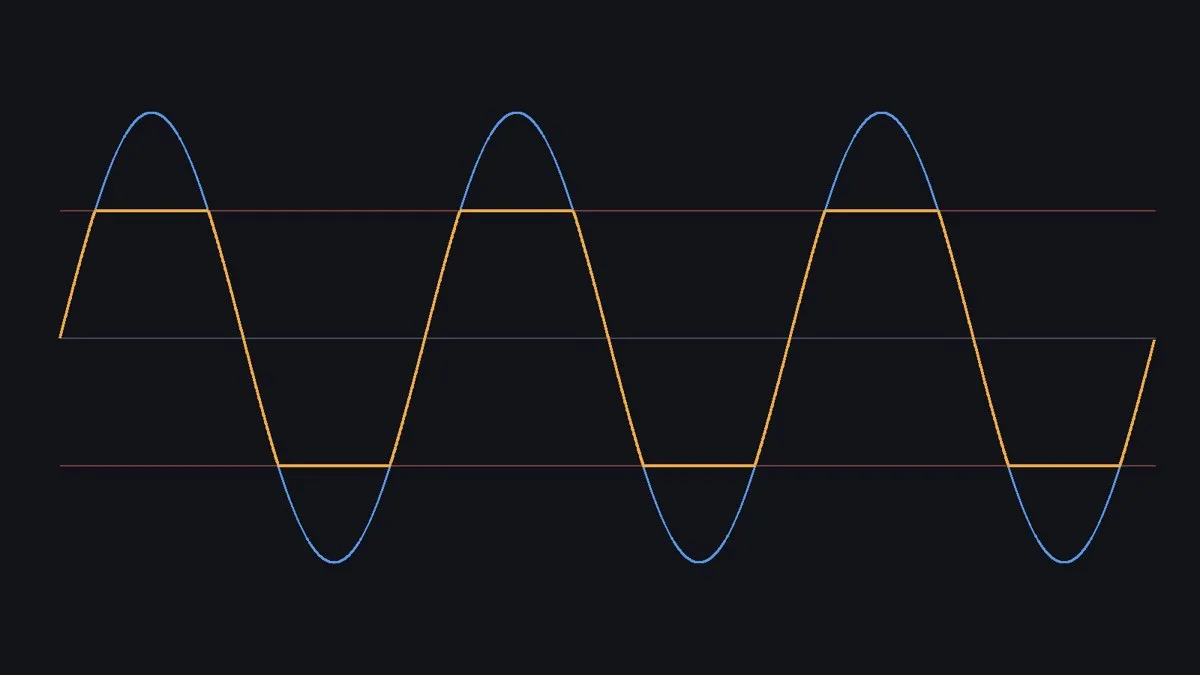
Clipping happens when a signal exceeds the highest level a system can represent. The part above the ceiling does not vanish, it is cut off. Instead of following its curve, the peak is flattened against the limit. In the digital domain, that ceiling is 0 dBFS, the largest value a sample can encode. Anything that would go further is forced back to that value.
This flattening changes the waveform, and therefore the harmonic content. A clipped sine tends toward a square wave, which adds harmonics. That is why clipping is audible: it colours the sound. In moderation it thickens and adds a little bite. Pushed hard, it distorts outright.
Hard clip and soft clip
There are two families. Hard clip shears the peak flat at the ceiling, with a sharp corner. It is efficient for gaining decibels, but generates high harmonics that can turn harsh. Soft clip rounds the peak off before limiting it, with a gentle curve. It brings in a more gradual saturation, often more musical, at the cost of slightly less level gain.
The choice depends on the material. On a kick or a synth bass, a discreet hard clip tames isolated peaks without the ear noticing. On a full bus or a complete mix, a light soft clip usually sits better, because the distortion spreads more gently.
Clipping or limiting, what is the difference
The confusion is common, since both contain peaks. A limiter watches the level, decides to reduce gain when it crosses a threshold, then releases. It works in time, with an attack and a release, and can breathe or pump if you push it. A clipper does not watch time: it cuts off anything above the ceiling instantly, sample by sample. No attack, no release, no pumping.
In practice the two complement each other. A clipper placed before a limiter removes the hardest, shortest peaks, the ones that would make the limiter work too hard. The limiter then holds the final ceiling and handles true peak without having to react to every isolated transient. This order is common on a mastering bus.
The true peak and inter-sample trap
A digital signal can sit below 0 dBFS sample by sample, yet exceed that threshold once reconstructed to analogue. Between two samples, the real curve can rise higher than the encoded points. These overshoots, called inter-sample peaks, cause clipping in the converter or in the broadcast encoder, where you do not hear it on your own system. That is why delivery targets impose a true peak ceiling, often at minus 1 dBTP. A clipper set on sample values does not protect against this: you need a limiter or a true-peak-aware clipper for the last line of defence.
When and how to use it
Clipping helps when isolated peaks stop you raising the overall level. Rather than crushing the whole mix with a limiter to tame two or three transients, you shave those transients with a clipper and let the rest breathe. A few field pointers:
- Start subtle. One or two decibels of shaved peak are already audible on a full mix.
- Check by ear, not just on the meter. Drum transients take clipping well, vocals and sustained instruments much less.
- Watch for distortion on pure tones. A pad, a sine bass or a voice quickly expose the added harmonics.
- Keep a true-peak limiter at the end of the chain for the final ceiling.
The gain structure upstream matters as much as the clipper itself: a clean, well-staged mix benefits far more from light clipping than a muddy one you try to rescue at the last stage. On that point, gain staging in the digital domain and the mastering chain order remain the foundations. For level control, a suitable meter and a grasp of loudness and true peak avoid nasty surprises on delivery. And to shape attack without distorting, a transient shaper is sometimes the better choice.
My take
Clipping has a bad name because it was long suffered rather than chosen. Used on purpose, a few tenths of a decibel on the hardest peaks, it does a job the limiter does poorly: keep the impact while gaining level. The rule fits in one sentence, listen to the colour it adds before looking at the gain it offers. On drums it goes almost unnoticed; on an exposed vocal it gives itself away fast. And whatever you do, true peak gets the last word.