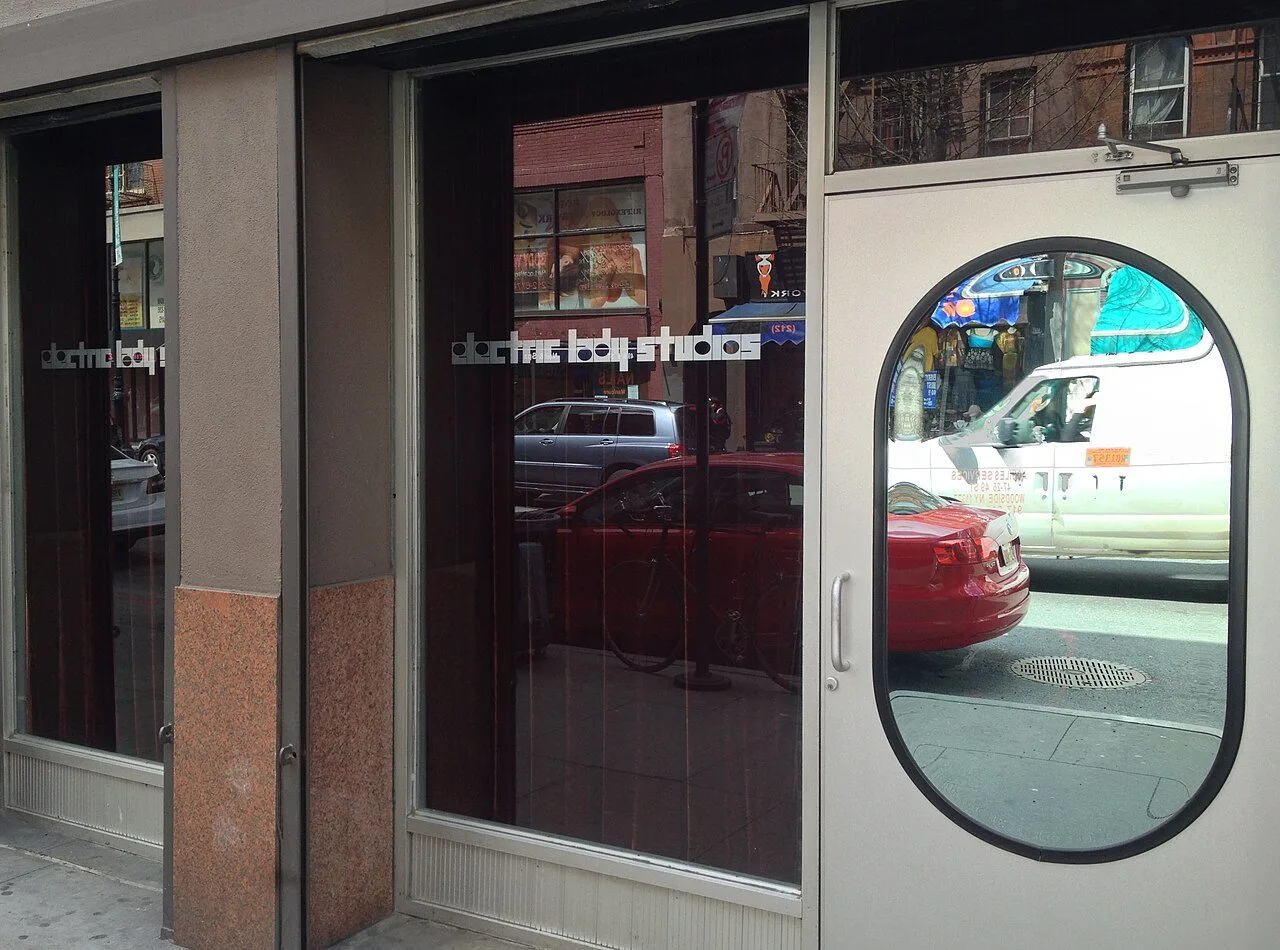
At 52 West Eighth Street, a stone’s throw from Washington Square, a door with an oval window looks like nothing special. Behind it hides one of the few studios a musician built for himself, to his own taste and quirks. Electric Lady Studios was Jimi Hendrix’s last big idea, and probably his most durable: the guitarist spent only a few weeks there before his death in September 1970, yet the place still records today.
From a Greenwich Village club to a studio
In 1968, Hendrix and his manager Michael Jeffery bought the Generation, a dying jazz club, planning to put artists on its stage. Engineer Eddie Kramer, the guitarist’s trusted sidekick, and manager Jim Marron talked them out of it: rather than one more club, a professional studio, built for Hendrix’s endless night sessions that were costing a fortune in New York rooms.
To design the place, Hendrix hired an unknown. John Storyk was in his early twenties, fresh out of Princeton, and had never designed a studio. Electric Lady would be his first, and the start of a whole career devoted to studio acoustics. Hendrix’s brief was short: as few right angles as possible, curved surfaces everywhere, theatrical lighting that could change colour, and a mood that soothes rather than intimidates.
A river under the floor
The build turned into a nightmare. Digging in, the crews found the building sat on a tributary of Minetta Creek, a buried stream that winds under Greenwich Village. Sump pumps had to go in, then be soundproofed so their hum would not bleed into takes. Time and budget nearly doubled, permits dragged, and a six-figure loan from Warner Brothers saved the project at the last minute. The final bill came close to a million dollars of the day, a sum that forced Hendrix to tour relentlessly to fund it.
The result broke with the sterile studios of the 1960s. Round windows, curved walls that break up standing waves without aggressive treatment, a space-themed mural painted across the surfaces, and an ambient-light machine that could flood the room with shifting colours. On the technical side, the original control room was built, per Eddie Kramer, around a Datamix console, probably 48-input, and an Ampex MM1000 tape machine wired for 24 tracks once a 24-head stack arrived. The room’s warm, curved sound owes as much to that architecture as to the gear.
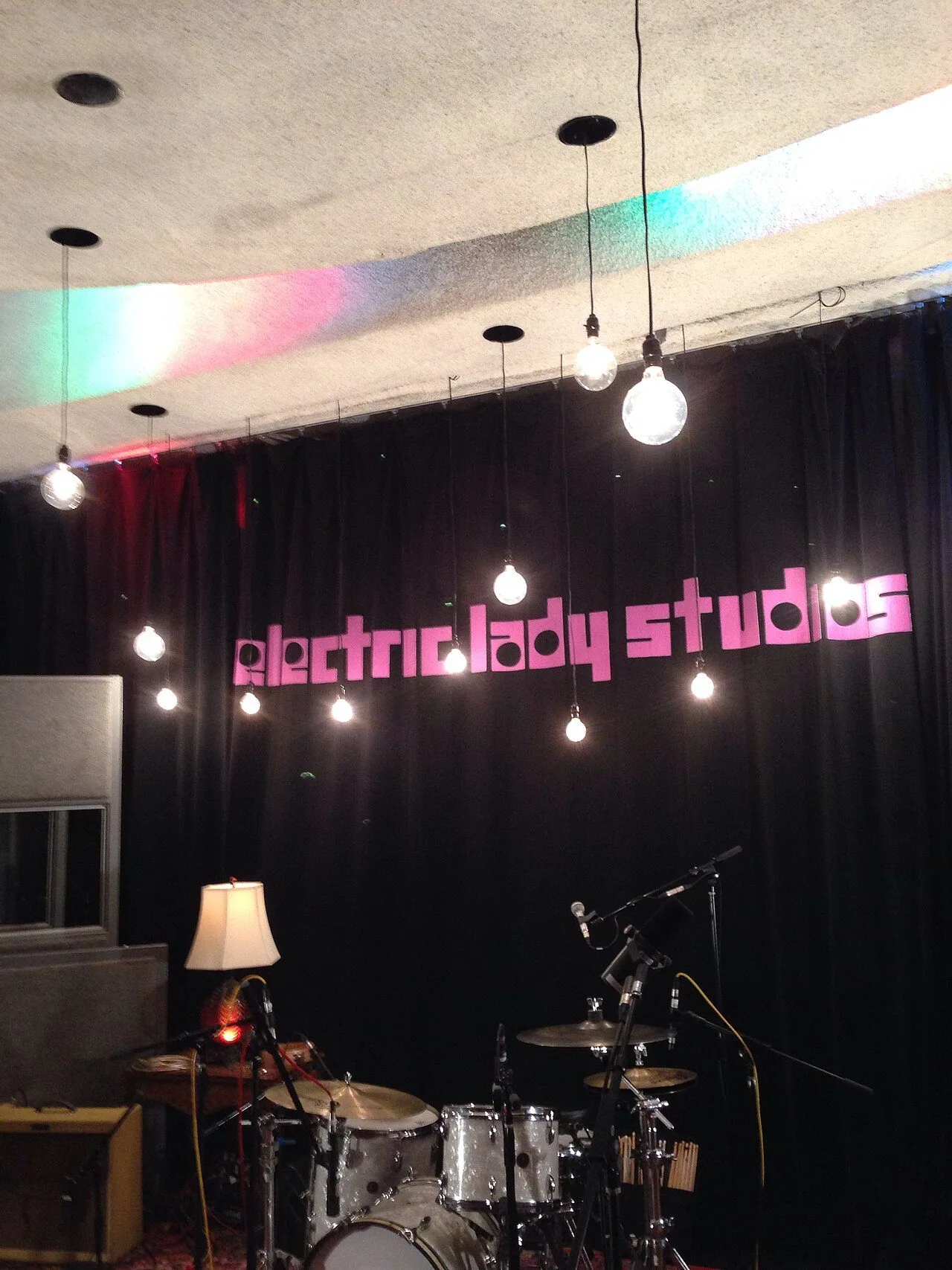
From Hendrix to the Soulquarians
The opening party took place on 26 August 1970. The next day, Hendrix recorded an instrumental, “Slow Blues”, his last studio session. A few days later he flew to Europe and died in London on 18 September. The studio he paid for outlived him and quickly became a top New York address.
Stevie Wonder spent long hours there in the early 1970s and shaped part of “Talking Book” in 1972. Patti Smith cut her debut album, “Horses”, there in 1975. That same year, David Bowie and John Lennon pieced together “Fame” for “Young Americans”. Chic recorded “Le Freak” there in 1978, Kiss cut “Dressed to Kill”. In the late 1990s, the Soulquarians collective took over the place and produced a wave of landmark albums: D’Angelo’s “Voodoo” in 2000, The Roots’ “Things Fall Apart”, Erykah Badu’s “Mama’s Gun”.
The curved studio in the 21st century
After years of financial trouble, investor Keith Stoltz and manager Lee Foster took over Electric Lady in 2010. They added a mixing studio on the second floor and turned the third into a self-contained unit with Studio C. The rooms filled with Neve and API consoles, and the client list stayed striking: Daft Punk’s “Random Access Memories” in 2013, several Taylor Swift albums, Adele, and the Rolling Stones laying down tracks for “Hackney Diamonds” with producer Andrew Watt in 2022.
What stands out is the continuity. Few historic studios cross the decades without losing their soul. Electric Lady manages it because its identity rests first on its architecture, not on a dated console model. Storyk’s curved walls still sound, whatever generation of gear plugs in. To gauge how much a room can stamp its mark on a record, think also of Hansa’s big room in Berlin and the sound of “Heroes”.
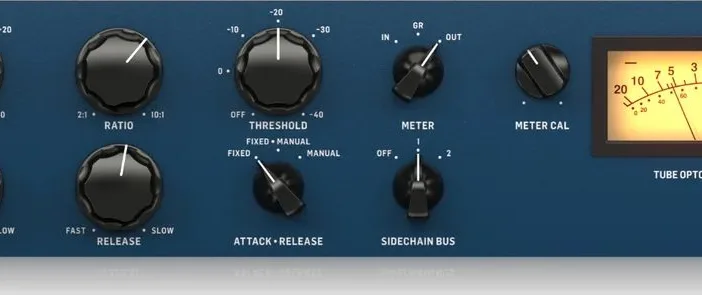
The rest of Electric Lady’s colour comes from the machines that ran between these walls: the grain of tape recorders, recreated today in plugin form as our guide to tape emulation explains, the 1980s digital reverb imposed by the Lexicon 480L, and the gentle optical compression of a Teletronix LA-2A. All tools that passed through these curved control rooms since 1970.
My take
Electric Lady is proof that a studio designed by an artist, for his own pleasure, can outlast a marketing temple. The stroke of genius was not the console, soon replaced, but the curved acoustics and the mood, two things no amount of new gear can copy. That one room hosted Hendrix, D’Angelo and Taylor Swift says plenty about what a well-drawn space brings to music. Next time a record seems to breathe, ask first which walls captured it.