


Yamaha DMP7
Yamaha's very first digital mixer: an 8-channel desk with motorized faders and recallable scenes (1987).
Original launch price (new) 448,000 JPY
Description
Technical
Specifications
Inputs / Outputs
| Total inputs | 8 |
|---|---|
| Mic inputs | 0 |
| Total outputs | 2 |
Processing
| Mix buses | 2 |
|---|---|
| Aux sends | 3 |
| DSP engine | Processeurs numériques Yamaha propriétaires (puces DEQ1) — traitement 24 bits sur le trajet signal, 32 bits dans la section EQ |
| Max sample rate | 44 kHz |
| Bit depth | 16 bits |
| Processing resolution | 24 bits |
| Configuration | Mélangeur numérique 8 voies vers 2 (bus stéréo), 100 % numérique |
| Galiseur | EQ paramétrique numérique 3 bandes par voie, ±15 dB, Q variable, réponses cloche ou plateau (bandes grave/aigu) |
| Effets Internes | 3 processeurs d'effets numériques ; départs 1 et 2 proposant 17 effets (reverb, gate reverb, delay, echo, flange, phasing, tremolo, symphonic, early reflections...) |
| Compresseur | Compresseur stéréo numérique intégré sur le bus stéréo |
Surface
| Physical faders | 10 |
|---|---|
| Motorized faders | Yes |
| Screens | 1 |
| Touchscreen | No |
Recording
| Onboard recording | No |
|---|
Networking
| Redundant PSU | No |
|---|---|
| Redundant networking | No |
Other
| Entr Es | 8 entrées ligne asymétriques au jack 6,35 mm, sans préampli micro (trims en face arrière) ; entrées micro possibles via l'ampli externe optionnel MLA7 |
|---|---|
| Sorties | Sortie stéréo au jack 6,35 mm et en XLR symétrique, plus sortie casque |
| Convertisseurs | Convertisseurs A/N et N/A 16 bits / 44,1 kHz dédiés à chaque entrée/sortie (qualité CD) |
| R Solution De Traitement | 24 bits sur le trajet général du signal, 32 bits dans la section égaliseur (source SoS 1992) |
| Plage Dynamique | 88 dB à l'origine, portée à 92 dB (env. 4 dB sous le CD) selon SoS 1992 |
| Faders Motoris S | 10 faders motorisés à commande numérique (8 voies + master + saisie de données) qui rejoignent physiquement les positions mémorisées |
| M Moires De Sc Nes | 30 scènes internes, extensibles à 97 avec la cartouche RAM4 optionnelle ; crossfade entre scènes jusqu'à 10 secondes |
| Midi | 3 prises DIN MIDI ; 206 paramètres pilotables ; rappel de scènes par program change ; bulk dump ; automation temps réel par note-on/contrôleurs |
| Cascade | Bus numérique de cascade permettant de chaîner jusqu'à 2 unités supplémentaires |
| Accessoires | Télécommande RTC1, ampli micro 8 canaux MLA7, pédale FC7 (options) |
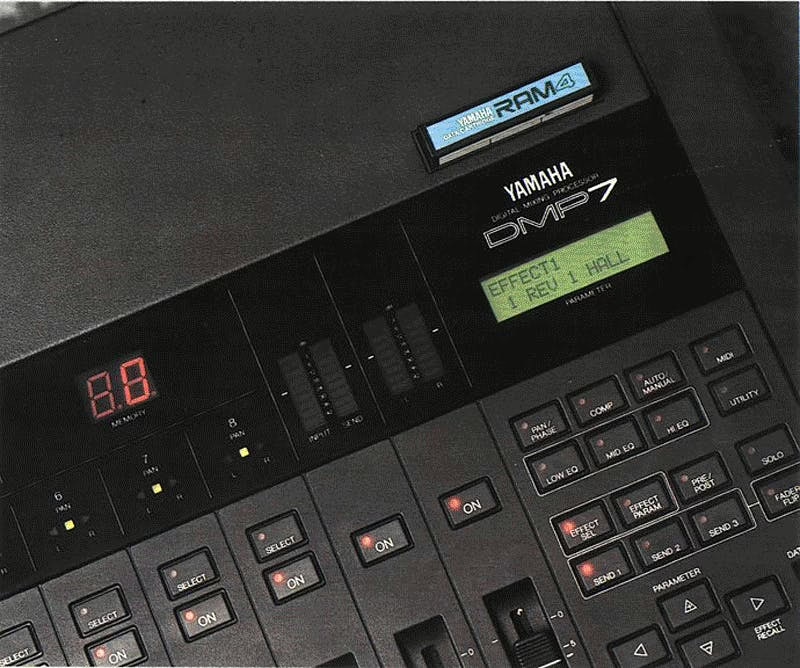
| Affichage | Écran LCD 16x2 caractères + afficheur LED 7 segments 2 chiffres pour le numéro de mémoire |
| Prix Uk Au Lancement | 2 999 £ TTC (Royaume-Uni, juillet 1987) ; 448 000 ¥ au Japon (mai 1987) |
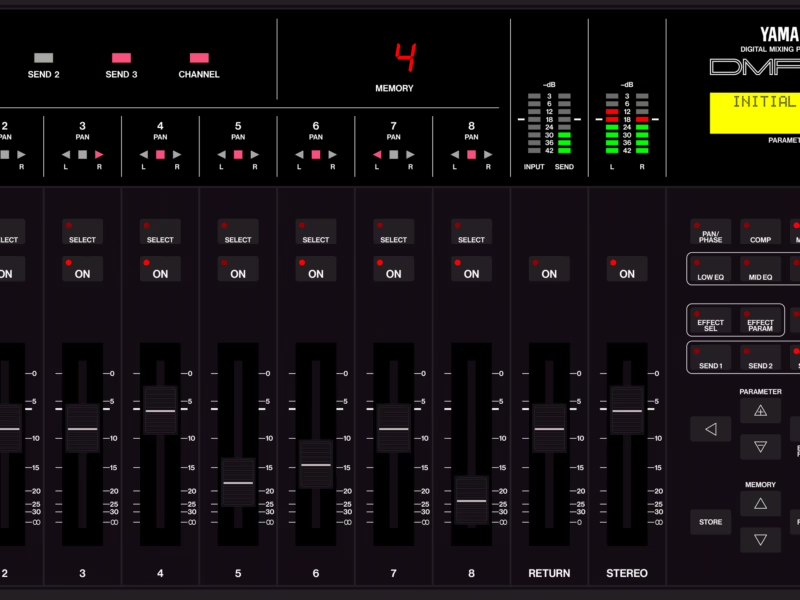
Strip & details
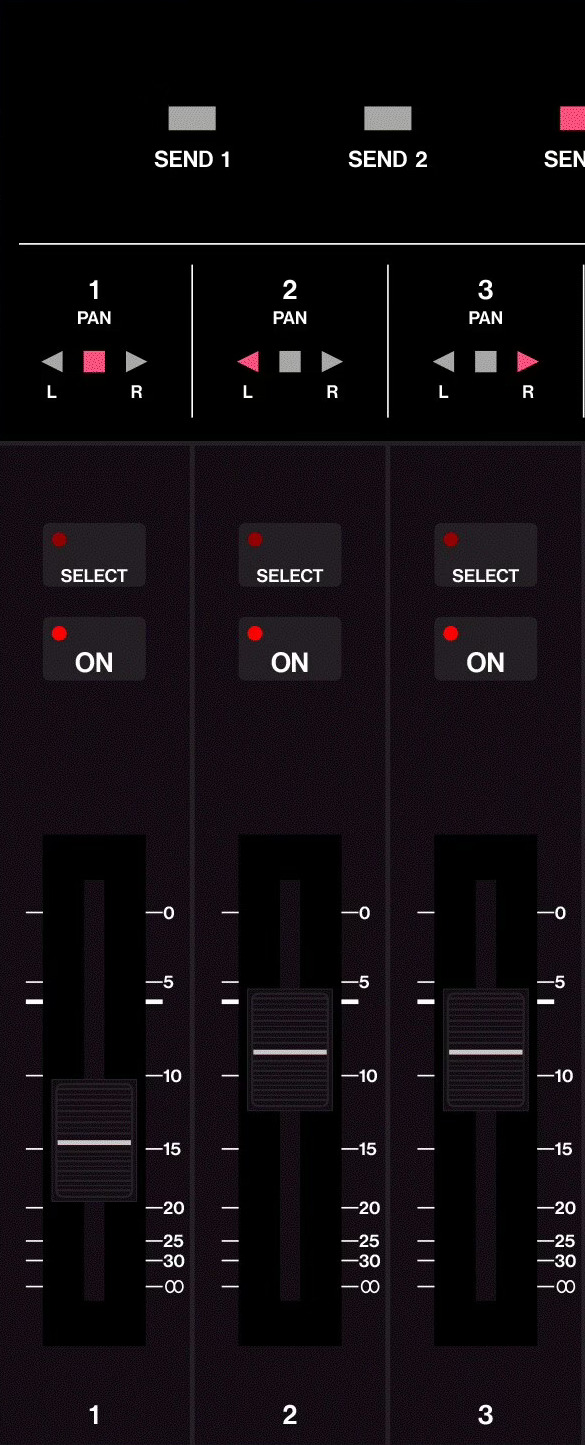
Rotate your phone to landscape for a better view of the strip.
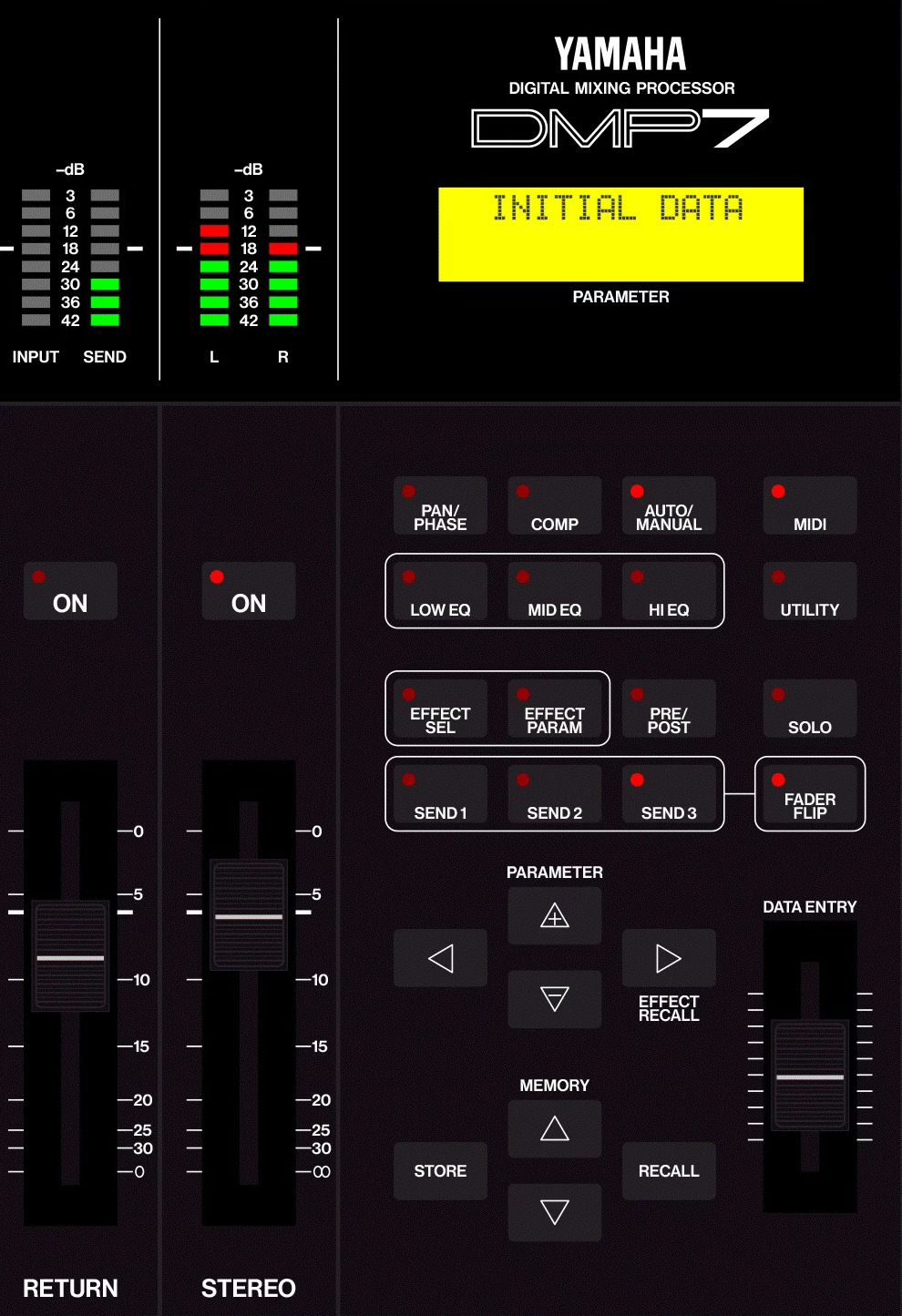
Rotate your phone to landscape for a better view of the strip.
Software
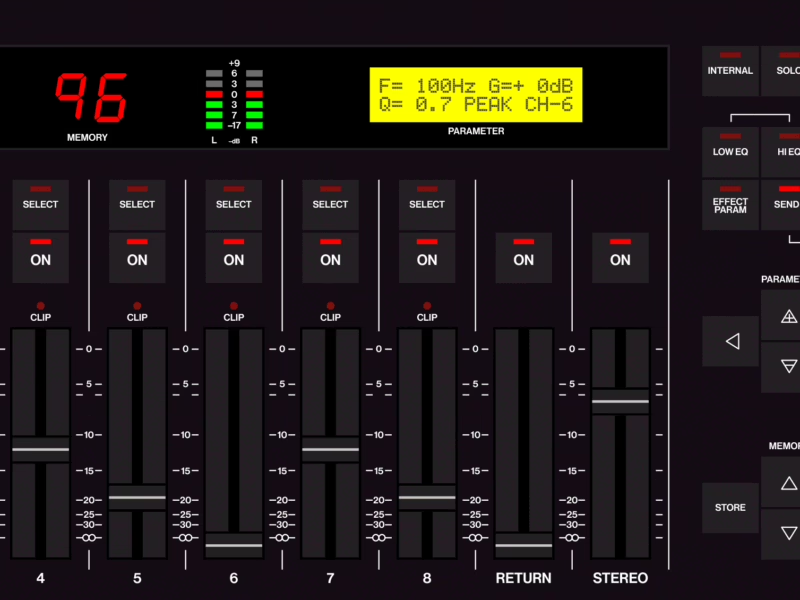
 Éditeur DMP7 pour Atari ST (Steinberg)
Accessories
Other
- Cartouche mémoire RAM4
RAM cartridge extending scene memories (up to 97).
- Télécommande RTC1
Dedicated remote control for the DMP range.
- Ampli micro externe MLA7
External 8-channel mic amplifier adding mic inputs to the DMP7.
Editorial & artists
Our take
History & design
Introduced in 1987, the Yamaha DMP7 (Digital Mixing Processor) was Yamaha's first digital console and one of the first digital mixers ever sold. Originally conceived as an on-stage submixer for synthesizers and digital tone generators (such as the DX7), it was later broadened to studio and PA use through outboard mic inputs and the optional MLA7 head amp.
Technically it is an 8-channel mixer feeding a stereo bus, entirely digital: each socket has its own 16-bit / 44.1 kHz converter (CD quality), with internal processing at 24-bit (32-bit in the EQ section). Every channel offers a 3-band digital parametric EQ (±15 dB), and the unit carries three effects processors (reverb, delay, flange, gate reverb, symphonic...) plus a stereo compressor on the main bus.
Its landmark innovation was automation: ten motorized faders physically move to stored positions, and 30 scenes (expandable to 97 via a RAM cartridge) store every parameter, with crossfades of up to 10 seconds. Its 206 parameters are MIDI-controllable, delivering in 1987 a level of total dynamic automation that even SSL's Total Recall could not match at the time. Steinberg was commissioned to write an Atari ST editor. The DMP7 was followed by the digital-I/O DMP7D (1988) and the entry-level DMP11.
Notable users
Links
- Manufacturer Yamaha Innovation Road — DMP7 yamaha.com
- Archive Yamaha Black Boxes — DMP7 (archive patrimoniale) yamahablackboxes.com
- Archive Yamaha Black Boxes — DMP7D (variante numérique) yamahablackboxes.com
- Press article Sound on Sound, juillet 1987 (David Mellor) — via mu:zines muzines.co.uk
- Press article Sound on Sound, décembre 1992 — Rediscovering the DMP7 (mu:zines) muzines.co.uk
- Press article Music Technology, février 1987 (mu:zines) muzines.co.uk
- Press article Front of House — Yamaha Celebrates 30 Years of Digital Mixers fohonline.com
- Forum Gearspace — Yamaha DMP7 gearspace.com
Related consoles
Some merchant links are affiliate links. Purchases may support Digital Mixing at no extra cost.
Documents are archived locally for preservation. Source credited. Takedown requests: [email protected]