


Description
Technical
Specifications
Inputs / Outputs
| Total inputs | 52 |
|---|---|
| Mic inputs | 48 |
| Mic preamps | 48 mic preamps; head-amp gain recall on the PM5D-RH |
| Expansion cards | 4 Mini-YGDAI slots |
Processing
| Mix buses | 24 |
|---|---|
| Matrices | 8 |
| DCA/VCA groups | 8 |
| DSP engine | Proprietary Yamaha 96 kHz DSP chip — 32-bit processing, 58-bit accumulator |
| Max sample rate | 96 kHz |
| Bit depth | 24 bits |
| Processing resolution | 32 bits |
| Channels | 48 mono + 4 stereo channels (expandable to 96 + 8 with the DSP5D) |
| Buses | 24 MIX buses configurable as groups or auxes, 2 stereo outputs + mono |
| EQ | 4-band parametric EQ per channel + 12 31-band graphic EQs |
| Dynamics | Compressor and gate/expander per channel |
| Effects and plug-ins | 8 internal multi-effect processors, including VCM (Virtual Circuitry Modeling) effects |
| Modularity and expansion | Expandable with the DSP5D system (up to 96 mono + 8 stereo channels) |
Surface
| Motorized faders | Yes |
|---|---|
| Screens | 1 |
| Touchscreen | No |
| Scenes and recall | 500 scene memories |
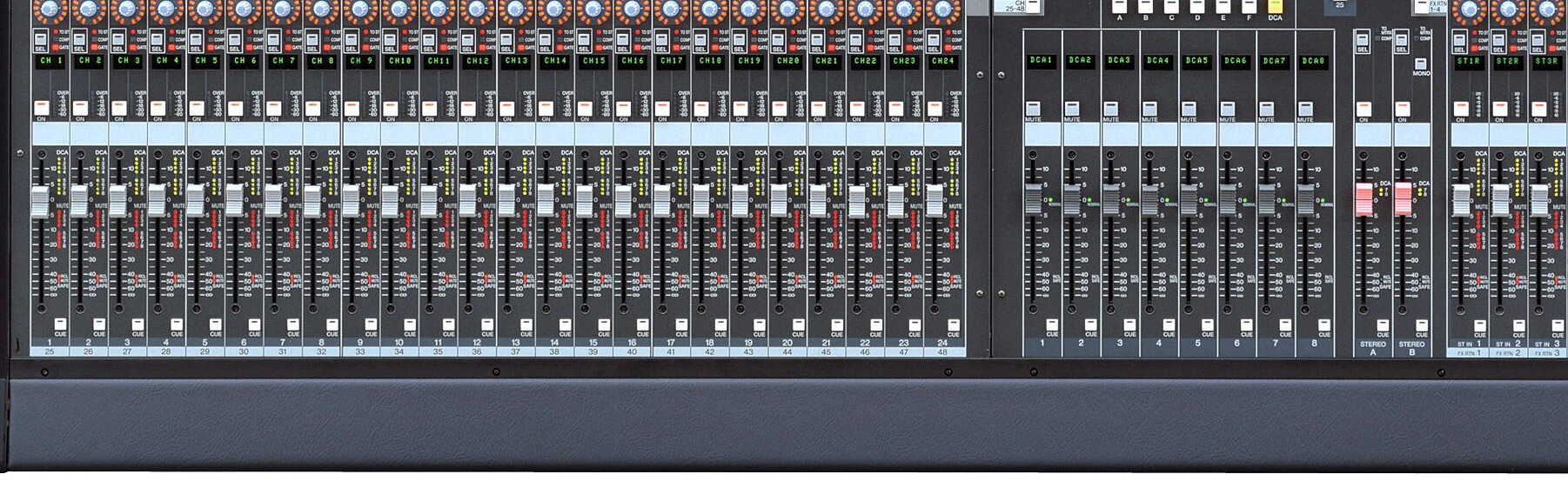
| Faders | 100 mm motorised faders: 24 channels (CH1-24 / CH25-48 layers), 8 DCA, stereo/mono and ST IN sections |
| Layers | CH1-24 and CH25-48 fader layers |
| Screens — details | Central backlit graphic LCD |
Recording
| Onboard recording | No |
|---|
Networking
| Networking & protocols | AES/EBU / MADI / ADAT |
|---|---|
| Redundant PSU | Optional |
| Audio networking | Digital cascade and Mini-YGDAI card expansion (AES/EBU, MADI, ADAT) |
Physical
| Width | 1,551 mm |
|---|---|
| Depth | 950 mm |
| Height | 283 mm |
| Weight | 97 kg |
Power
| Power draw | 300 W |
|---|---|
| Power supply | Internal AC supply + external PW800W unit (redundancy possible) |
Other
| Applications | Live sound, touring, festivals, broadcast |
|---|---|
| Lineage | First digital live console in the PM series; offered as PM5D-RH and PM5D-EX (DSP5D); replaced by the CL/QL then Rivage PM |
Strip & details
Rotate your phone to landscape for a better view of the strip.
Rotate your phone to landscape for a better view of the strip.

Rotate your phone to landscape for a better view of the strip.
Diagrams
Rotate your phone to landscape for a better view of the diagram.
Software
- Studio Manager / PM5D EditorOffline and online editing and control application for the PM5D, within Yamaha's Studio Manager environment.Download
Accessories
Power supply
- PW800W
External power supply for the PM5D, allowing redundant operation.
Other
- DSP5D
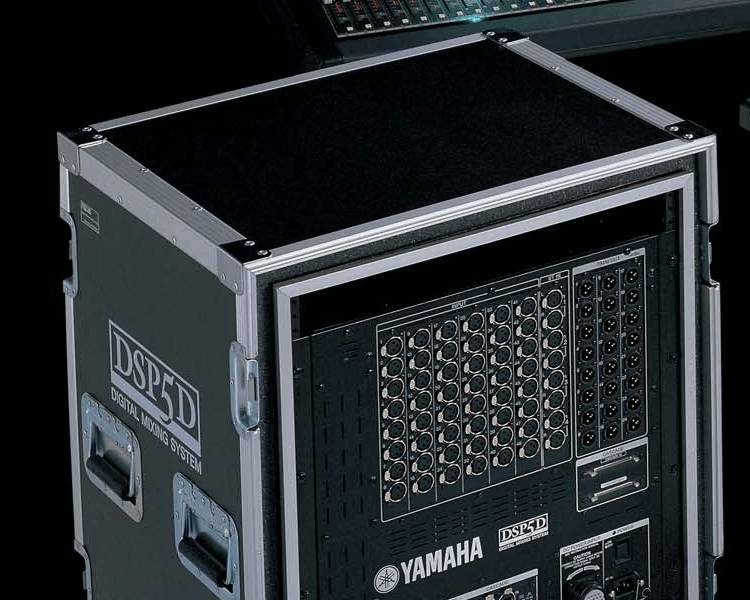
Rack-mountable DSP expander taking the PM5D up to 96 mono + 8 stereo channels.
Documents
Editorial & artists
Our take
History & design
The Yamaha PM5D is a digital live-sound mixing console introduced in 2004, the first digital machine to carry Yamaha's prestigious PM (Professional Mixer) name. It handles 48 mono and 4 stereo channels at 96 kHz, with 24 MIX buses configurable as groups or auxes, 8 matrix outputs, two stereo outputs and a mono output.
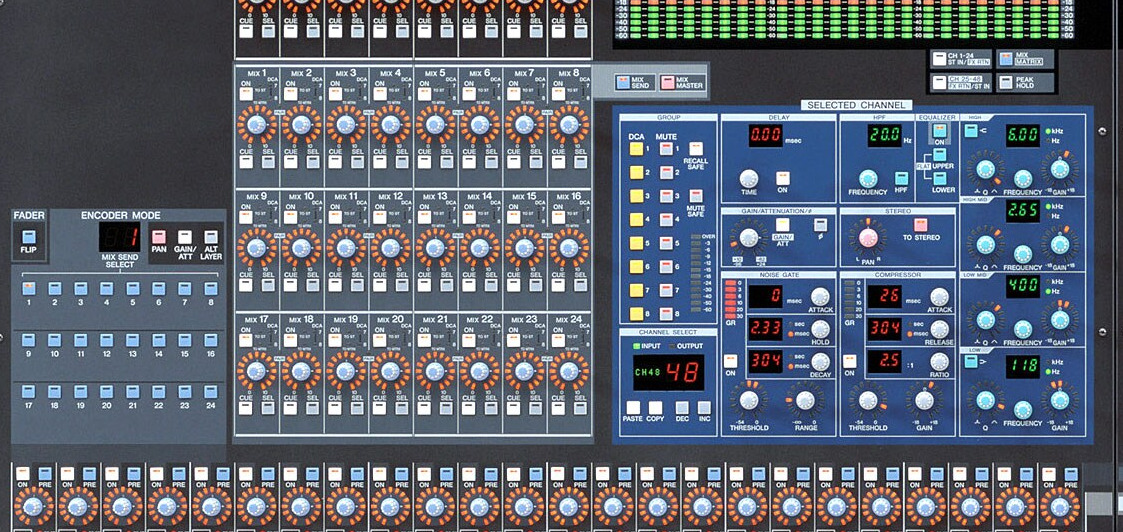
The control surface keeps a near-analog philosophy: a large number of 100 mm motorised faders (24 channels across two layers CH1-24 / CH25-48, 8 DCAs, stereo and ST IN sections) and a full Selected Channel section giving direct access to the EQ, dynamics and gate of the chosen channel. Processing includes a four-band parametric EQ per channel, twelve 31-band graphic EQs, eight multi-effect processors and Yamaha's VCM (Virtual Circuitry Modeling) effects. Up to 500 scenes can be stored.
Connectivity relies on four Mini-YGDAI slots and a digital cascade link; power comes from an external PW800W supply. The PM5D was offered in a PM5D-RH version (mic-preamp recall) and can be expanded with the DSP5D system (up to 96 mono + 8 stereo channels). It preceded the CL and QL series and the flagship Rivage PM range.
Links
Related consoles
Some merchant links are affiliate links. Purchases may support Digital Mixing at no extra cost.
Documents are archived locally for preservation. Source credited. Takedown requests: [email protected]