


Yamaha DSP5D
Rackmount digital mixing system — the PM5D-RH engine without a surface, standalone or cascaded (Japan, 2005)
Description
Technical
Specifications
Inputs / Outputs
| Total inputs | 48 |
|---|
Processing
| Mix buses | 24 |
|---|---|
| Matrices | 8 |
| DSP engine | DSP engine identical to the PM5D-RH (recallable preamps), without control surface |
| Max sample rate | 96 kHz |
| Bit depth | 24 bits |
| Architecture | Rackmount digital mixing system: effectively the electronics of the PM5D-RH (recallable head amps) without a control surface. It is operated from a computer (DSP5D Editor software) and works either standalone or cascaded with a PM5D console. |
| Channels | 48 mono inputs + 4 stereo inputs, 24 Mix buses, 8 Matrix buses and 24 Omni outputs. |
| Channel processing | Full channel functionality (gain, EQ and filters, dynamics, sends), 8 effect processors and 12 graphic equalizers. |
| Modularity and expansion | 2 Mini-YGDAI expansion slots (vs 4 on the PM5D) accepting a wide range of analog and digital I/O cards, plus CobraNet and EtherSound networking. · Cascaded: PM5D + 1 DSP5D = 4 input fader layers, i.e. 96 mono and 8 stereo channels; PM5D + 2 DSP5D = 6 layers, i.e. 144 mono and 24 stereo channels, with DSP power doubled then tripled. |
Surface
| Physical faders | 0 |
|---|---|
| Motorized faders | No |
| Touchscreen | No |
Recording
| Onboard recording | No |
|---|
Networking
| Networking & protocols | EtherSound / AES/EBU / ADAT / Network |
|---|---|
| Redundant PSU | No |
| Redundant networking | No |
| Audio networking | The DCU5D Digital Cabling Unit lets the DSP5D be located up to 120 m from the PM5D via a single Cat-5 cable, converting the PM5D cascade signals to and from Cat-5 audio (remote stage-box function). |
Strip & details
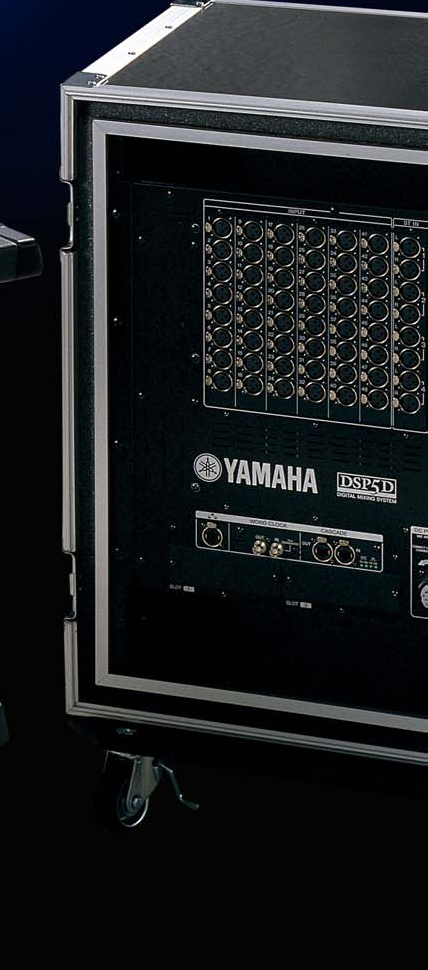
Rotate your phone to landscape for a better view of the strip.
Software
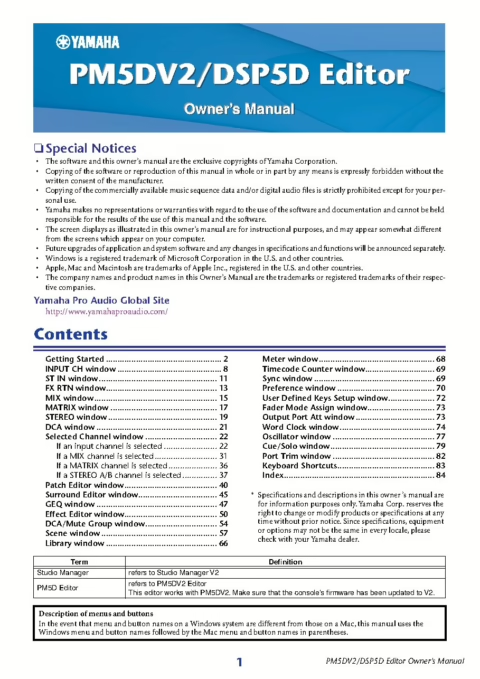
- DSP5D EditorSoftware to control and edit the DSP5D from a computer (part of Yamaha's Studio Manager environment): since the DSP5D has no surface, this editor is its primary means of control.
Accessories
Other
- DCU5D Digital Cabling Unit
Digital cabling unit that locates the DSP5D up to 120 m from the PM5D over a single Cat-5 cable, converting the cascade signals to Cat-5 audio.
Documents
Editorial & artists
Our take
History & design
Launched by Yamaha in 2005, the DSP5D is a rackmount digital mixing system conceived as the companion to the PM5D console. Its nature is clear: it is, essentially, the electronics of the PM5D-RH (with its recallable head amps) without a control surface. It is therefore operated from a computer, via the DSP5D Editor software, and can run standalone or cascaded with a PM5D.
Its resources mirror the bigger console's: 48 mono inputs and 4 stereo inputs, 24 Mix buses, 8 Matrix buses, 24 Omni outputs, full channel functionality (gain, EQ and filters, dynamics, sends), 8 effect processors and 12 graphic equalizers. Expansion is via 2 Mini-YGDAI slots (vs 4 on the PM5D), opening the door to analog/digital I/O cards and to CobraNet and EtherSound networking.
The whole point lies in cascading. A PM5D paired with one DSP5D gives 4 input fader layers, i.e. 96 mono and 8 stereo channels; with two DSP5D units you reach 6 layers, 144 mono and 24 stereo channels, processing power doubled then tripled. For remote configurations, the DCU5D Digital Cabling Unit places the DSP5D up to 120 metres from the console over a single Cat-5 cable, effectively turning it into a remote processing stage box.
Links
Related consoles
Some merchant links are affiliate links. Purchases may support Digital Mixing at no extra cost.
Documents are archived locally for preservation. Source credited. Takedown requests: [email protected]