


Studer OnAir 3000
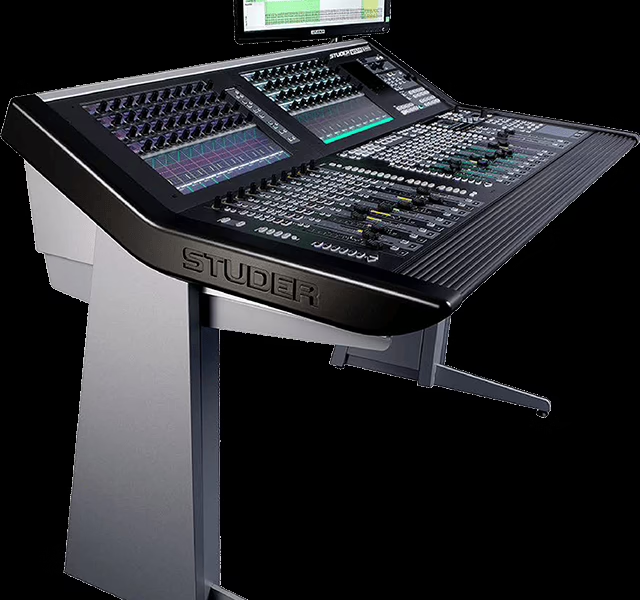
Fully modular digital radio broadcast console, up to 48 faders, “Touch-n-Action” philosophy (Switzerland, 2000)
Description
Technical
Specifications
Inputs / Outputs
| Inputs / outputs | I/O via the modular Studer D21m system: MADI, AES/EBU and optional cards (including Dante and Dolby E), full 96 kHz operation. |
|---|
Processing
| DSP engine | New Studer DSP engine, D21m modular I/O system (96 kHz operation) |
|---|---|
| Max sample rate | 96 kHz |
| Bit depth | 24 bits |
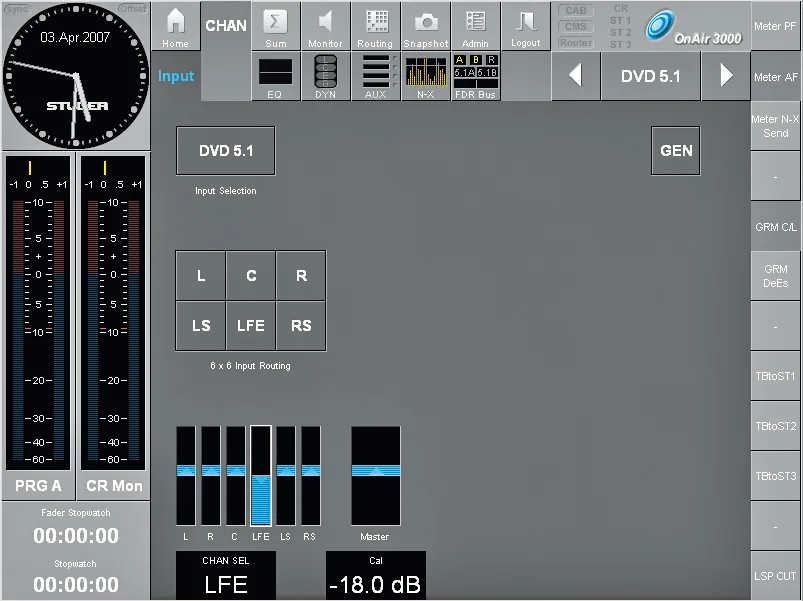
| Architecture | Fully modular desk paired with a new DSP engine. Ergonomics carry over the patented “Touch-n-Action” philosophy of the OnAir 2000, with colour GUI screens. |
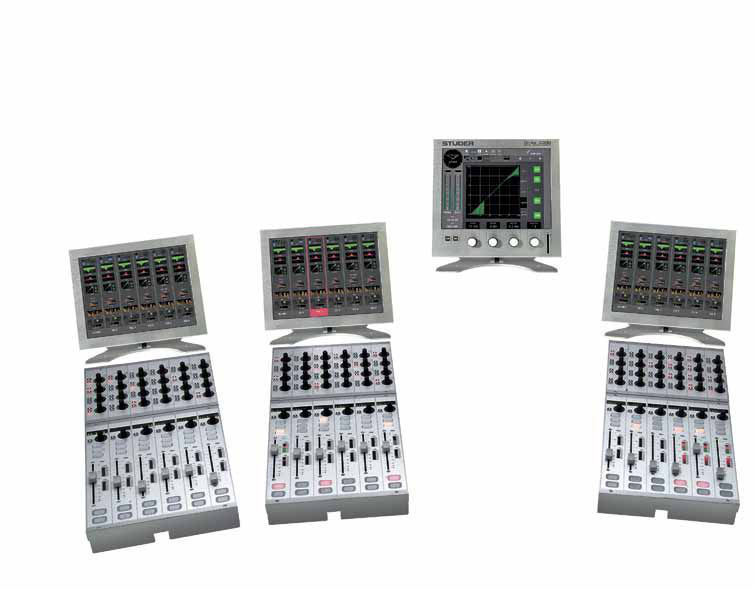
| Modularity and expansion | Available modules: fader, motorized fader, fader-assign, monitoring and talkback, main screen and fader-screen modules. Layouts range from a comprehensive engineer-operated continuity desk to a single fader panel for DJ/newsroom use, up to a PC-operated system with no physical controls. |
Surface
| Motorized faders | Yes |
|---|---|
| Touchscreen | No |
| Faders | Fader module = 6 strips; up to 8 modules, i.e. a maximum size of 48 faders. Each strip: a 100 mm fader, 4 large illuminated configurable buttons with replaceable labels and 12 small illuminated buttons, plus 2 LEDs (overload in red, active fader-start in blue). |
Recording
| Onboard recording | No |
|---|
Networking
| Networking & protocols | MADI / Dante / AES/EBU |
|---|---|
| Redundant PSU | No |
| Redundant networking | No |
Other
| Applications | Positioned in the medium-to-upper radio market segment (private stations and public networks). Studer announced the 1,000th OnAir 3000 sold. |
|---|
Strip & details
Rotate your phone to landscape for a better view of the strip.
Software
Other screenshots
Documents
Editorial & artists
Our take
History & design
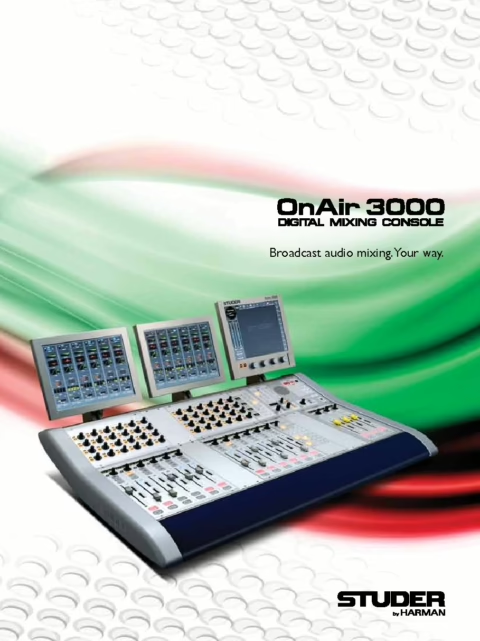
Launched by Studer at the turn of the 2000s, the OnAir 3000 is a digital console aimed at the medium-to-upper radio market — both private stations and public-service networks. Its design rests on a fully modular desk and a new DSP engine, while the ergonomics extend the patented “Touch-n-Action” philosophy of the hugely popular OnAir 2000, based on colour GUI screens.
Modularity is the watchword. The fader module groups six strips; up to eight modules can be fitted, taking the console to a maximum of 48 faders. Each strip has a 100 mm fader, four large illuminated configurable buttons with replaceable labels, twelve small illuminated buttons and two LEDs (overload in red, active fader-start in blue). The module catalogue includes faders, motorized faders, fader-assign, monitoring and talkback, main screen and fader-screen modules. Layouts thus range from a full engineer-operated continuity desk to a single fader panel for a DJ studio or newsroom, up to a fully PC-operated system with no physical controls.
On the audio side, the OnAir 3000 relies on the modular Studer D21m I/O system — MADI, AES/EBU and optional cards (Dante, Dolby E decoding) — with full-resolution 96 kHz operation. The console won over major broadcasters: the BBC (with one of its largest Studer deployments), Rede Globo in Brazil, Danmarks Radio, Turkey's TRT and Egypt's ERTU, with Studer announcing the 1,000th unit sold.
Notable users
- BBC
One of the largest deployments of Studer OnAir 3000 consoles.
- Rede Globo
Brazilian broadcaster equipped with OnAir 3000.
- Danmarks Radio (DR)
Danish public broadcaster using the OnAir 3000.
- TRT
Turkish public radio and television broadcaster using the OnAir 3000.
- ERTU
Egyptian public broadcaster using the OnAir 3000.
Links
Related consoles
Some merchant links are affiliate links. Purchases may support Digital Mixing at no extra cost.
Documents are archived locally for preservation. Source credited. Takedown requests: [email protected]