


Description
Technical
Specifications
Processing
| Architecture | 'SARP' principle: digital control of a rack-based audio path, settings shown on a video monitor |
|---|---|
| Channels | Channel/bus count not confirmed — to be verified |
Surface
| Touchscreen | No |
|---|---|
| Ergonomics | Assignable console with centralised functions; commands reduced to three types (On, Off, Variable) |
| Scenes and recall | Fast configuration from power-up (rough mix on faders + auxiliaries + basic EQ within minutes) |
| Screens | Video monitor showing animated knobs/switches with colour-coded status |
Recording
| Onboard recording | No |
|---|
Networking
| Redundant PSU | No |
|---|---|
| Redundant networking | No |
Documents
Editorial & artists
Our take
History & design
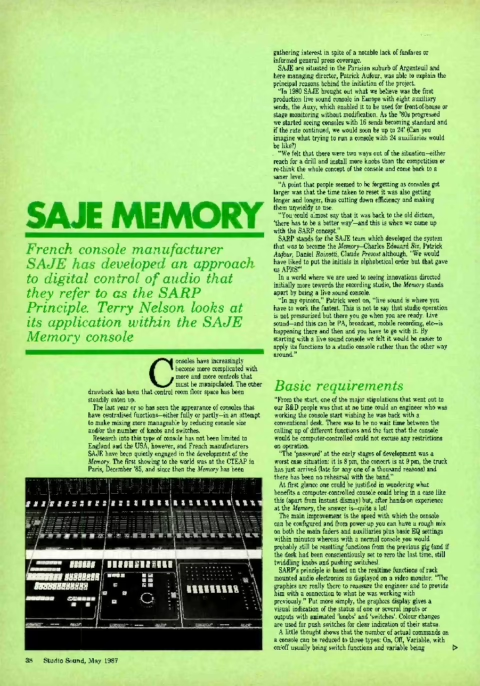
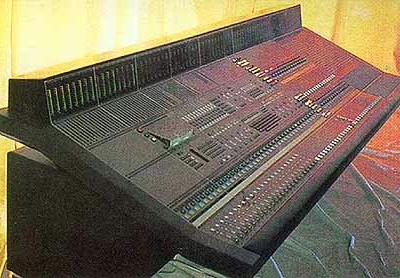
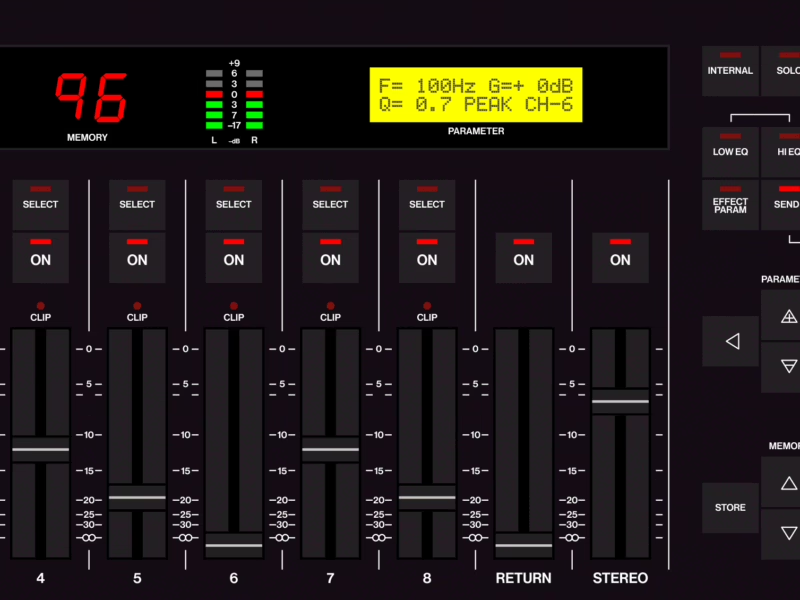
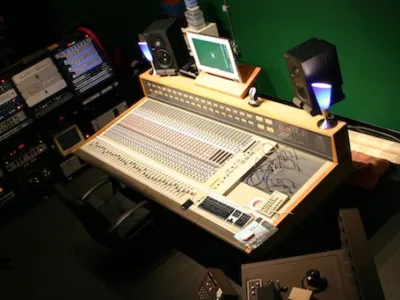
The SAJE Memory is a French computer-controlled live-sound console unveiled at the CTEAP show in Paris in December 1985. It relies on an in-house principle called 'SARP', which applies digital control to a signal path handled by rack-mounted audio electronics: settings are shown on a video monitor as animated 'knobs' and 'switches', with colour coding indicating switch status.
The idea grew from an observation: as consoles grew larger (8, then 16, and soon 24 auxiliaries), they became bulky and slow to reconfigure. Rather than adding ever more knobs, SAJE centralised functions and reduced commands to three fundamental types: On, Off and Variable. The main benefit is configuration speed: from power-up, an engineer can get a rough mix on the main faders and auxiliaries, with basic EQ, within minutes.
SAJE deliberately designed the Memory as a live console (PA, broadcast, mobile recording), reasoning that a live desk demanding in speed would then be easier to adapt to the studio than the other way around. Low-profile and little covered by the press of its day, the Memory nonetheless remains a French pioneer of the assignable, graphic-display console concept.
- Patrick Aufour — SAJE managing director / designer (SARP team)
Links
Related consoles
Some merchant links are affiliate links. Purchases may support Digital Mixing at no extra cost.
Documents are archived locally for preservation. Source credited. Takedown requests: [email protected]