


Description
Technical
Specifications
Inputs / Outputs
| Total inputs | 253 |
|---|---|
| Mic inputs | 12 |
| Total outputs | 12 |
Processing
| Mix buses | 128 |
|---|---|
| Matrices | 1 |
| DCA/VCA groups | 36 |
| DSP engine | Stealth Digital Processing (Super FPGA + DSP TigerSHARC), double moteur |
| Max sample rate | 65,535 kHz |
| Bit depth | 24 bits |
| Processing resolution | 40 bits |
Surface
| Physical faders | 52 |
|---|---|
| Motorized faders | Yes |
| Screens | 3 |
| Touchscreen | Yes |
Recording
| Onboard recording | No |
|---|
Networking
| Networking & protocols | MADI / Optocore / Dante / SoundGrid / AES/EBU |
|---|---|
| Redundant PSU | Yes |
| Redundant networking | Yes |
Physical
| Width | 1,496 mm |
|---|---|
| Depth | 875 mm |
| Height | 503 mm |
| Weight | 141 kg |
Power
| Power draw | 600 W |
|---|
Other
| Canaux Entree | 253 canaux d'entrée en traitement complet |
|---|---|
| Chemins Traitement | 256 chemins de traitement, disponibles indifféremment à 48 kHz et 96 kHz |
| Bus Mixage | 128 bus aux / sous-groupes configurables, plus bus master (LR/LCR/5.1) |
| Matrice | Matrice 32 x 32 à traitement complet |
| Groupes Controle | 36 groupes de contrôle (VCA / faders / mute groups) |
| Eq Canal | EQ paramétrique 4 bandes sur les entrées (8 bandes sur les sorties), filtres coupe-haut/bas 24 dB/octave, EQ dynamique, DiGiTuBe, delay de canal, double point d'insert, DYN 1 et DYN 2 |
| Effets | 48 effets stéréo internes et 32 EQ graphiques 32 bandes gangables |
| Surface | 52 faders motorisés 100 mm (3 bancs de 12 sous écrans + 16 faders assignables au centre) |
| Ecrans | 3 écrans tactiles LCD 15" et 3 bandeaux de bargraphs LCD |
| Io Local | E/S locales : 12 entrées analogiques, 12 sorties analogiques, 12 AES mono |
| Reseau | 4 ports MADI redondants par moteur + une boucle Optocore standard (jusqu'à ~1 392 connexions I/O sur une seule boucle optique) |
| Conversion | Conversion A/N et N/A 24 bits, traitement interne en virgule flottante jusqu'à 40 bits |
| Redondance | Double moteur amovible et alimentations redondantes remplaçables à chaud (90-260 V, 600 VA) |
| Latence | Latence de traitement typique ~2 ms à 48 kHz (env. 1,1 ms à 96 kHz) |
| Encombrement | 1 496 x 875 x 503 mm, 141 kg (245 kg en flightcase) |
Strip & details
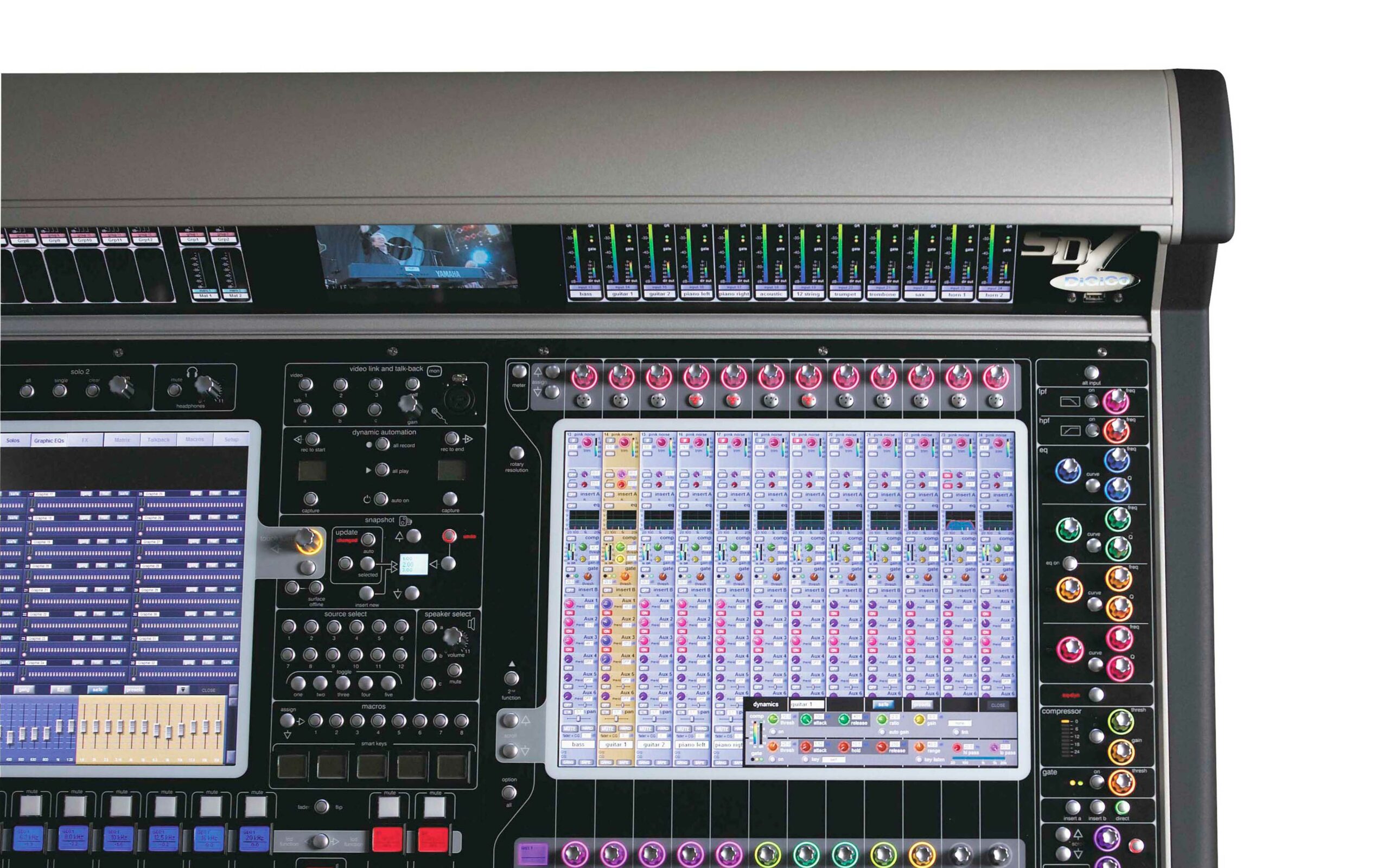
Rotate your phone to landscape for a better view of the strip.
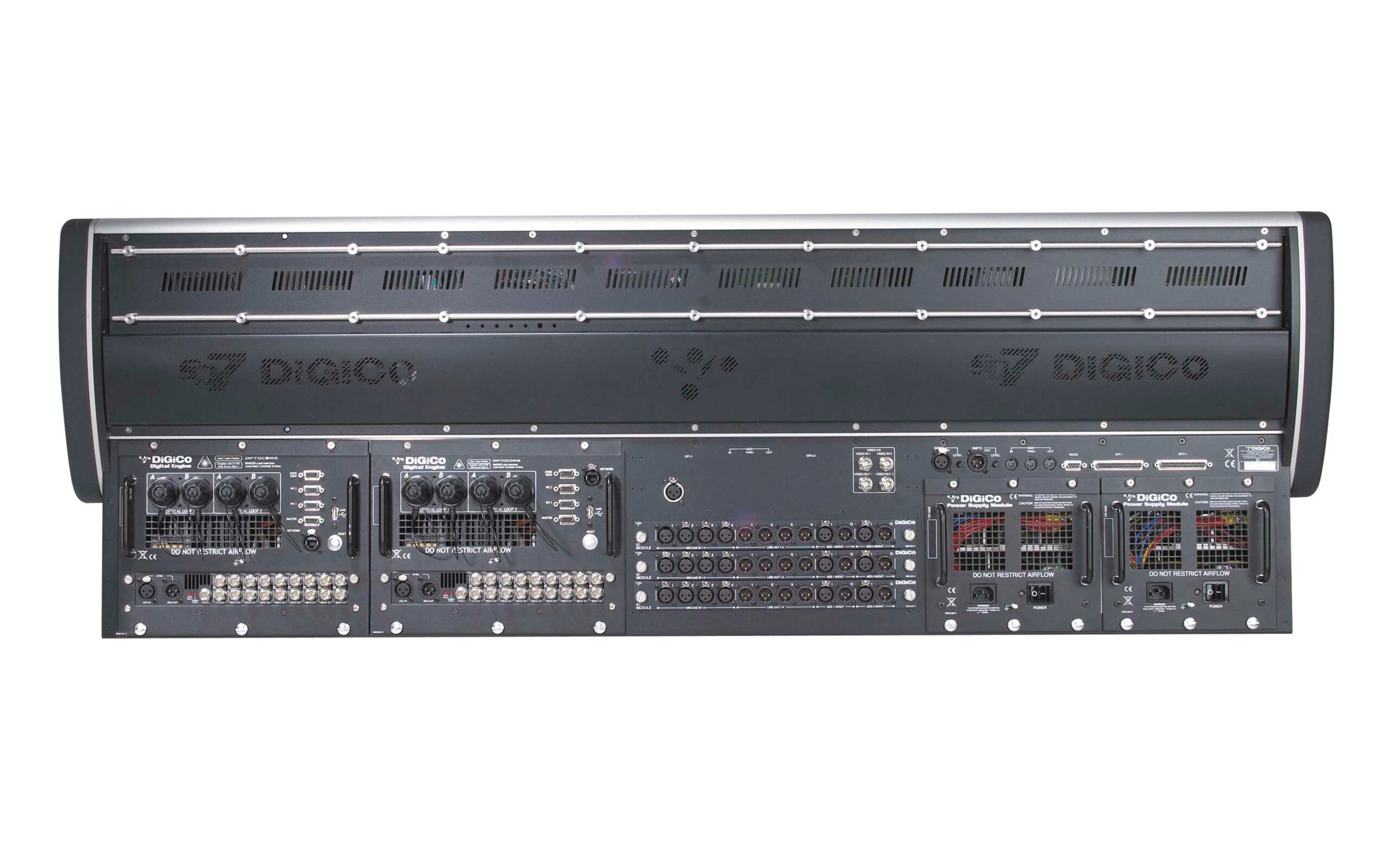
Rotate your phone to landscape for a better view of the strip.
Software
- DiGiCo SD7 Offline SoftwareOffline editor/simulator to prepare and save SD7 sessions on a PC ahead of the show.
- Firmware SD7 (Stealth Core / Core 2)Firmware updates for the Stealth platform, including the Stealth Core 2 upgrade delivering more processing power.
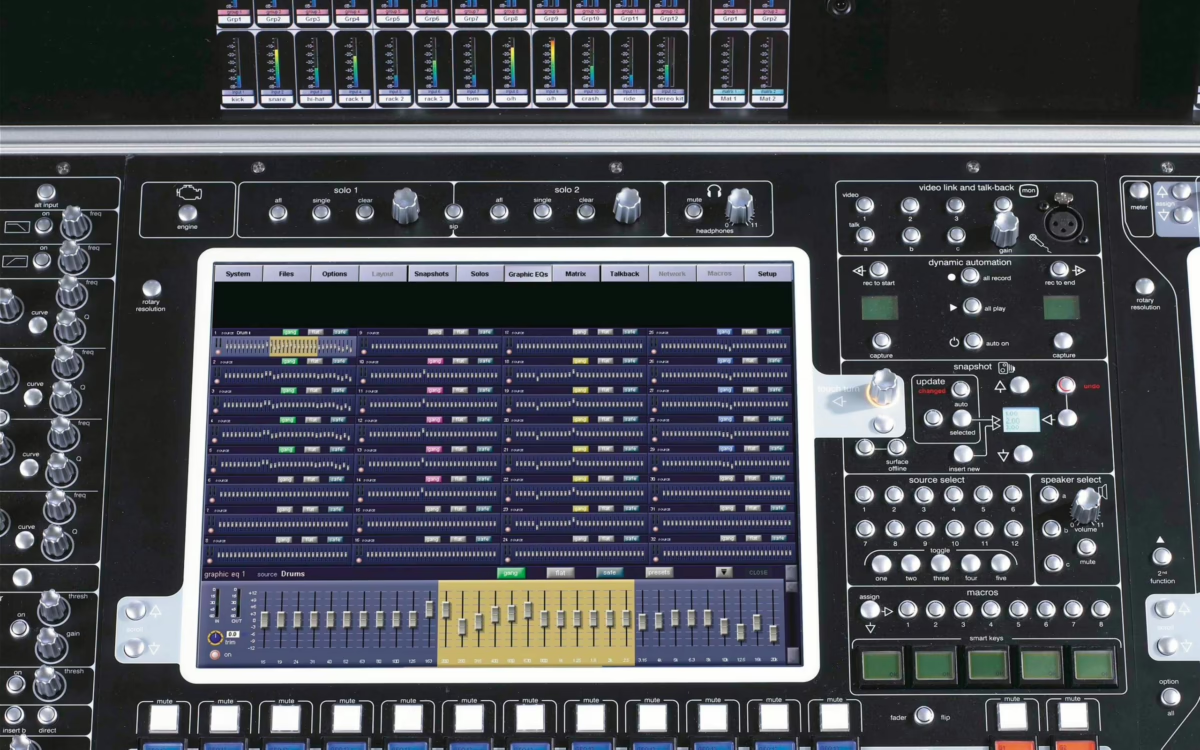
Other screenshots
Accessories
Stagebox / rack
- DiGiCo SD-Rack
Main stage rack for the SD consoles, remote analogue preamps over Optocore/fibre.
- SD-MiNi Rack / SD-Nano Rack
Compact SD-range stage racks for lighter configurations.
I/O card
- Cartes DMI (Waves SoundGrid, Dante, MADI)
Optional interface cards adding networking and plugin integration (Waves SoundGrid, Dante).
Flight case
- Flightcase SD7
Dedicated touring flightcase (approx. 1,600 x 600 x 1,240 mm, ~245 kg with the console).
Documents
Editorial & artists
Our take
History & design
The SD7 topped DiGiCo's SD range at its 2008 launch. It brought the Stealth Digital Processing engine to large scale, using Super FPGA components backed by TigerSHARC DSPs in a dual-engine architecture for redundancy. It handles 253 input channels, 128 aux/sub-group buses, a 32 x 32 matrix, 36 control groups, 48 stereo effects and 32 32-band graphic EQs, identically at 48 or 96 kHz.
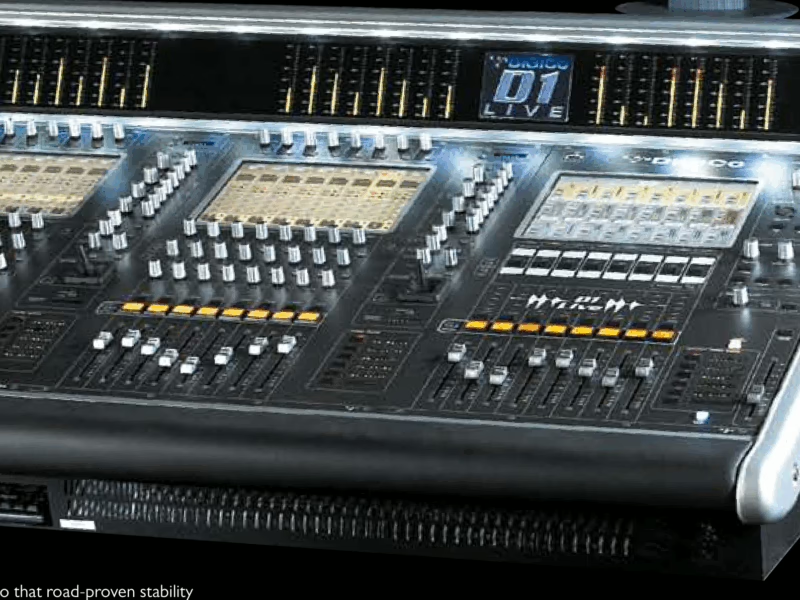
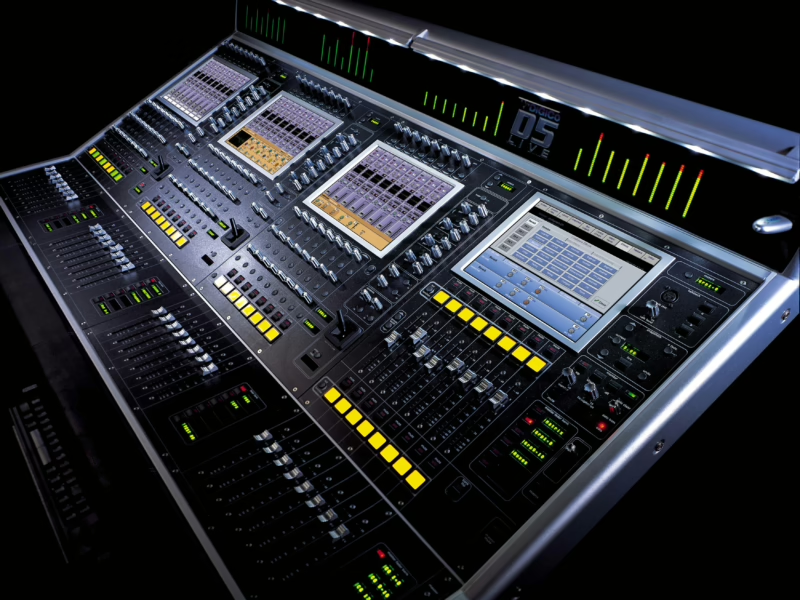
The work surface is arranged around three 15" touchscreens, each above a bank of 12 faders, plus 16 assignable faders in the centre, for a total of 52 motorized 100 mm faders. Local I/O (12 analogue inputs and outputs, 12 AES) is complemented by four redundant MADI ports per engine and an Optocore loop, allowing preamps to sit in remote SD-Racks over fibre — up to nearly 1,400 I/O connections on a single loop.
Designed for mission-critical reliability, the SD7 relies on redundancy at every stage: dual removable engine, hot-swappable PSUs, doubled MADI and Optocore. Compatible with the Waves ecosystem (SoundGrid) and with Dante via expansion cards, it fits into every touring infrastructure.
The brand's long-standing flagship, the SD7 was later carried forward and modernised by the Quantum range (Quantum7), which keeps the same ergonomics on an updated FPGA platform.
- James Gordon — Managing Director / dirigeant DiGiCo (gamme SD)
Notable users
- U2 (360° Tour, Joe O'Herlihy)
L'ingénieur façade historique de U2, Joe O'Herlihy, retient la SD7 pour le 360° Tour, avec une console à la façade et deux aux retours pour The Edge et Bono. À confirmer sur source primaire dédiée.
- Coldplay (Dan Green, FOH)
L'ingénieur façade Dan Green mixe Coldplay sur SD7 depuis la tournée Viva la Vida (2011), puis sur les tournées suivantes (Head Full of Dreams, Music of the Spheres), la SD7 étant décrite comme la seule console retenue pour le groupe.
- Pink (Beautiful Trauma World Tour)
Des consoles DiGiCo SD7 gèrent plus de 120 canaux à la façade et aux retours sur le Beautiful Trauma World Tour.
Links
- Manufacturer Page produit officielle DiGiCo SD7 digico.biz
- Manufacturer Fiche technique / data sheet officielle SD7 (PDF) digico.biz
- Archive DiGiCo — Wikipedia (historique de la marque) en.wikipedia.org
- Press article Big Tours Traveling with DiGiCo SD7 Consoles — FOH Magazine fohonline.com
- Press article DiGiCo SD7 – the only console for Coldplay — ET Now etnow.com
Related consoles
Some merchant links are affiliate links. Purchases may support Digital Mixing at no extra cost.
Documents are archived locally for preservation. Source credited. Takedown requests: [email protected]