When you set a digital console at front of house and a stage box upstage, one cable is often enough to carry every channel both ways. On Midas, Behringer and Klark Teknik consoles, that cable speaks AES50. It is a quiet but central building block of the modern show, and understanding it saves plenty of patch and cabling mistakes.
What AES50 is
AES50 is an Audio Engineering Society standard for linking two digital audio devices, point to point, over a network-style cable. It grew out of the SuperMAC technology developed by Klark Teknik, then standardised. The goal is simple: replace the bulky analogue multicore and its dozens of pairs with a single cable that carries audio both ways, the clock and control data.
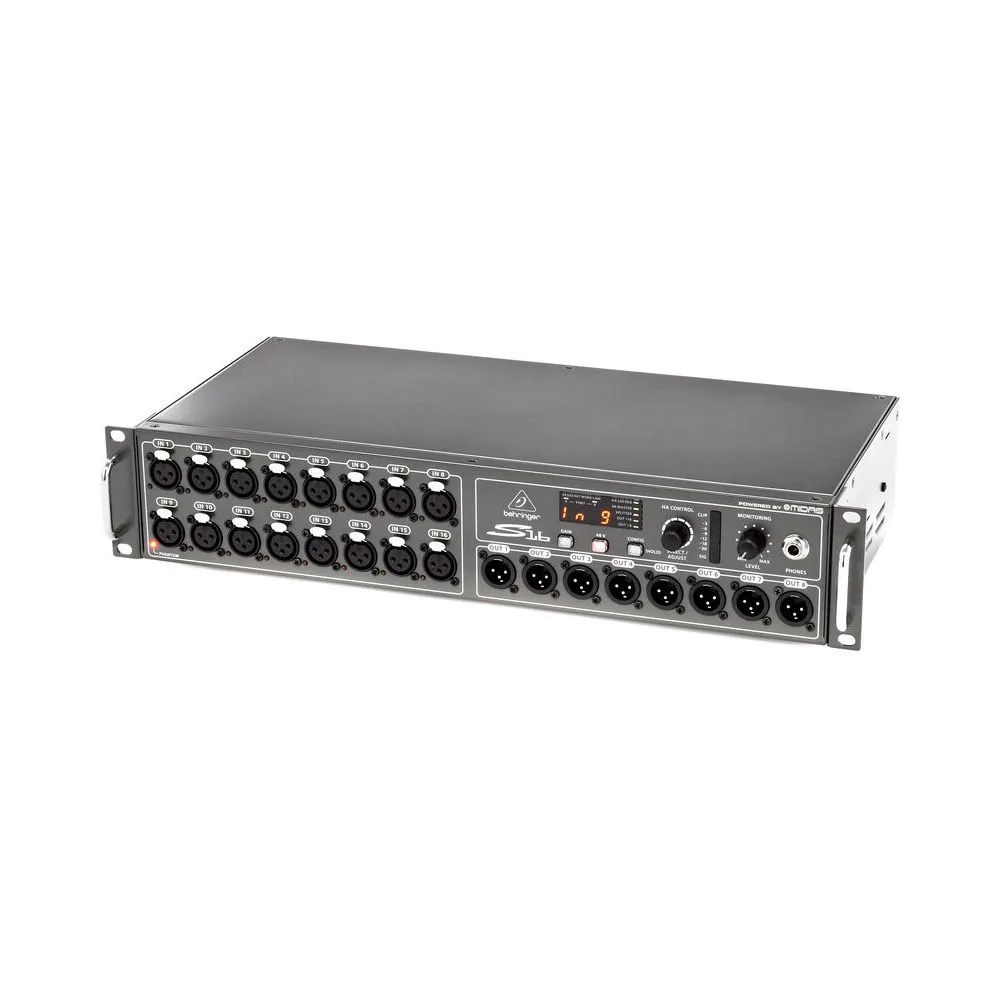
In practice, a console and a stage box connect back to back. The stage box holds the mic preamps and converters, as close to the sources as possible, and sends the digitised audio to the console. The other way round, the console sends its outputs to the amps or the monitors wired to the stage box.
What one cable carries
In its SuperMAC form, an AES50 link carries up to 48 bidirectional channels at 48 or 44.1 kHz, and 24 channels at 96 kHz, in 24-bit, over a shielded Cat5e cable up to around a hundred metres. Latency is very low and, above all, deterministic, on the order of a fraction of a sample, which makes it negligible for a live mix.
One key point: the clock travels in the link. The stage box synchronises itself to the console, with no separate clock cable and nothing to set. For the detail of what a digital clock is and why it matters, we have covered it in a dedicated guide; here, just remember that with AES50 it comes built in.
AES50, Ethernet and Dante are not the same
AES50 uses RJ45 connectors, often in the etherCON format, and a cable that looks like a network cable. The resemblance stops there. An AES50 link is point to point: it does not pass through a network switch, it does not route, and nothing on it is IP-addressed. You do not mix computer traffic onto it, you connect two devices, full stop.
That is the core difference with an audio-over-IP network such as Dante, which travels precisely through switches and shares the pipe with other streams. If those ideas interest you, see our explanation of audio-over-IP with Dante and of MADI, another point-to-point transport at 64 channels. AES50 plays in the same league as MADI, but with a return path included on the same cable.
Where you meet it
AES50 is the backbone of the whole Midas and Behringer ecosystem. You find it on the Behringer X32 and Wing, on the Midas M32 and the PRO series, linked to stage boxes such as the Behringer S16 and S32 or the Midas DL16, DL32 and DL251. For very high channel console-to-engine links, the HyperMAC variant goes up to 384 channels over copper or fibre.
Most of these devices offer two ports, A and B. You can plug in two separate stage boxes, or dedicate the second cable to redundancy: if the first one fails, traffic switches to the backup. That is a welcome safety net live.
In practice on a stage
A few habits keep you out of trouble. Use genuinely shielded Cat5e cable, with etherCON connectors that stand up to dust and stage tugs, and stay under a hundred metres per segment. Never drop a network switch in the middle of an AES50 link: it will not pass. And since the clock rides on the cable, there is no master clock to set at the stage box.
One last useful point when a front-of-house and a monitor console share the same stage box over AES50: the analogue preamp gain is common to both consoles, because there is only one physical input stage. Each console then trims its own digital gain on its side. This behaviour, gain sharing, is why you agree up front on who owns the preamps. If you record the show in parallel, our guide to multitrack recording on the X32 and M32 rounds out the picture.
My take
AES50 is one of those technologies you forget precisely because it works. One cable, audio both ways, the clock included, and a stage box that lines itself up on its own: hard to get more direct for linking a console to the stage. Its limit is also its strength, the point-to-point design, which keeps out all the complexity of a network at the cost of routing flexibility. For the vast majority of stages built around a Midas or a Behringer, it is exactly the right tool, and port B for redundancy brings the calm a live show needs.