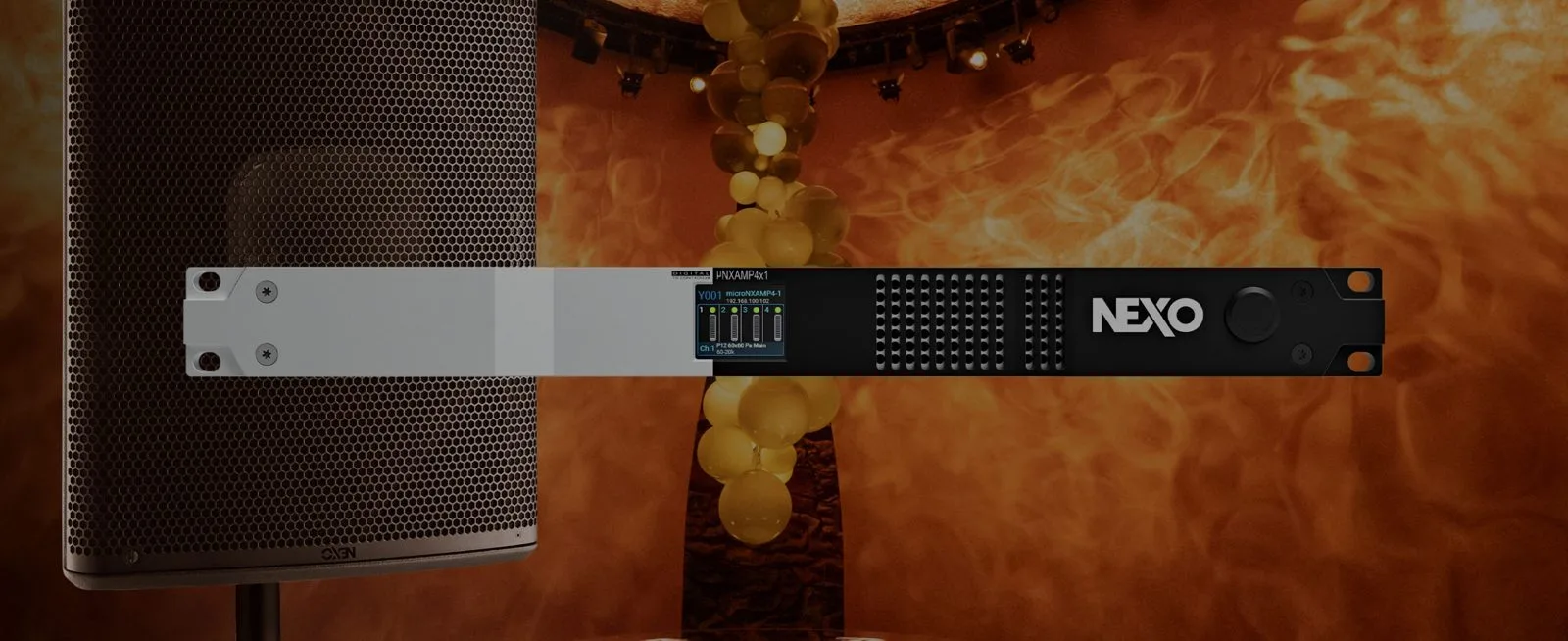
Nexo rounds out its amplifier-processor range with the microNXAMP4X1, a powered speaker controller that fits into a single rack unit while carrying the digital processing inherited from the flagship NXAMP Mk2. The idea is to bring the big series’ computing power and presets down into a compact box, built for smaller Nexo systems on tour and in fixed installs alike.
NXAMP Mk2 DSP in a 1U box
At the heart of the microNXAMP4X1 are two 64-bit multicore DSPs lifted straight from the NXAMP Mk2. That’s the whole point of the unit: an integrator gets the same alignment, protection and optimization algorithms as on the flagship, but for lighter rigs. Conversion runs at 24-bit/96 kHz, with a stated ±1 dB response from 10 Hz to 20 kHz, 110 dB of dynamic range and 580 µs of latency on a flat setup. A 1.8-inch color TFT display (128 × 160) and front-panel controls let you check the four channels without a computer.
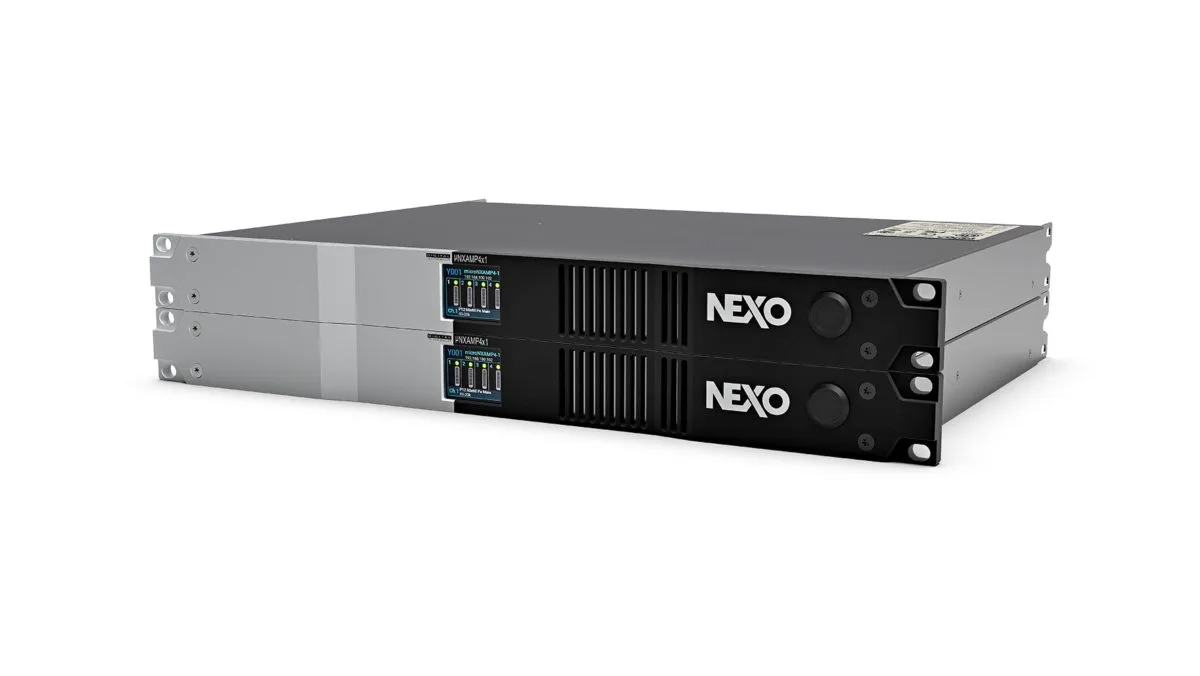
Four Class-D channels, up to 4,000 watts bridged
On power, the four Class-D channels deliver 1,000 W into 4 Ω (750 W into 8 Ω and into 2 Ω), with a maximum output voltage of 135 V per channel. The unit reconfigures as needed: bridged, two channels reach 2,000 W into 8 Ω; in bridge-parallel, a single output hits 4,000 W into 4 Ω. That routing flexibility is the hallmark of Nexo’s powered controllers, where one chassis can drive tops or subs depending on how the channels are split.
Usable power is never judged on its own, of course: it always reads against the distance to cover and the speakers’ sensitivity, a topic we broke down in our piece on sound level and distance in live sound. An amp that knows exactly which cabinet it feeds, through its dedicated preset, gets more out of every watt than a generic power block.
Audio over IP and two versions
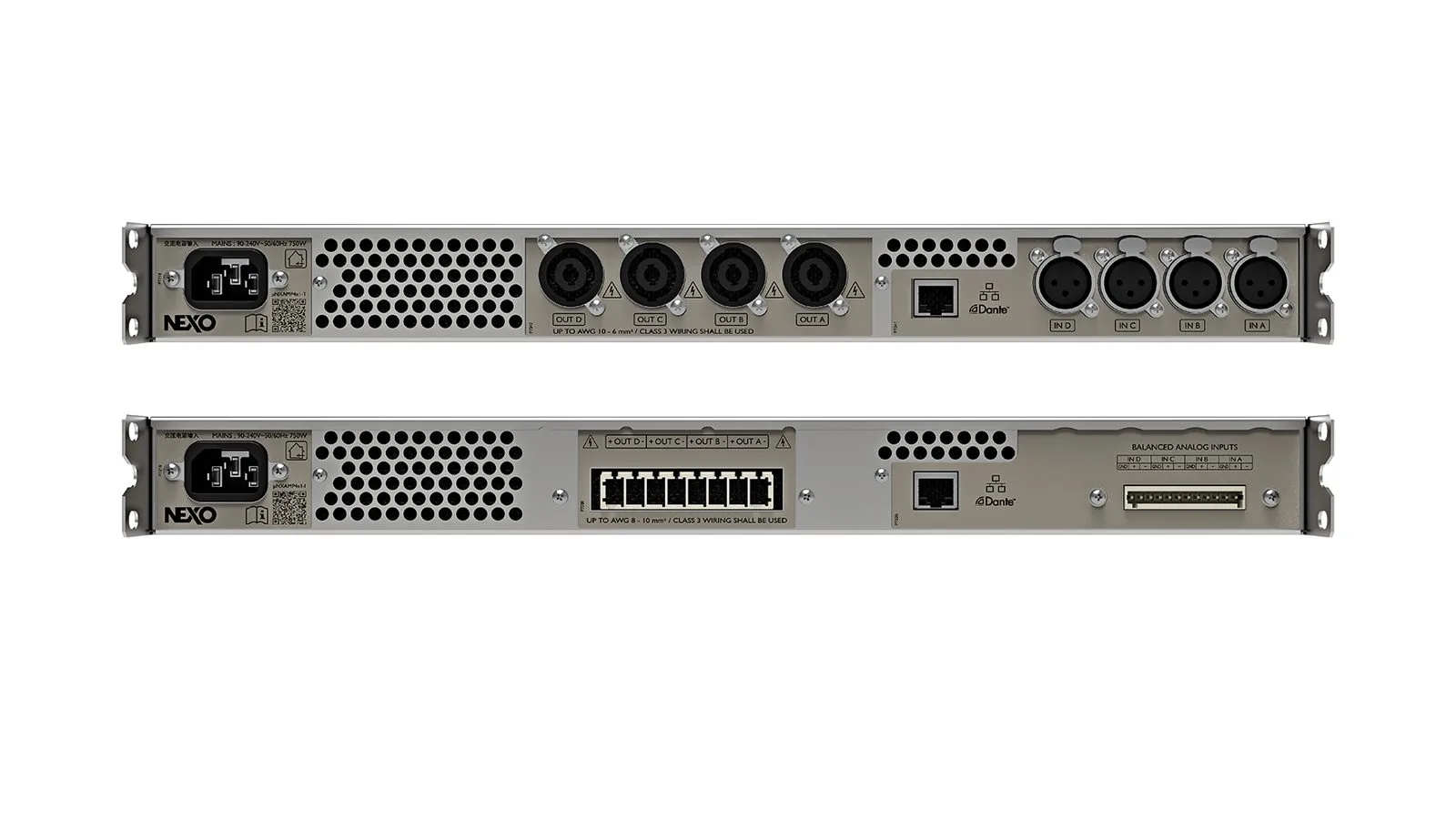
The microNXAMP4X1 takes four balanced analog inputs and four Dante inputs, carried over the control RJ45 port, with AES67 compatibility on top. Control and monitoring run through a 100 Mb Ethernet port and Nexo’s own NeMo software, which centralizes DSP parameters and the supervision of an amp fleet. Fitting it into an audio network then becomes something to administer like any other node — ground we covered with managing a large Dante network.
Nexo offers two versions that differ only in their connectors. The touring build uses XLR3 inputs and Speakon NL-4 outputs; the install version swaps both for WAGO push-in terminals, taking up to 10 mm² cable on the outputs. Either way, the chassis stays a 1U unit 502 mm deep at 10 kg, with a universal power-factor-corrected supply running 100 to 240 V.
Who is it for?
The microNXAMP4X1 targets compact Nexo systems, point-source cabinets in particular, where the NXAMP Mk2 would be overkill and the nanoNXAMP4 would run short on headroom. For a provider already invested in Nexo, the appeal is twofold: preset consistency with the rest of the fleet, and a backup or small-venue amp that speaks exactly the same language as the big blocks. Nexo has not announced a public price at this stage.
My take
Dropping the NXAMP Mk2’s DSP into a 1U box is the kind of move that speaks straight to integrators. The real comfort isn’t the power spec, already solid, but the certainty that presets and protection match the big amps in the fleet: a system gets aligned once, documented once, and serviced without relearning an interface. The two builds, touring and install, show Nexo aiming at fixed and mobile work alike. What’s left is the price, which will decide its place against a compact powered-controller field that’s now well stocked.
Frequently asked questions
What’s the difference between the touring and install versions?
Only the connectors change. The touring version has XLR3 inputs and Speakon NL-4 outputs, built for fast, repeated cabling. The install version switches to WAGO push-in terminals on both inputs and outputs, for a fixed, tidy hookup in an integration rack.
Does the microNXAMP4X1 handle audio over IP?
Yes. It has four Dante inputs carried over its network port, with AES67 compatibility. The same 100 Mb Ethernet port handles control via Nexo’s NeMo software, which supervises DSP parameters and amp status remotely.
What real power should you expect per channel?
Each channel delivers 1,000 W into 4 Ω, 750 W into 8 Ω and 750 W into 2 Ω. Bridging or paralleling the channels pushes that to 2,000 W into 8 Ω across two channels and 4,000 W into 4 Ω in bridge-parallel on one output.
Do you need a computer to run it?
Not for everyday use: the 1.8-inch TFT and front-panel controls are enough to check and adjust the channels. The NeMo software is still needed for advanced setup or for supervising a large number of units on the network.