The DJM-A7 is AlphaTheta’s move to bring its flagship DJM-A9 mixer down to a more reachable price without gutting what made it a club staple. Same four-channel layout, same sound engine, same 32-bit ESS conversion: the plan is to put the A series’ tone and feel within reach of smaller booths, bars and serious home setups.
DJM-A9 feel and sound, at a lower price
AlphaTheta leans into the family resemblance. You get the four-channel layout, the 45 mm faders, the Soft Mix curve mode and the 32-bit ESS conversion chain that built the A9’s reputation. The cuts land where you’d expect on a cheaper model: a single mic input (XLR / 1/4″ TRS combo) instead of two, no talkover, and a slightly tighter footprint (331 × 387.8 × 107.9 mm). For a DJ chasing A-series sound without flagship money, it’s a sensible trade.
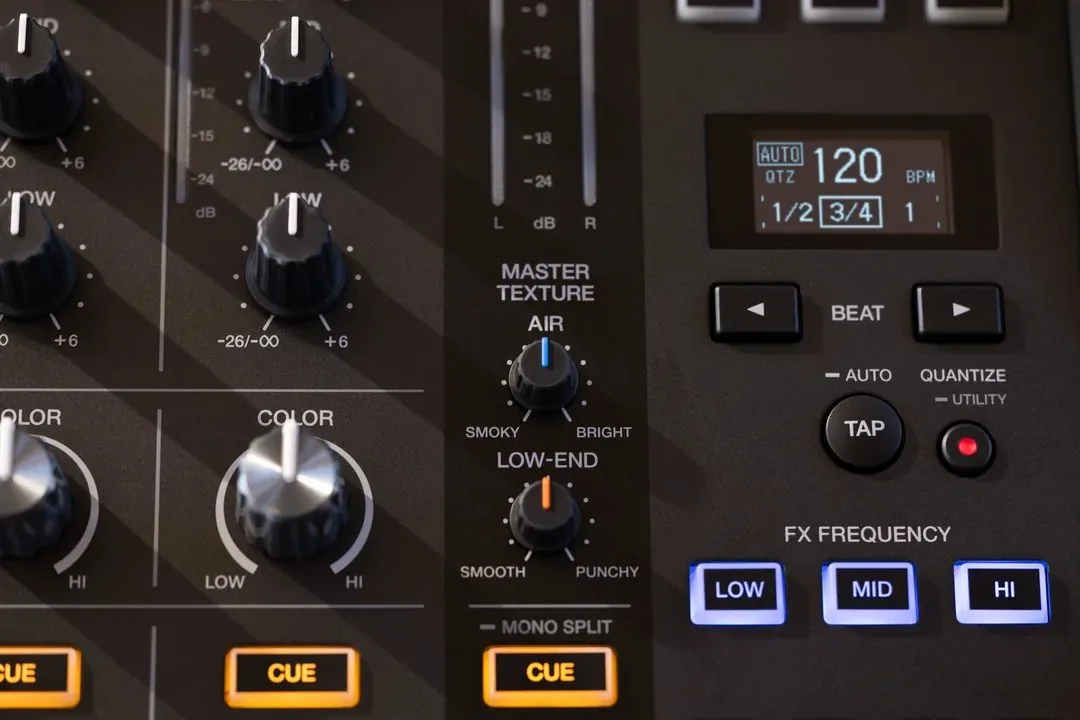
Master Texture: tuning the master to the room
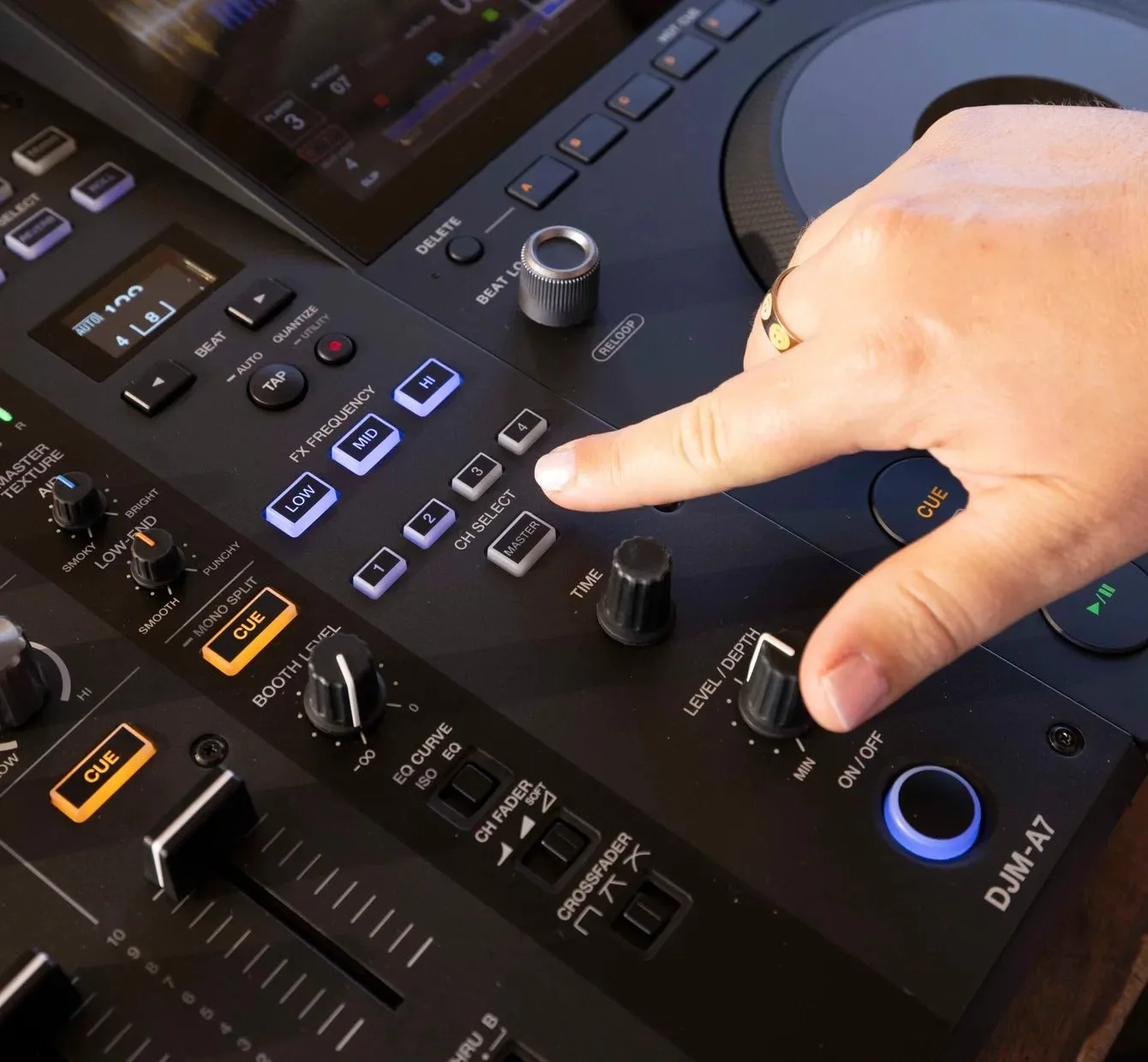
The headline feature is Master Texture. Two knobs act on the master output: AIR shifts the top end between Smoky and Bright, Low-End works the bottom between Smooth and Punchy. The point is practical — reshape the master to a room’s acoustics, a thin PA or an over-reverberant space in seconds, without waiting for a systems engineer to show up. AlphaTheta pitches it as an industry first on a DJ mixer. In practice, it’s the kind of tool that saves you from bending every channel’s EQ to fix a global playback problem.
On effects, the mixer carries four Sound Color FX, including a new Split Filter aimed mainly at the midrange, and a Beat FX selection now driven by six illuminated buttons rather than a rotary selector — a more direct move mid-set.
A hub at the center of an ecosystem
The DJM-A7 doesn’t work alone. Its USB Type-C MULTI I/O port links the RMX-IGNITE effects processor over a single cable, with audio running digitally between the two units. Wireless monitoring runs over SonicLink, AlphaTheta’s own 2.4 GHz link, with Touch Pairing on compatible headphones after a firmware update.
For software control, two USB Type-C ports take a Mac or PC. The mixer unlocks for rekordbox with no subscription (Hardware Unlock) and stays compatible with Serato DJ Pro and djay, which keep their own subscription terms. It’s a classic move for the brand: sell a mixer that acts as a hardware pivot between several environments rather than locking the user into one.
Positioning and price
Announced on November 10, 2026 and due to ship shortly after, the DJM-A7 lists at around $1,599 (£1,369 / €1,599). That puts it clearly under the DJM-A9 while keeping its control vocabulary, which makes it a strong pick for clubs wanting a second booth that matches their main mixer, and for DJs who play on varied rigs and don’t want to relearn an interface every night. Against all-in-one systems like the Denon DJ Prime 4 G2, the DJM-A7 takes the opposite route: a standalone mixer built to slot into a rig you already own.
My take
Master Texture is the clever part here. Two knobs to tune the master to a tired or overly bright room is exactly what you miss when you land on a system you didn’t set up yourself — and it beats twisting every channel’s EQ. The rest is a promise kept: the A9’s feel and sound at a lower price, at the cost of one mic and talkover. At this money, the real question isn’t quality, which is there, but whether the gap to the flagship still justifies, for you, reaching higher.
Frequently asked questions
What sets the DJM-A7 apart from the DJM-A9?
The A7 keeps the four-channel layout, the 45 mm faders and the A9’s 32-bit ESS conversion. It differs with a single mic input instead of two, no talkover and a slightly more compact body. Master Texture, on the other hand, is unique to this new mixer.
Do you need a subscription to use it with software?
Not for rekordbox: the mixer is unlocked in Hardware Unlock mode, with no subscription. Serato DJ Pro and djay, however, keep their own subscription terms for software control.
How does the RMX-IGNITE effects unit connect?
Through the USB Type-C MULTI I/O port, over a single cable. Audio then runs digitally between the RMX-IGNITE and the mixer, which avoids the analog inputs and simplifies booth wiring.
Does wireless monitoring work with any headphones?
Monitoring runs over SonicLink at 2.4 GHz, with Touch Pairing on compatible AlphaTheta headphones after a firmware update. A standard wired headphone still works on the dedicated output.