A long-running fixture of Behringer’s announcement cycle, the CS Mini has gone from concept to a product listed on the company’s own site, complete with a demo video. It also corrects a common assumption: despite what the early images suggested, this little Yamaha CS-80-inspired analog synth is not a three-voice design but a single-oscillator one.
From rumour to official spec
Behringer first asked its community about a CS Mini four years ago, then the project resurfaced this summer through its Synthtribe software, as we reported in our first CS Mini article. The company has since posted the official page and a walkthrough handled by one of its in-house presenters. Between the concept and the finished unit, the detail that changes everything is the architecture: what looked like a small polyphonic synth turns out to be a single-VCO monophonic one, built in the same format as the brand’s other mini synths, the CZ Mini and UB-Xa Mini that go after Korg’s Volca line.
A miniature CS-80, in its own way
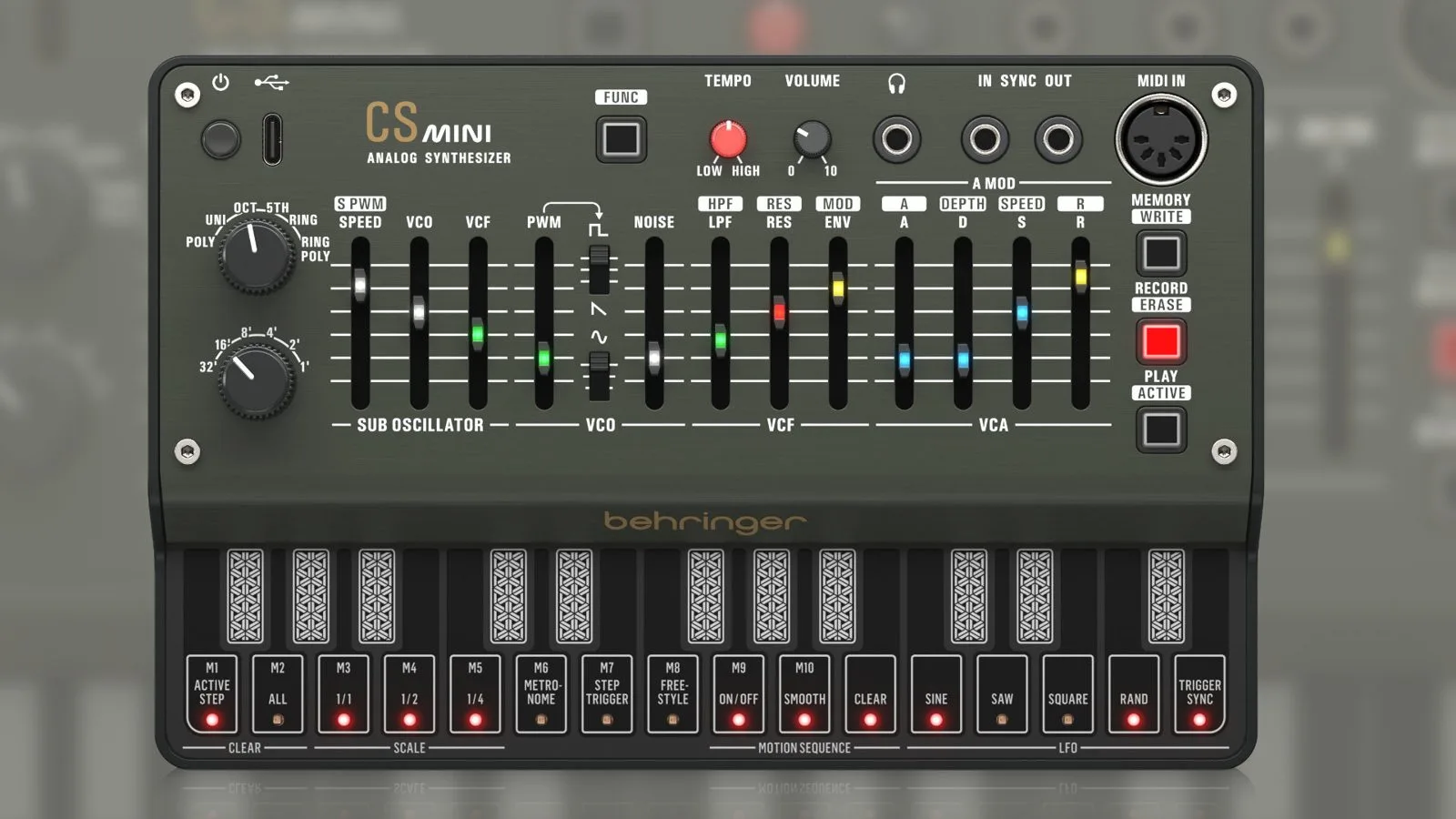
The single oscillator offers three simultaneously selectable waveforms, sawtooth, sine and pulse, the last with pulse width modulated by the internal LFO. The range spans a wide 32′ to 1′, and a noise generator rounds it out. The filter borrows the original Yamaha CS circuits: it switches between low-pass and high-pass via a function button, each with its own cutoff and resonance. A ring modulator with attack, release, depth and speed completes the picture, a CS-80 staple fans were hoping for.
For modulation, there is an ADSR envelope on the amp and a multi-mode LFO, sine, sawtooth, square and random, enough for vibrato, wah and rhythmic movement. Behringer kept the original Yamaha CS labelling, so the section marked sub-oscillator is in fact a second LFO. Several play modes are on offer, from paraphonic to unison, octave, fifth and two ring-mod variants. If paraphonic voicing is new to you, we broke it down in our guide to synth polyphony.
Play, sequencer and connectivity
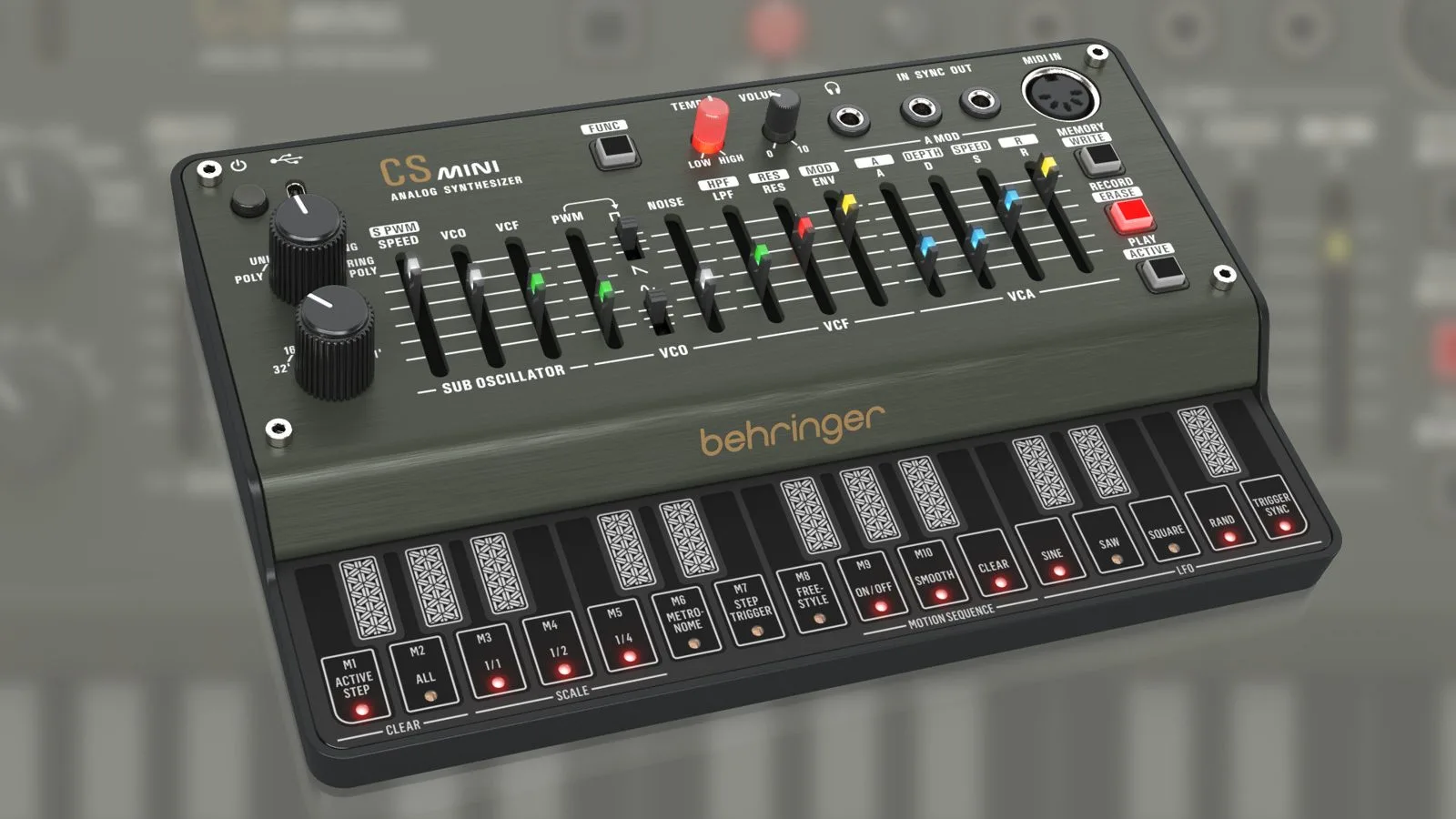
The panel has 27 touch keys for direct playing, but the CS Mini also runs over MIDI and packs a step sequencer with motion recording, now a signature of the brand’s mini synths. Connectivity fits on one edge: a USB-C socket for power and MIDI, a headphone and line output, sync in and out, and a 5-pin DIN MIDI input. Being an analog synth, it has no onboard preset memory; its MIDI CC implementation does let you build a software editor to save patches. The rest of the architecture, oscillator, filter and envelopes, follows the logic of subtractive synthesis.
Price and availability
Behringer has not announced a price or a date. Earlier estimates hovered around $100, in line with the Mini range, but nothing is confirmed. The company is also still working on the DS-80, the full-size CS-80 clone that the CS Mini essentially condenses into a pocket format.
My take
A monophonic, single-oscillator CS-80 is obviously not the 1976 monster, and some will miss the original’s polyphonic ring mod. But at this size and likely price, the appeal is elsewhere: having the two-mode filter and the ring modulator under your fingers, for a handful of notes, is enough to carve basslines and warm pads without hauling out the big rig. The motion sequencer makes it a genuine little performance box. The real price and, above all, the sound remain to be heard: the demo is promising, the verdict will come from the ears.