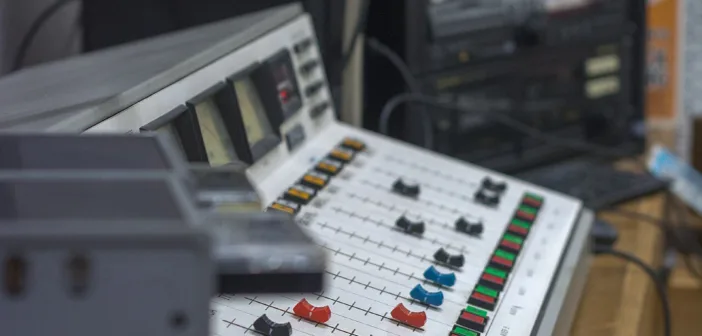
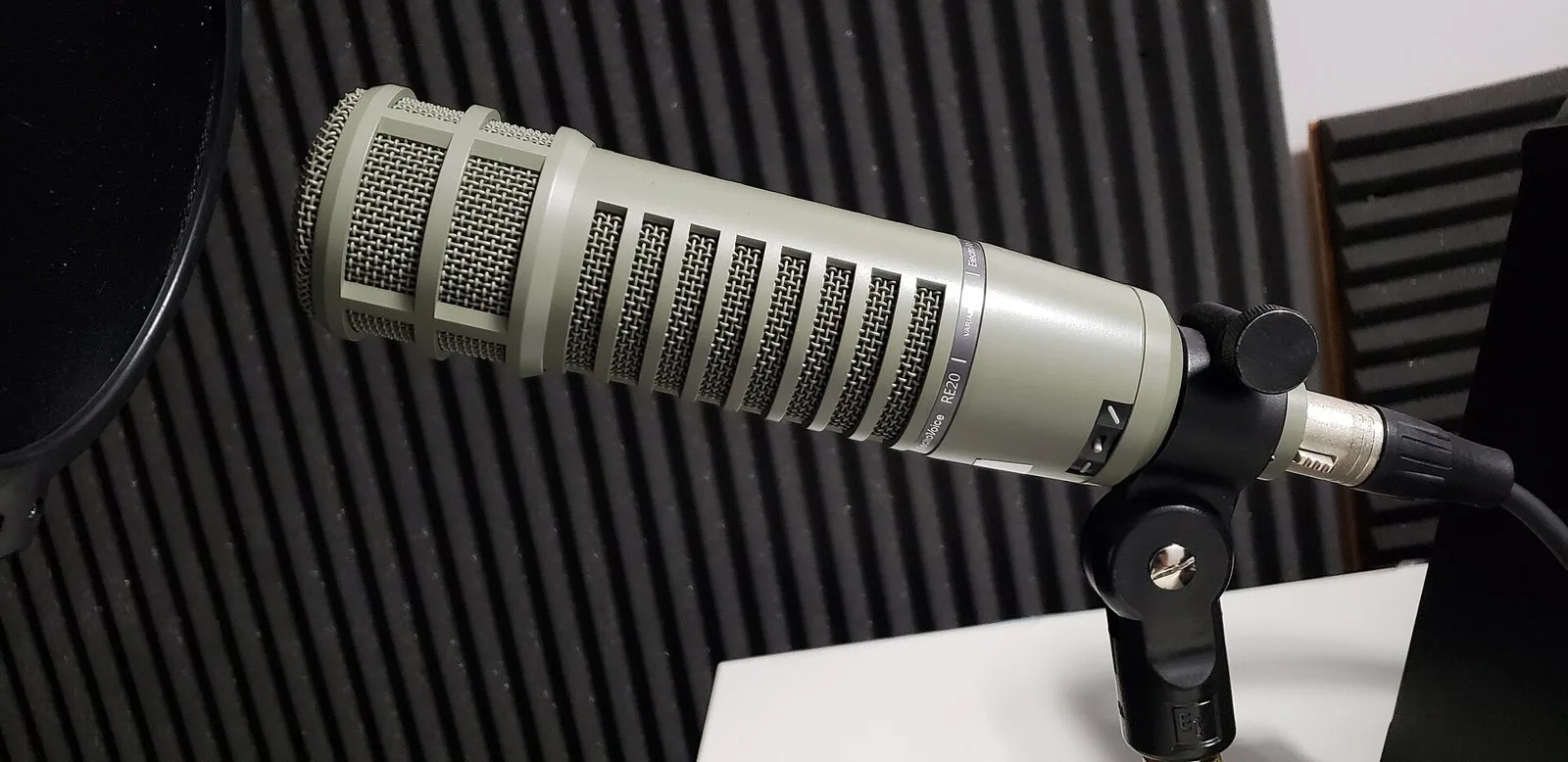
In a radio booth, a matte grey cylinder hangs off an arm, slotted grille turned toward the host. Nine times out of ten, it is an Electro-Voice RE20. The model was born in 1968 at Electro-Voice in Buchanan, Michigan, and it has barely left the studios since. Few audio products can claim that kind of longevity with no major redesign.
Variable-D, the idea that changes everything
A plain cardioid mic suffers from proximity effect: the closer the source, the more the bass rises. On radio, where a host presses their lips to the grille and never stops moving, that bass bump becomes a nightmare to ride. Electro-Voice answered with the Variable-D system, for Variable Distance. The body carries several ports along its length, each feeding the rear wave to the diaphragm from a different distance. The result fits in one line: the tone stays steady whether you sit two inches away or a foot out, and the voice keeps the same footing.
The RE20 is still a large-diaphragm dynamic with a cardioid pattern, but that design detail sets it apart. Where a condenser grabs the room and reacts to every move, the RE20 forgives distance changes and ignores much of the reverberation of an untreated space. To place it among the families, our guide to dynamic versus condenser mics lays out the landmarks.
Built for live work
The rest of the spec sheet points the same way. An internal pop filter takes plosives without an outboard windscreen, handy when a team runs fast from guest to guest. An internal shock mount, paired with a humbucking coil, rejects desk vibration and the magnetic fields of nearby screens and transformers. The steel body carries real weight, around 730 grams, which keeps it steady on a tired arm. A bass roll-off switch tames the low end when a voice sounds too full. The response runs from 45 Hz to 18 kHz, with a controlled presence that flatters speech without hissing.
These traits draw the profile of a spoken-word mic above all. At the head of a radio voice chain, the RE20 hands the compressor and the on-air processor a signal that is already steady, with no stray bass or shifting tone to fix.
Far beyond radio
Studio engineers soon put it to other work. In front of a kick drum, the RE20 became a go-to for catching the beater with body and little ring. It turns up on brass, trombone or sax, on bass cabinets and sometimes on a lead vocal with a strong colour. The same family gave the RE320, a more modern variant with a kick-tuned filter. Then the podcast wave arrived, and a whole generation of voices rediscovered the grey cylinder that radio had never let go. To build a clean recorded voice, the principles of a mixing vocal chain apply just the same.
Nearly sixty years after launch, the RE20 is still in the catalogue, almost unchanged. It was never the flashiest or the priciest mic, and maybe that is why it has outlived the trends: it does one thing very well, the voice up close, and it has done it since 1968.
My take
The RE20 does not impress on a spec sheet, it impresses behind an open mic eight hours a day. Variable-D is one of the rare acoustic tricks that solves a real floor problem instead of adding a flattering curve. You might have thought the podcast era would pass it by; the opposite happened, it crossed radio’s studios without ageing. A voice mic that costs sensibly and lasts three careers is not something you meet often.