
Developer Valery Mironov, already known for his Cellular synth, has just released Sentient, a synthesizer for iOS and macOS whose engine runs on a neural network. Its principle is as simple to state as it is unusual in use: the instrument listens to everyday sounds and uses them to gradually build a wavetable that is unique to each user. Out now for $5.99, it is worth a close look.
A synth that listens to the world
Most synthesizers start from fixed waveforms – sine, sawtooth, pre-recorded wavetables. Sentient does the opposite: it learns. You feed it sound to listen to – a voice, street noise, an object snapping – and its neural network analyses what it hears to extract waveforms. As it listens, the instrument builds a personalised wavetable, shaped by the sounds you have given it. No two users will ever get exactly the same instrument.
The idea taps into a deeper trend: after sampling and classic wavetable synthesis, machine learning is becoming a source of sonic material in its own right. Where a sampler replays a recording and a wavetable synth reads a fixed table, Sentient rebuilds material from what it has learned.

How the learning works
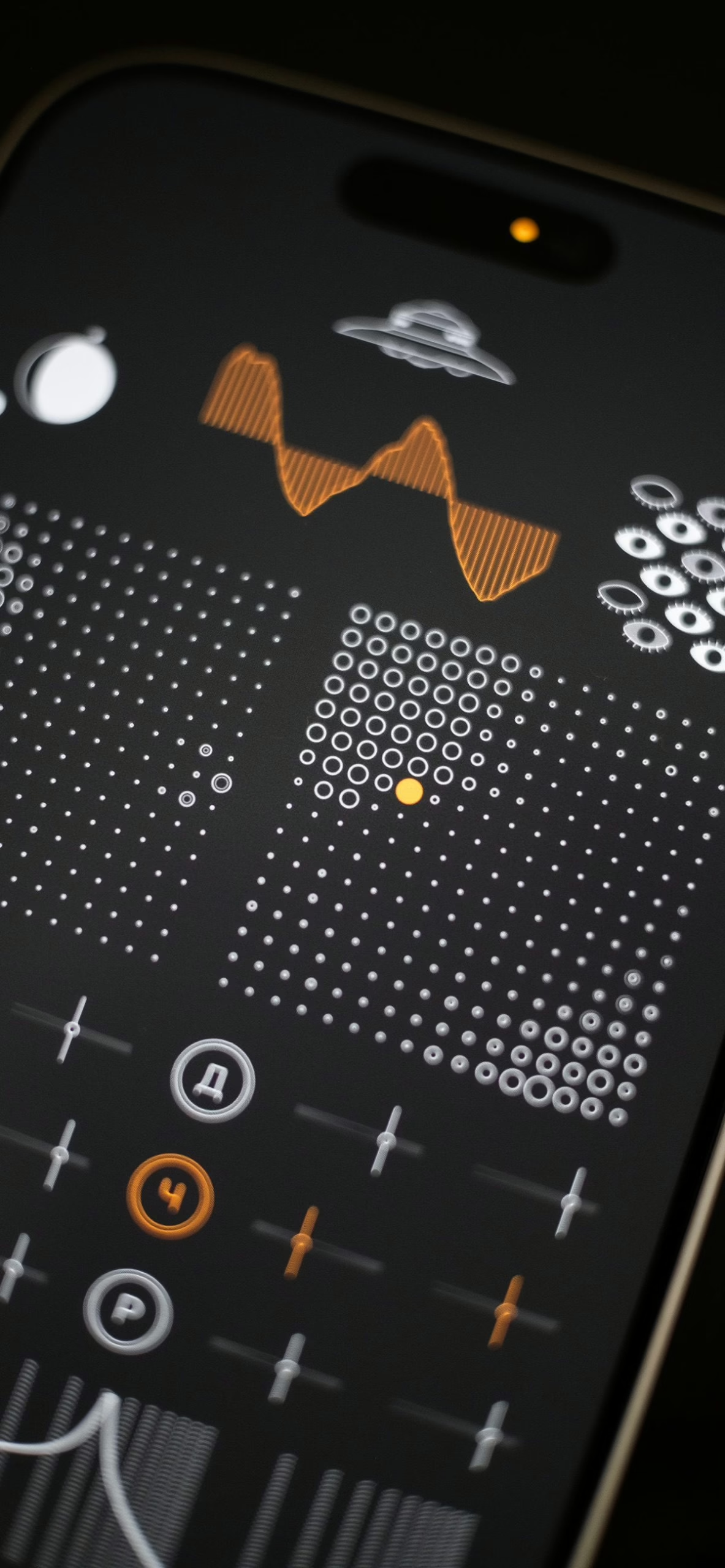
The interface stages the neural network in a very visual way. A controller with eyes represents the learning system: when the eyes are open, the network learns; when they are closed, learning is disabled. A vertical drag adjusts the learning rate, a horizontal drag sets the influence of neighbouring neurons. In practice, when a sound is analysed, the best-matching neuron updates and “swells” more than the others, pulling its neighbours along to create smooth tonal transitions.
The network is organised into two hemispheres, shown as two grids where each cell is a neuron storing a waveform. You can select neurons there to play with the learned material. A memory module, presented as a planetary interface, lets you save, browse and recall the network’s various states – a poetic way to manage your synthesis snapshots.
The synthesis: oscillator, modulation, filter
Beyond the neural part, Sentient remains a genuinely playable synth. The synthesis section offers oscillator waveform selection with frequency and volume sliders, a modulation depth and rate, and routing of that modulation to several destinations: pan, drive, filter frequency and resonance. A star-marked slider drives filter selection and drive, rounded out by frequency and resonance controls.
The keyboard, finally, is like no other: its eight keys are represented by Lissajous figures, those curves born from combining harmonic oscillators, each corresponding to a note. An aesthetic choice consistent with the spirit of the instrument, where everything, down to the keyboard, points back to sonic material itself.
Price, platforms and availability
Sentient is available now for $5.99. It runs as a standalone app and as an AUv3 plugin on iOS (iPhone and iPad) and on macOS in native Apple Silicon, and supports MIDI. So you can use it on its own, on the go on a tablet, or drop it in as an instrument in a workstation. At that price, it is above all an invitation to experiment: a sonic sandbox where the raw material is your own recordings.
If building your own sonic material appeals to you, carry on with our explainers on wavetable synthesis, on sampling, and on voice-transformation techniques such as the vocoder. To stay with engines that rebuild sound grain by grain, see also our piece on the Minimal Audio Lucid granular processor.
My take
This is exactly the kind of object that makes synthesis on a tablet exciting: one strong idea, carried all the way through its interface, for the price of a coffee. Learning from everyday sounds is not a gimmick – it is a real source of timbres no preset will hand you. You can smile at the blinking eyes and the planetary interface, but the musical gesture is real: feed the instrument, listen to it digest, play the result. At $5.99, the question is not whether it will replace your main synth, but everything it will make you find that you were not looking for.