The vocoder carries a reputation as a gimmick — the famous “robot voice.” That sells it short. Behind the cliché sits one of the most ingenious tools in electronic instrument design, invented to transmit speech before it became an instrument in its own right. Understanding how it works changes everything: you stop twisting knobs at random and finally get a synthetic voice that is clear and musical, not just a metallic gargle.
What is a vocoder?
The word comes from voice coder. A vocoder takes two signals and imposes the spectral signature of one onto the other. The first signal, the modulator, is usually a voice: it supplies the words, the articulation, the rhythm of the syllables. The second, the carrier, is most often a synthesizer: it supplies the tone and the pitch. The vocoder continuously analyses the shape of the voice’s spectrum and “stamps” it onto the synth. The result: the synth starts to speak, with your words but its own timbre and melody.
That is the fundamental difference from a simple voice effect: here, the voice is not heard directly. It acts as a mould. The material poured into that mould is the carrier.
How it works: bands and envelope followers
The mechanism is clearer than it looks. The vocoder splits the modulator’s spectrum into a series of frequency bands using a bank of band-pass filters — eight, sixteen, twenty bands depending on the model. In each band, an envelope follower measures the voice’s energy level in real time. You get a moving photograph of the vocal spectrum: which frequency zones are strong, which are weak, moment by moment.
In parallel, the carrier passes through an identical filter bank that splits it into the same bands. Each carrier band is then driven in level by the corresponding envelope from the voice: where the voice has energy, the carrier band opens; where it has none, the band closes. Summing all those processed bands gives a sound with the carrier’s timbre that follows the changing shape of the voice — that is, its formants, the resonances that tell an “ah” from an “ee.” Naturally, the more bands there are, the more detailed the result and the more intelligible the text.
Carrier and modulator: the right choice
The quality of a vocoded sound starts with the carrier. For the filters to have something to sculpt, you need a signal that is rich in harmonics and sustained: a sawtooth, a square wave, a thick pad, possibly with added noise. A plain sine wave gives nothing — with no harmonics, there is nothing to filter. That is why a carrier from subtractive synthesis, with its sawtooth oscillators, is the classic starting point; a wavetable texture or even an FM patch can bring a more original grain.
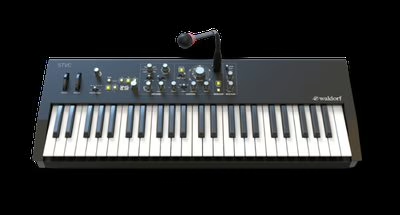
The move, then, is twofold: you speak or sing into the mic while you play the carrier on the keyboard. You decide the melody and the chords with the held notes, while the text comes from the voice. Playing a chord instantly gives a multi-voice robot choir. The link between the keyboard and the sound engine rests on the same principles as any electronic instrument — see our article on MIDI and CV/Gate.
The consonant problem
The vocoder’s Achilles heel is consonant intelligibility. Vowels, rich in harmonics, come through beautifully. But sibilant and plosive consonants — “s,” “t,” “f,” “sh” — are high-frequency noises with no defined pitch. A melodic carrier cannot reproduce them: the text blurs as soon as sibilants appear. The fix, present on good vocoders, is a dedicated “unvoiced” circuit that detects those noises and lets a little of the voice’s high end through, or injects noise into the carrier at the right moment. Set well, this path restores the consonants and makes the lyrics understandable. It is often what separates a professional vocode from robotic mush.
Vocoder, talkbox, autotune: don’t mix them up
Three effects produce “weird voices,” and they get confused all the time. The vocoder is electronic: it crosses two signals inside a machine. The talkbox is acoustic: an instrument’s sound is fed into a tube the player puts in their mouth, which physically shapes the timbre before a mic picks it up — the very organic sound of certain guitar solos. Extreme autotune, finally, only corrects and quantises the pitch of the voice; there is no carrier and no modulator. Three techniques, three results: it helps to know which one you are after.
Using it well
A few habits make all the difference:
- Choose a bright, sustained carrier (sawtooth, pad), never a sine wave.
- Over-articulate and separate the syllables: the vocoder cannot guess what the mic does not clearly capture.
- Enable and dial in the consonant path (“unvoiced,” “sibilance”) to bring back the “s” and “t” sounds.
- Play sustained chords for a choir effect, low notes for a massive machine voice.
- Blend a thread of dry voice under the vocode if the text must stay perfectly clear.
Where it comes from, where you hear it
The vocoder was born in Bell Labs in the 1930s, to compress and encrypt speech over the phone — it even served secret communications during the Second World War. Its musical career took off in the 1970s and 1980s, from Wendy Carlos’s experiments to Kraftwerk’s robots, through funk and, later, electronic pop. Today you find it both as a dedicated hardware synth and as a plugin in any DAW, and it is no longer limited to the voice: run a drum loop as the modulator over a pad, and you get a pad that pulses in time with the groove.
My take
The vocoder deserves better than its “robot voice” label. It is a superb sound-design tool, as long as you grasp that it crosses two signals rather than “transforming” one voice. Set the carrier with care, mind the consonant path, and you move from gimmick to genuine instrument — capable of synthetic choirs, rhythmic textures and impossible voices. The best advice fits in one word: articulate. A perfect carrier will never save mushy diction, while a modest vocoder, well played, can sound superb.