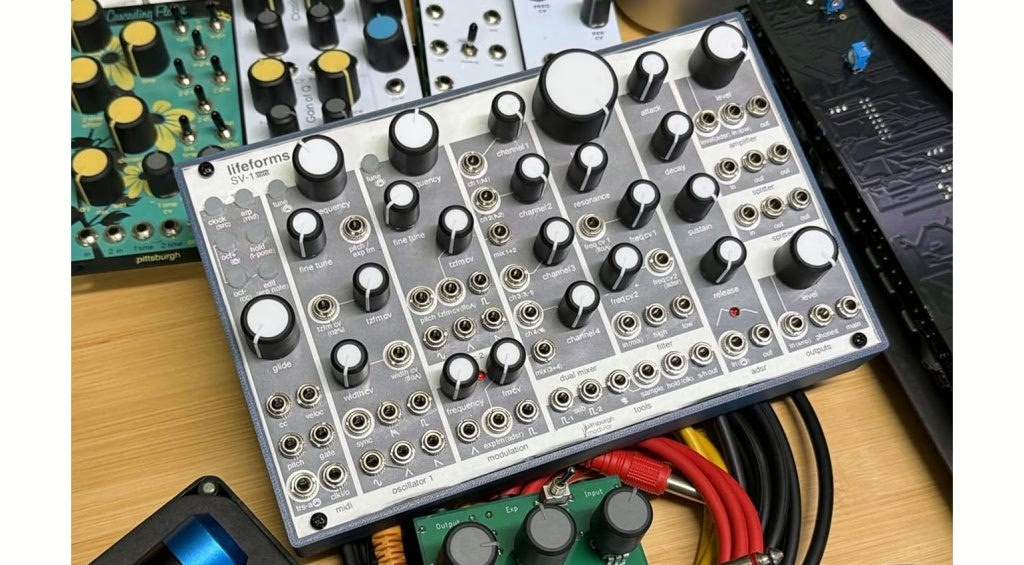
There’s an unwritten rule in synth land: when an instrument gets a “mini” edition, it loses voices, outputs, a slice of its soul – in exchange for a friendlier price. Pittsburgh Modular just flipped that rule on its head. The Lifeforms SV-1 Mini squeezes its cult semi-modular into a smaller chassis while keeping the entire architecture, and it lands $200 below the original at $599. Expect it in January 2027.
The SV-1 is no minor entry in the Pittsburgh catalogue. For a lot of players it was the East Coast approach to synthesis in a ready-to-play box: a pre-wired signal path, a bank of patch points to rewire everything, and that slightly raw analog signature the company is known for. Shrinking it without stripping it is a bold call.
A mini that cuts nothing
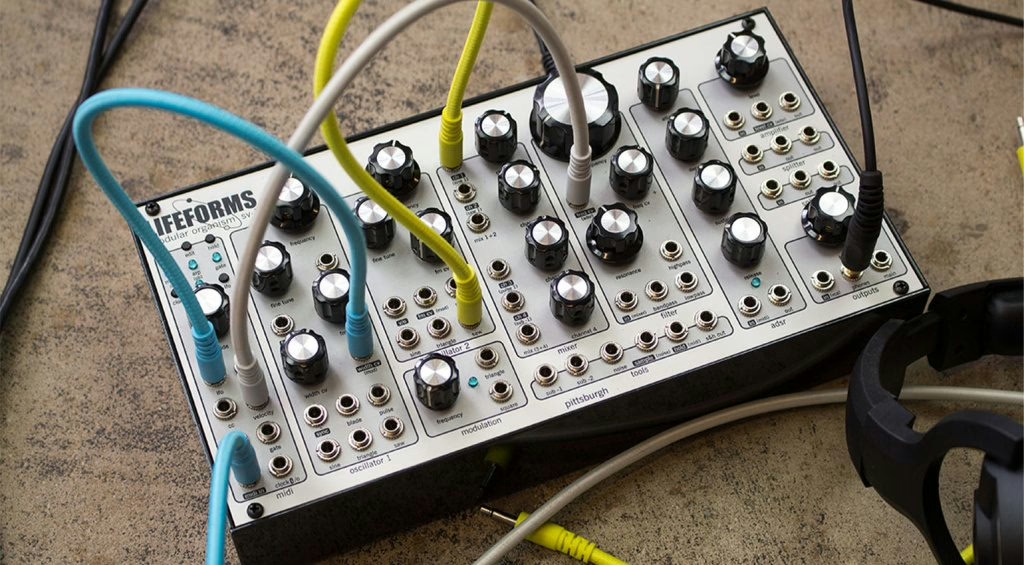
Under the hood, it’s the exact SV-1 recipe: two analog oscillators – five waveforms on the first, four on the second – including the signature Blade wave, a sawtooth variant that conjures a dense, natural chorus with no added effect. Add pulse-width modulation, thru-zero FM, exponential FM and hard sync, plus two sub-oscillators (-1 and -2 octaves) to thicken the low end.
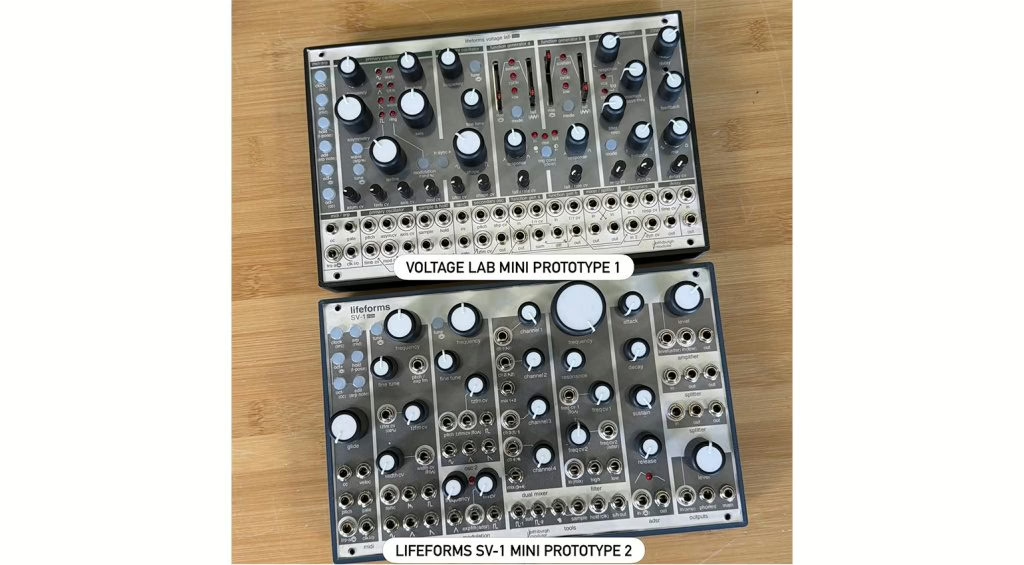
The heart of the “Pittsburgh” character is its state-variable multimode filter, with simultaneous low-pass, high-pass and band-pass outputs and voltage control across the full frequency range. Around it sit two chained mixers, a four-stage ADSR envelope (with that punchy, plucky bite), two LFOs – tweaked in response to user feedback, the company notes – a VCA and a splitter. Nothing was sacrificed to the smaller footprint.
MIDI, arpeggiator and standalone play
For control, the SV-1 Mini carries an advanced MIDI-to-CV converter with a TRS-A MIDI input, an arpeggiator and glide. It also breaks out dedicated outputs for velocity, CC, pitch, gate and clock – enough to sit at the centre of a small system or lock to the rest of the studio. A headphone output and a line output round things off: like its bigger sibling, it plays on its own with no rack or patching required, yet stays wide open the moment you want to reroute its internal wiring.
Pittsburgh finally brackets its range
The announcement makes most sense next to the brand’s other recent release: the SV-2, a ground-up redesign of the semi-modular that moved upmarket with a built-in keyboard and a roughly EUR 1,599 price tag. With the SV-1 Mini, Pittsburgh Modular now covers both ends of its line – a flagship at the top, a compact analog gateway at the bottom – with the original SV-1 still sitting in between, its structure carried over wholesale into the Mini.
| Model | Format | Indicative price | Positioning |
|---|---|---|---|
| SV-1 Mini | Compact desktop | $599 | Entry point, full architecture |
| SV-1 (original) | Desktop / 48 HP eurorack | ~$799 | The original semi-modular |
| SV-2 | Keyboard | ~EUR 1,599 | Upmarket redesign |
The first batch is capped at 300 units, sold directly by Pittsburgh Modular, with production wrapping in mid-December for January shipping. In other words, this is a prototype teased on social media rather than a product on the shelf just yet – specs could still shift before it hits the production line.
A “mini” that aims true
Having lived through the analog-to-computer shift in music-making, I’ve seen enough reissues and shrunken reboots to stay wary: too often, “mini” is an excuse to shave off whatever made the instrument special. Here the logic runs the other way, and that’s what makes it interesting. Keeping the filter, both full oscillators and the patch bay while lowering the entry ticket is a bet that a semi-modular’s worth lies in what it does, not in the size of its case. A good piece of hardware earns its keep when it brings something audible – and an analog state-variable filter that sings under your fingers qualifies.
Then there’s the teaching side: patching a modulation by hand, hearing an envelope hit a VCA, closing a filter manually – that’s a kind of learning the all-in-the-box workflow quietly skips. At $599, the SV-1 Mini puts that experience within reach of a wider audience, in the same accessible-semi-modular vein as the Vannes Devices Obsidian. If Pittsburgh delivers on its January promise, this little box could become one of the best on-ramps to East Coast synthesis. We’re keen to hear it.