An in-ear monitor install rarely fails because of the gear. It fails because the frequency plan was rushed, because the console send was tapped in the wrong place, or because the limiter was never set. This guide follows the install in the order it actually happens — from the console output to the musician’s ear — with the points where time gets lost and the points where risk gets taken.
- The console feed is taken from a stereo mix set to pre-fader, never post-fader.
- The frequency plan is built on site, with every other transmitter switched on: that step decides how reliable the night will be.
- Usable UHF spectrum is allocated country by country — check your national regulator before buying.
- The transmitter’s limiter is not a comfort feature: it is hearing protection.
- A badly sealed earpiece produces exactly the same symptom as an underpowered system: the musician turns it up.
The four links in the chain
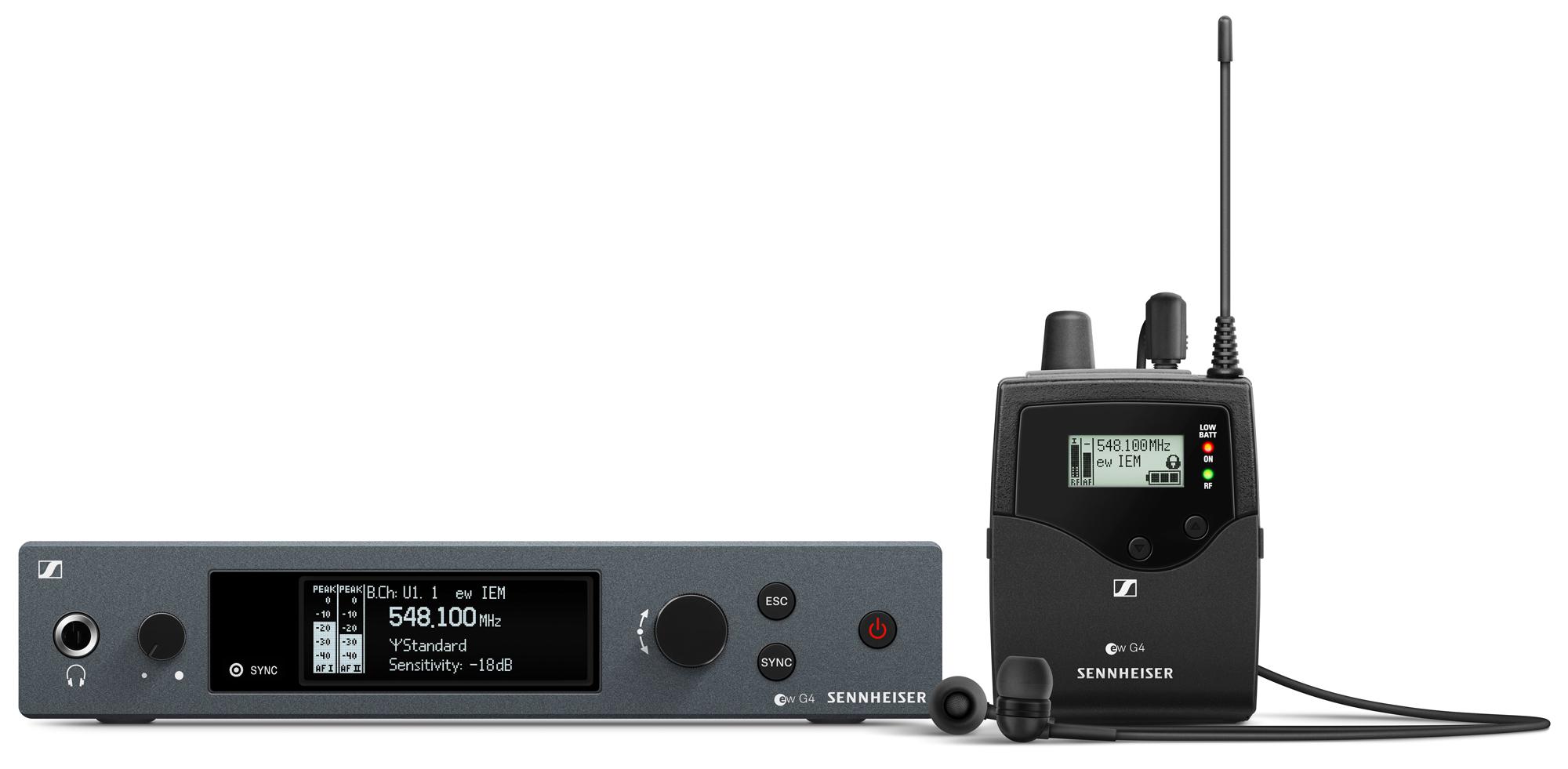
An in-ear system comes down to four links: a dedicated mix built on the console, a transmitter in a rack, a beltpack receiver, and the transducers themselves. In the wired version, transmitter and receiver disappear in favour of a simple headphone amplifier or a personal mixing box — and most of the difficulties go with them.
Wired or wireless: decide before you buy
The question applies position by position, not to the whole band. A drummer, a keyboard player, a backing vocalist at a mic stand have no need for mobility: wiring them costs three times less, removes battery management, and frees up that many frequencies for the people who genuinely move. The one caveat on wired systems is cable length, which eventually tells on impedance and on stage safety.
| Criterion | Wired | Wireless UHF |
|---|---|---|
| Cost per musician | Low | High |
| Preparation before the show | Practically none | Frequency plan required |
| Risk of dropout | None | Real, to be managed |
| Mobility | Limited to the position | Total |
| Consumables | None | Batteries or cells every service |
The wiring, in order
The console feed comes from a stereo mix configured pre-fader. Same principle as a wedge, and for the same reason: the musician must lose nothing when front of house moves. Our article on auxiliaries on an audio mixing console covers that tap point, which remains the single most common cause of a musician waving at you mid-set.
The output then runs to the transmitter at balanced line level. Transmitters in the usual price bracket expect quarter-inch jack or XLR depending on the model: that is where ten minutes vanish for want of the right adaptors. Site the rack away from wireless microphone receivers — more on that below — and get the antenna out of the metal rack as soon as you pass two transmitters, using a combiner to bring you back to a single radiating antenna. A closed rack with four antennas inside is a system that will reach ten metres instead of fifty.
On the musician’s side, the beltpack is set last. On stage the only variable you leave them is volume; everything else — mix balance, correction, ambience — is handled at the mix position or on a dedicated personal mixer.
The frequency plan, where it is all decided
Wireless monitor links live in the UHF television spectrum, and the exact limits are set country by country by the national regulator. Two general points hold almost everywhere. The 700 MHz range, once the natural home for these links, has been handed to mobile networks across most territories: gear from before that reallocation is now both unlawful and unusable in those bands. And transmit power is capped, with the exact ceiling depending on the jurisdiction and on whether the link is a microphone or a monitor feed. Before buying anything, and especially before buying second-hand, check what your regulator currently allows at the address where you will be working.
The difficulty is not finding free frequencies: it is finding frequencies that are compatible with one another. Two transmitters near each other create intermodulation products at predictable frequencies, and a third transmitter sitting exactly on one of them will drop out without anything on its display suggesting a problem.
The reliable method has three steps. Scan on site, in the room, with every other transmitter powered up — microphones, instrument links, intercom, cameras. Calculate the plan with the manufacturer’s software, which handles the intermodulation products you will not work out by hand. Then sync the receivers over infrared, and write the plan down: you will want it tomorrow, in another room, to understand what changed.
Never place an in-ear transmitter next to a wireless microphone receiver. The transmitter is radiating continuously a few centimetres from an input designed to catch microvolts: the receiver overloads and the microphone drops out, while everybody hunts for the fault on the microphone side. One transmitter rack and one receiver rack, several metres apart, with remote antennas on each side — that is the only layout that holds.
The settings that make the difference
Gain structure is set from the end of the chain backwards, not the other way round. Bring the console output to nominal, set the transmitter’s input sensitivity so its meters work in the upper green on loud passages, then let the musician adjust their own volume at the pack. An under-modulated transmitter forces the beltpack volume up, which also brings up the system’s noise floor.
The limiter on the transmitter is set before the first note and never switched off. An earpiece delivers its energy straight into the ear canal, without the space that cushions a wedge: one accidental feedback, one mic stand knocked over, one talkback misrouted, and the damage is immediate and permanent. It is the only setting in the whole install whose stake is not musical.
Moving to in-ears almost always fails for the same reason: the musician ends up shut in. Cut off from the room, from the audience, from their own acoustic instrument. Two moves fix most of it — a pair of ambience microphones at the back of the room, blended discreetly into the mixes, and a genuine stereo image rather than duplicated mono. That is what turns an adequate system into one people agree to keep. And it costs two console inputs.
Correction, finally, works differently from a wedge. An in-ear system knows no feedback: the surgical cuts you make on a floor monitor no longer have a reason to exist. What stays useful is clearing the low mids for intelligibility and avoiding aggressive top end, which pushes people to turn the overall level down and then hear nothing else.
Care and hygiene: the part everyone forgets
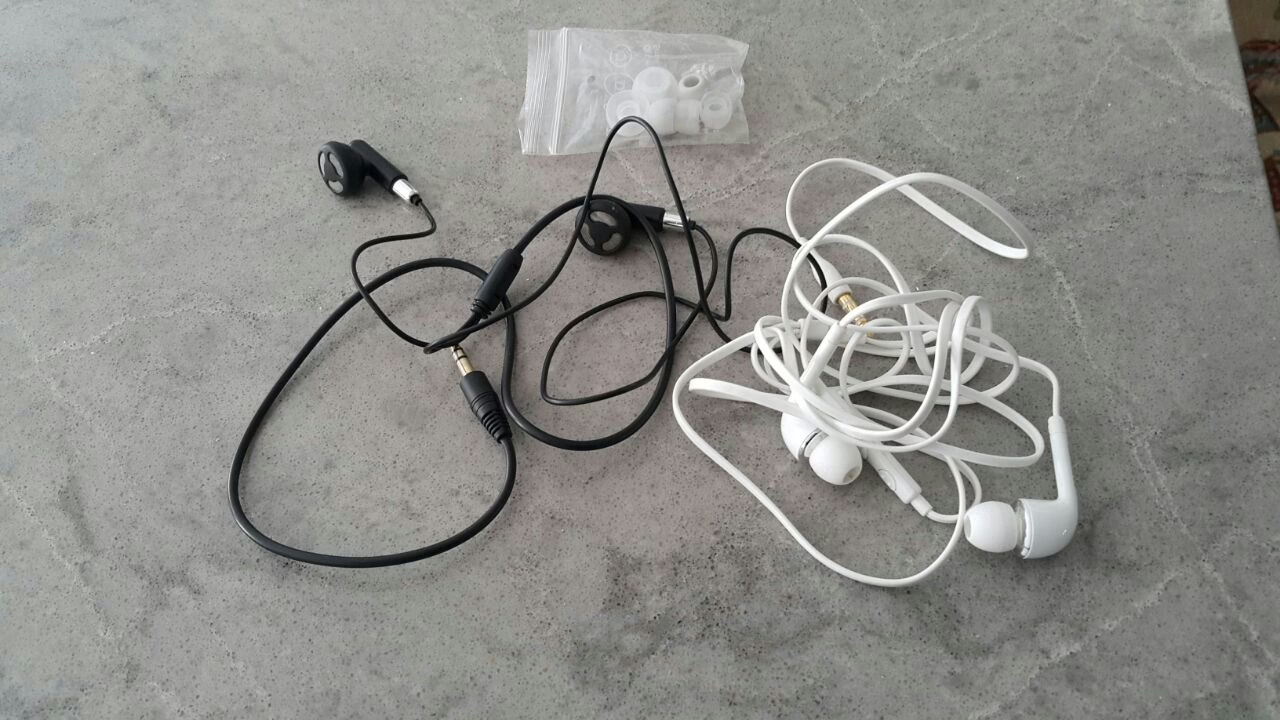
Earpieces shared between several people demand basic discipline, and not only for comfort. Foam tips are consumables: they get replaced, not cleaned. Silicone tips wash in warm soapy water and air-dry, never in alcohol, which hardens them. The transducer filters clog with wax and cause a progressive loss of top end in one ear only — a symptom often blamed on the system when a filter change fixes it in thirty seconds. In a rental stock, an individual pouch per user is the only approach that survives.
What to watch afterwards
The musician’s comfort depends on a factor you do not control from the mix position: the seal of the ear tip. A poorly fitted in-ear loses all its bass, and the wearer’s natural reflex is to turn up to compensate — with the hearing risk you can imagine. Custom moulds settle the question permanently but cost real money; failing that, a set of foam tips in several sizes in the flight case solves half the complaints in ten seconds.
That leaves the operational basics: charged and labelled packs by position, a spare set of cables, and the frequency plan written down. If you are still weighing whether to equip the whole band, our article on when in-ear monitors make sense looks at the configurations where they genuinely help — and those where a good wedge stays ahead.
Frequently asked questions
Stereo mix per musician, or is mono enough?
Stereo genuinely improves comfort: it lets you place sources in space and reduces listening fatigue over a long set. Mono, on the other hand, doubles how many musicians you can equip with the same bus count. On a limited console, well built mono for everyone beats stereo for two and nothing for the rest.
Do in-ears add latency?
Analogue UHF systems add practically none. Perceptible latency, when there is any, comes from the console and the digital chain upstream, not from the wireless link. Digital transmission systems add a little more, which remains inconsequential at stage scale.
Can consumer earphones be used?
To get by, yes. In regular service, no: passive isolation is insufficient, which pushes the volume up, and the cable is not detachable — it will break at the first snag, generally at the worst moment. A detachable connector is the real dividing line for stage gear.
How many wireless systems can coexist?
That depends entirely on the spectrum available on site, not on the gear. A rural venue will comfortably run a dozen links; a dense city centre with several television transmitters will halve that. Which is precisely what the preliminary scan is for.