


Euphonix Crescendo
Euphonix's first system: a digitally controlled analog console (1990)
List price at launch 127,000 USD as of 1990
Description
To me the Crescendo is Euphonix's birth certificate: a 100% analog core under digital control, with SnapShot Recall and full automation — the direct ancestor of the CS2000/CS3000 and System 5.
Technical
Specifications
Inputs / Outputs
| Mic preamps | Multiplying DACs (MDAC) for variable gain |
|---|---|
| Inputs / outputs | Per strip: 2 mic/line preamps + 4 line inputs, 2 faders (upper/lower), 4 aux sends |
Processing
| Aux sends | 4 |
|---|---|
| Architecture | Digitally controlled analogue console (digital surface + analogue Audio Mainframe) |
| Audio performance | 15 Hz – 30 kHz (±0.2 dB) · Noise: −84 dBu (24 faders open) · THD+N < 0.01%; IMD (SMPTE) < 0.01% · Crosstalk: −84 dB (between any two signals) · Headroom: 24 dB · Dynamic range: > 110 dB |
| EQ | 4-band parametric EQ with real-time curve display (designed by Rob Silfvast) · 2 × 4-band EQ per strip (2 shelving + 2 parametric), 1/4 dB resolution, MixView display |
| Processing engine | IBM 386+ host computer via RS-232; MixView graphical interface (EQ curves, on-screen help) |
Surface
| Touchscreen | No |
|---|---|
| Automation | TotalAutomation + SnapShot Recall (full recall of settings) |
| Metering | 19-segment LED bargraph meters per strip (VU/peak, programmable scale) |
| Scenes and recall | Complete reconfiguration within one SMPTE frame · Up to 99 SnapShots per strip + 10 recallable console configurations (dynamic via SMPTE/EBU) |
Recording
| Onboard recording | No |
|---|
Networking
| Redundant PSU | No |
|---|---|
| Redundant networking | No |
| Audio networking | Multicore control link between Mix Controller and Audio Mainframe (RS-422/RS-232 for the host computer) |
Physical
| Width | 1,355 mm |
|---|---|
| Depth | 771 mm |
| Height | 864 mm |
| Dimensions | Audio Mainframe: 1288 × 442 × 483 mm (H×W×D), i.e. 50.7 × 17.4 × 19 in |
Power
| Power supply | Audio Mainframe ~2.5 kW (dedicated linear power supply) |
|---|
Other
| Variants and configurations | Configurations from 5624 (56 inputs / 24 track buses) to 9624 (96 inputs) |
|---|---|
| Price | US$127,000 – 214,000 (£65,000 – 110,000) depending on configuration, 1991 |
Strip & details
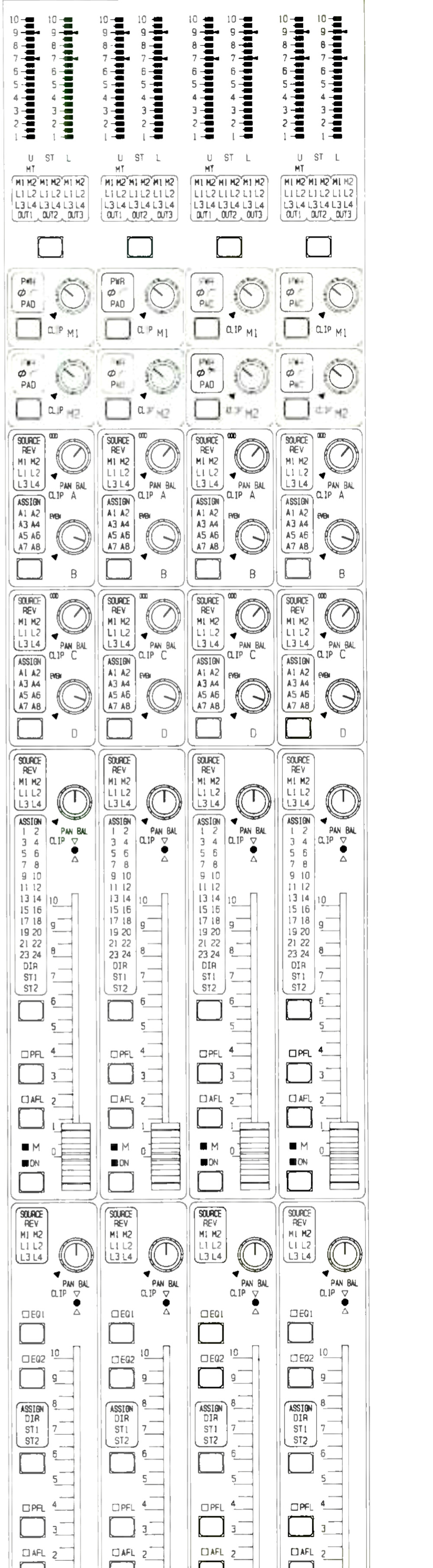
Rotate your phone to landscape for a better view of the strip.
Editorial & artists
Our take
History & design
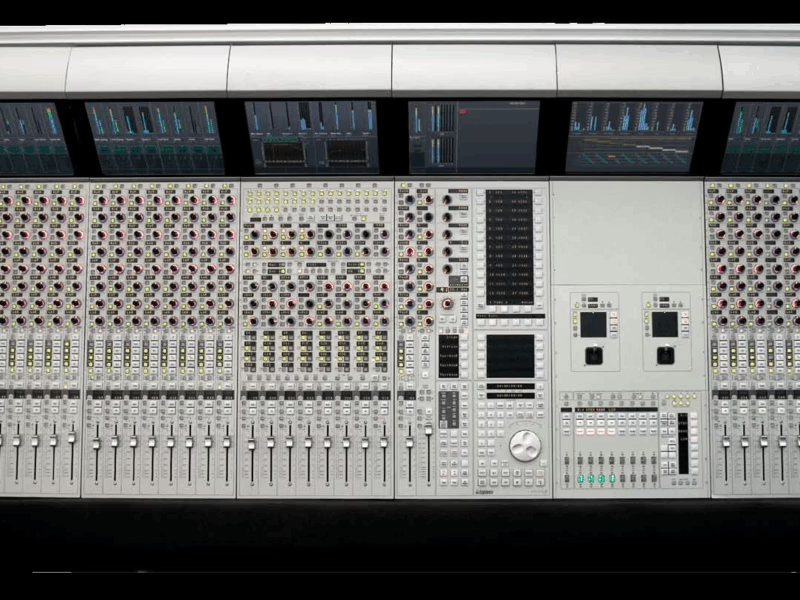
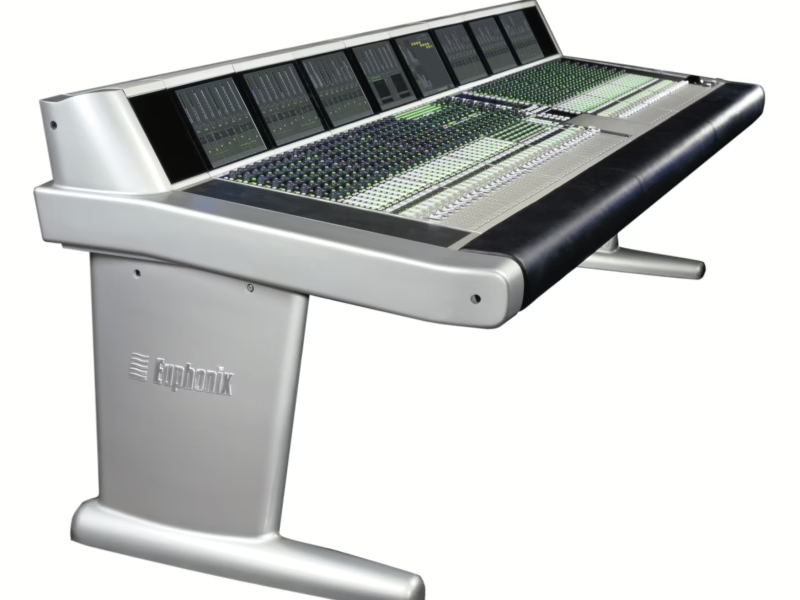
The Crescendo (model CS-1) is Euphonix's first product and one of the pioneers of the digitally controlled analog console. Audio stays entirely in the analog domain, processed in a rack called the Audio Mainframe, while a digital mixing surface (the Mix Controller, roughly the size of a table) drives every parameter over a control link. Variable-gain elements rely on multiplying DACs (MDACs), and a full reconfiguration of the console can happen within a single SMPTE frame. Its signature features were full TotalAutomation and SnapShot Recall, storing and recalling every setting — EQ, aux, dynamics. The four-band parametric equalizer, designed by Rob Silfvast, displayed its response curve on screen in real time, a first for the era. The first system was delivered to Poolside Studios in San Francisco in 1990. The Crescendo paved the way for the CSII, CS2000 and CS3000, which shared the same design philosophy.
- Scott Silfvast — Concept & founder
- Rob Silfvast — 4-band parametric EQ
- Adam Reif — Mechanical design
- Andrew Kalman — Firmware
- Russ Kadota — Software
Notable users
- Poolside Studios
First Crescendo system delivered (San Francisco, 1990).
Links
- Press article Mix Online — Euphonix Control and Operating Network mixonline.com
- Manufacturer Studio Sound (May 1991) — Review “Crescendo Audio Mixing System” (David Miles Huber) worldradiohistory.com
- Press article TV Technology — Euphonix celebrates 20 years tvtechnology.com
- Archive Resurface — Euphonix System 5 (history of the line) resurface.audio
- Archive Wikipedia — Euphonix en.wikipedia.org
Related consoles
Some merchant links are affiliate links. Purchases may support Digital Mixing at no extra cost.
Documents are archived locally for preservation. Source credited. Takedown requests: [email protected]