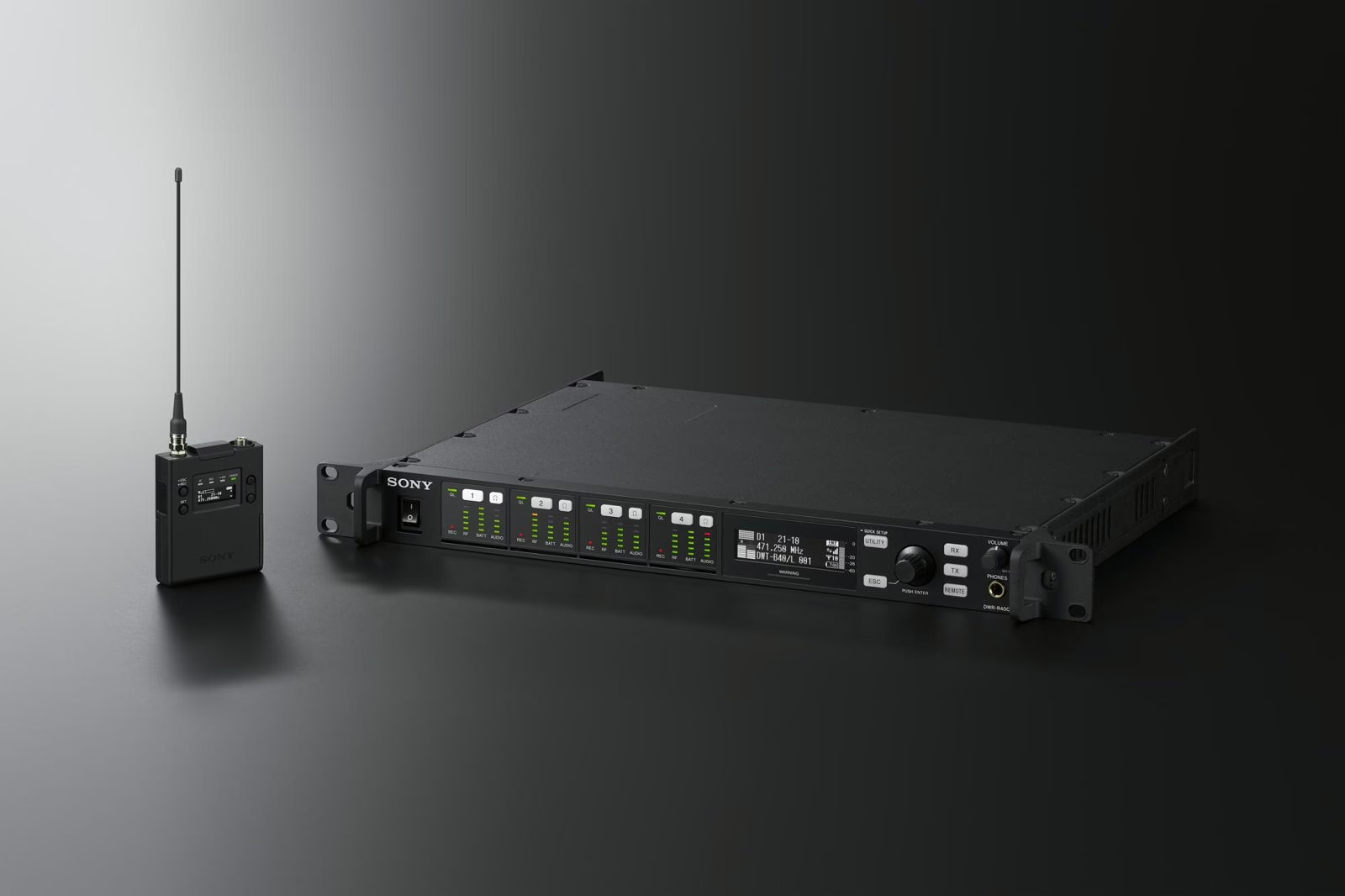
Sony has announced the fourth generation of its DWX digital wireless microphone series, built around two ideas: simpler setup and safer capture. The launch pairs the DWT-B40 bodypack transmitter with the DWR-R40Q rack receiver, both expected to ship in February 2027.
A safety net inside the transmitter
The headline feature hides in the DWT-B40: a 32-bit float internal recorder, driven by Sony’s own algorithm, that captures the signal locally while transmitting. If the RF link drops, the backup track stays clean, with no distortion at any input level — that is the whole point of 32-bit float. A dedicated REC button, timecode sync and remote record control from the receiver (Cross Remote) round out a system built for shoots and live shows where nothing can be lost.
The DWT-B40 takes a condenser mic directly with +48V phantom power, and runs on either a lithium-ion battery (sold separately) or USB — welcome flexibility on location. RF output reaches up to 50 mW (region dependent), and several transmission modes let you trade low-latency sound quality against maximum reliability in RF-congested broadcast or sports settings.
Four channels in a single rack
Facing it, the DWR-R40Q packs four true-diversity channels into a 1U chassis. Its receiving circuitry has been reworked to hold up in crowded environments, with a four-antenna diversity mode adding stability. On the output side, the receiver moves to Dante with four output ports while keeping analog XLR connections for conventional workflows. In short: four reliable wireless channels per rack unit, ready to slot into an all-IP setup or a traditional analog patch.
Setup that anyone can handle
Configuring digital wireless has traditionally demanded real expertise. Sony now claims frequency configuration and pairing across four channels in a handful of button presses. The goal is explicit: bring pro-grade reliability to less specialised users, from theatre and opera to musicals and studios of every size. The series stays compatible with earlier DWX generations, protecting existing inventories.
| Unit | Highlights |
|---|---|
| DWT-B40 (transmitter) | Internal 32-bit float, timecode, +48V, Li-ion or USB, up to 50 mW |
| DWR-R40Q (receiver) | 1U, 4 true-diversity channels, 4 antennas, Dante + XLR |
| Workflow | 4-channel pairing in a few buttons, backward compatible with DWX |
Positioning and price
Sony stresses an “accessible price point” for professional-grade performance, a way to push high-end digital wireless toward a wider audience. Announced European prices sit around €1,290 for the DWT-B40 transmitter and €6,490 for the four-channel DWR-R40Q receiver, with availability expected in early 2027. To place this launch in a fast-moving wireless market, revisit our pieces on the Sennheiser Spectera handheld and the new Neumann KK 104 A and KK 105 A capsules.
Frequently asked questions
What is the built-in 32-bit float recording for?
It provides a backup track captured directly in the transmitter. If the RF link drops, you still recover the audio, with no clipping and no unusable noise floor: 32-bit float handles any level and re-normalises in the edit.
Does the DWR-R40Q fit a networked setup?
Yes. The receiver exposes four Dante outputs alongside analog XLR, so it drops into an audio-over-IP infrastructure or a traditional patch without swapping hardware.
Can it mix with older DWX gear?
The fourth generation remains compatible with previous DWX generations. An existing inventory can be expanded gradually rather than replaced in one go.
How is the transmitter powered?
The DWT-B40 runs on a lithium-ion battery (sold separately) or over USB. That dual option eases power logistics on long shoots and outdoor captures.
My take
Putting a 32-bit float recorder inside the transmitter answers the one real fear of wireless: a dropout at the worst possible moment. The idea is not new among field-recorder makers, but folding it into a broadcast bodypack changes the game for scripted work and live shows. The four-channel 1U receiver with Dante ticks the modern-rack box, and the promise of simpler setup lands well — digital wireless has long intimidated people. Spectrum availability remains the sticking point, but in principle Sony has secured the most fragile link in the chain.