


Otari Advanta
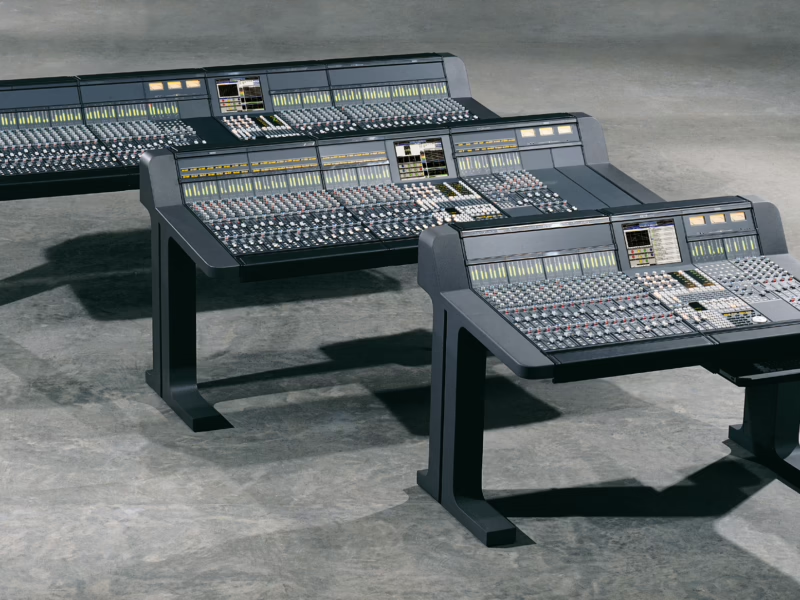
Large-format digital console for broadcast / post / music (40-bit DSP)
List price at launch 200,000 USD as of 1997
Description
Technical
Specifications
Inputs / Outputs
| Total inputs | 256 |
|---|
Processing
| Mix buses | 72 |
|---|---|
| Aux sends | 32 |
| Matrices | 24 |
| DSP engine | 40-bit DSP, remote rack-mounted digital engine linked to the surface via Ethernet |
| Max sample rate | 96 kHz |
| Bit depth | 24 bits |
| Processing resolution | 40 bits |
| DSP engine — details | 40-bit DSP; 24-bit / 96 kHz operation |
| Channels | 16 physical paths per input section × 8 virtual (up to 128 paths/section, 1024 virtual/console) |
| Buses | 72 main recording buses + 24 reassign buses |
| Aux sends — details | 32 aux sends |
| EQ | 4-band parametric EQ + HPF/LPF, 6 filters, 3 dynamics, 1 insert per path |
| Surround and immersive | Full surround panning and monitoring |
Surface
| Screens | 1 |
|---|---|
| Touchscreen | No |
| Metering | 16 tricoloured 40-segment LED meters per section (Chroma technology) + non-touch LCD screens |
| Control surface | Expandable control surface linked over Ethernet to a processing rack (engine, I/O, PSUs) |
Recording
| Onboard recording | No |
|---|
Networking
| Networking & protocols | MADI / Network |
|---|---|
| Redundant PSU | No |
| Redundant networking | No |
Other
| Variants and configurations | From 32-in/24-bus to 128+-in/48-bus; up to 256 inputs (music version), 3 operator positions (film variant) |
|---|
Accessories
I/O card
- MADI I/O
MADI I/O option for the Advanta.
- System Sync Card
System synchronisation card.
Fader extension
- Group Master Fader Panel
Group master fader panel.
Other
- RADAR II Remote
Remote control of the Otari RADAR II recorder from the console.
Documents
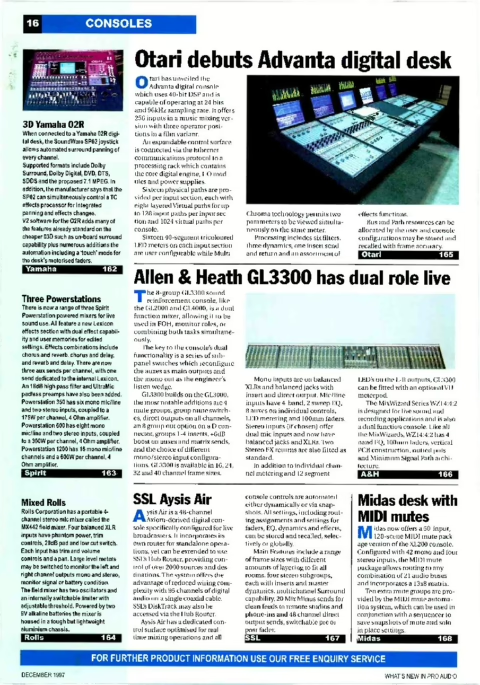
Editorial & artists
Our take
History & design
The Otari Advanta is a large-format digital console unveiled in late 1997 for music mixing, broadcast and film post-production. It is built around 40-bit DSP processing capable of running at 24-bit / 96 kHz. The expandable control surface connects over Ethernet to a processing rack housing the digital engine, I/O modules and power supplies.
Its architecture is highly modular: each input section provides 16 physical paths, each carrying 8 layered virtual paths — up to 128 input paths per section and 1024 virtual paths per console. The music version could reach 256 inputs; the film variant offered three operator positions. Routing relies on 72 main recording buses and 24 reassign buses, with 32 aux sends and full surround-format support.
Per-path processing includes six filters, three dynamics processors, one insert (send/return) and four-band parametric EQ with high-pass and low-pass filters. Metering combines LCD screens (non-touch) with sixteen 40-segment tricoloured LED meters per input section; the 'Chroma' technology lets two parameters be shown on a single meter. Bus and path resources are freely allocated by the user, and configurations can be stored and recalled with frame accuracy. Offered from 32-in / 24-bus up to more than 128-in / 48-bus, the Advanta targeted the very high end, with pricing starting around $200,000.
Notable users
- VRT
Flemish public broadcaster: purchase of four Advanta systems, two of them Broadcast Production versions.
Links
Related consoles
Some merchant links are affiliate links. Purchases may support Digital Mixing at no extra cost.
Documents are archived locally for preservation. Source credited. Takedown requests: [email protected]