Some machines only reveal their true worth once they’ve vanished from the catalog. Pittsburgh Modular’s Lifeforms SV-1 is one of them: a complete analog synth voice packed into a Eurorack enclosure, equally at home on a bottomless drone or a cutting lead, and never once apologetic about its grit. Discontinued for a while now, it left a gap plenty of players hoped would be filled. Consider it filled: Pittsburgh Modular is teasing the Lifeforms SV-2, billed as the SV-1’s direct successor, with a full reveal set for August 11, 2026.
A teaser, a date, and a clear sense of intent
Founder Richard Nicol posted a short mood film whose entire soundtrack was built on the SV-2 — multitracked into a DAW, then treated with EQ and compression. The message is unmistakable: this instrument knows how to sound, and it knows how to do it at opposite ends of the spectrum. Nicol sums it up as being at home with both “complex tones” and “lo-fi noise.” In other words, a synth that chases character, not clinical neutrality.
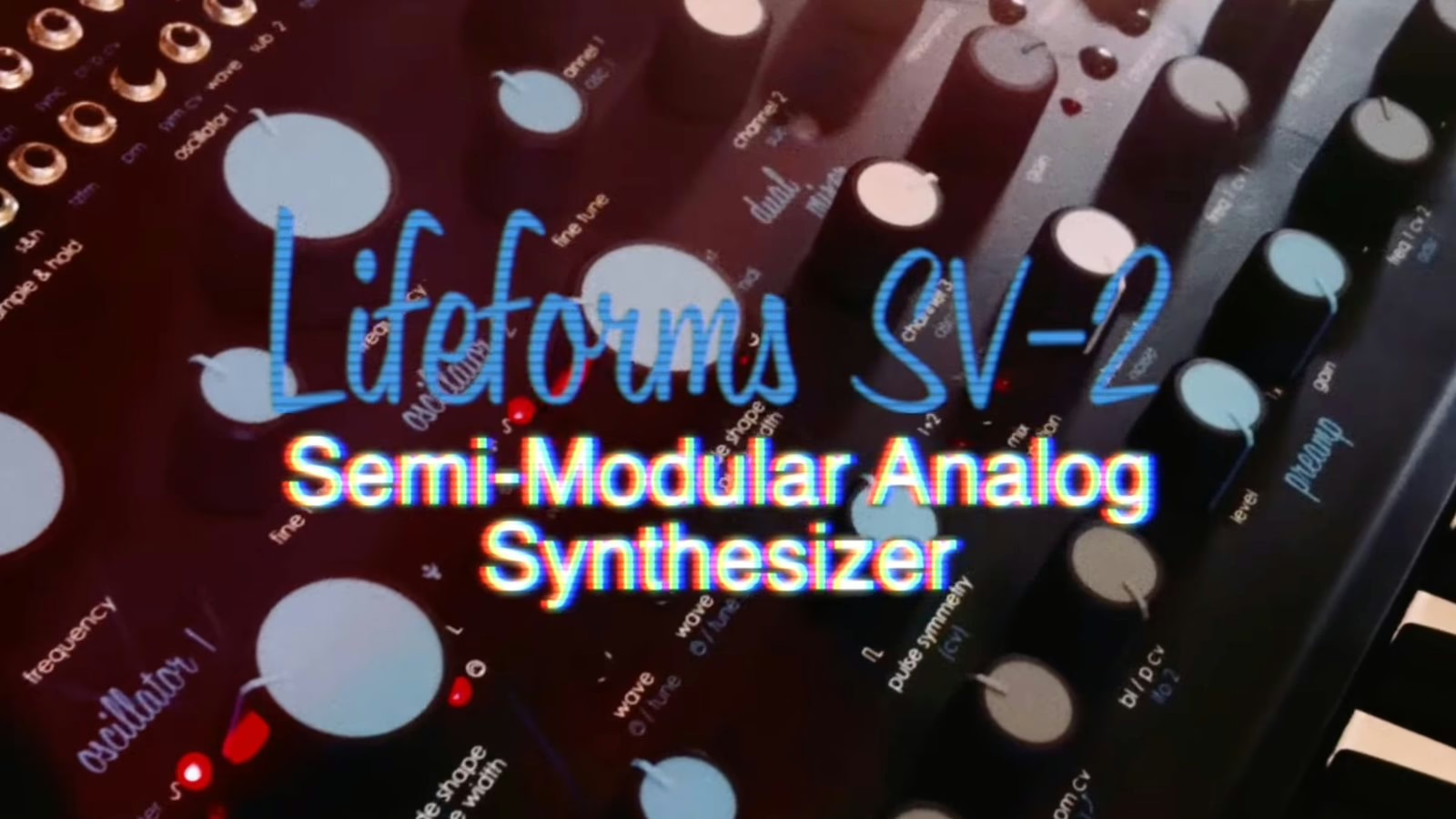
The most obvious change is the format. Where the SV-1 lived in a rack, the SV-2 adopts a full keyboard in the ergonomic lineage of the brand’s Taiga: a row of generous knobs, a patch field, and the practicality of an instrument you can play standing or seated without building a whole system around it. For a semi-modular, that choice matters — it makes the machine instantly playable for anyone with no case, no power supply, and no desire to fall down the modular rabbit hole.
What Pittsburgh Modular has let slip
The final specs land on August 11, and it would be dishonest to state today what’s still conditional. Here, though, is what the company has teased — read it as intent rather than a spec sheet set in stone:
- paraphonic and duophonic modes, opening the voice up beyond strict mono play;
- a heavy focus on square waves, with pulse width modulation (PWM) and pulse symmetry modulation — the tools to sculpt far livelier timbres than a static square;
- a state-variable multimode filter, two LFOs, a four-stage envelope, and a dual chained mixer section, straight out of the house philosophy.
For context, the SV-1 carried two multi-waveform VCOs, PWM, FM, hard sync and a variable-width “blade” waveform, rounded out by a MIDI-to-CV interface. If the SV-2 keeps that DNA while widening the polyphony and adding a keyboard, this is a genuine step up rather than a mere reskin.
A comeback landing in a golden moment for semi-modulars
The SV-2 isn’t arriving in a vacuum. The analog semi-modular category has rarely been this alive: the Vannes Devices Obsidian reconciles East and West Coast schools in one box, the Hampshire Electronics Vulcan MK2 squeezes an 8-voice polysynth into a module, and Tim Exile’s playable Karst system reinvents the very act of patching. In that field, Pittsburgh Modular is playing a different hand: the characterful voice, built for live gesture, with no feature bloat.
I’m inclined to give it the benefit of the doubt, and not for nothing. What has always set Pittsburgh Modular apart is a kind of restraint in the design: few gimmicks, circuits with a sonic point of view, and a signature you hear from the first note. At a time when too many synths pile on menus just to tick boxes, an instrument that commits to a grain and a simple playing flow has real value. The one unknown that will decide everything is still under wraps: the price. That’s what will tell us whether the SV-2 is an object of desire or a genuinely sensible buy. See you on August 11 for the full spec sheet — and to find out whether the teaser holds up under scrutiny.
Full specs and pricing will be revealed on August 11 on the Pittsburgh Modular website.