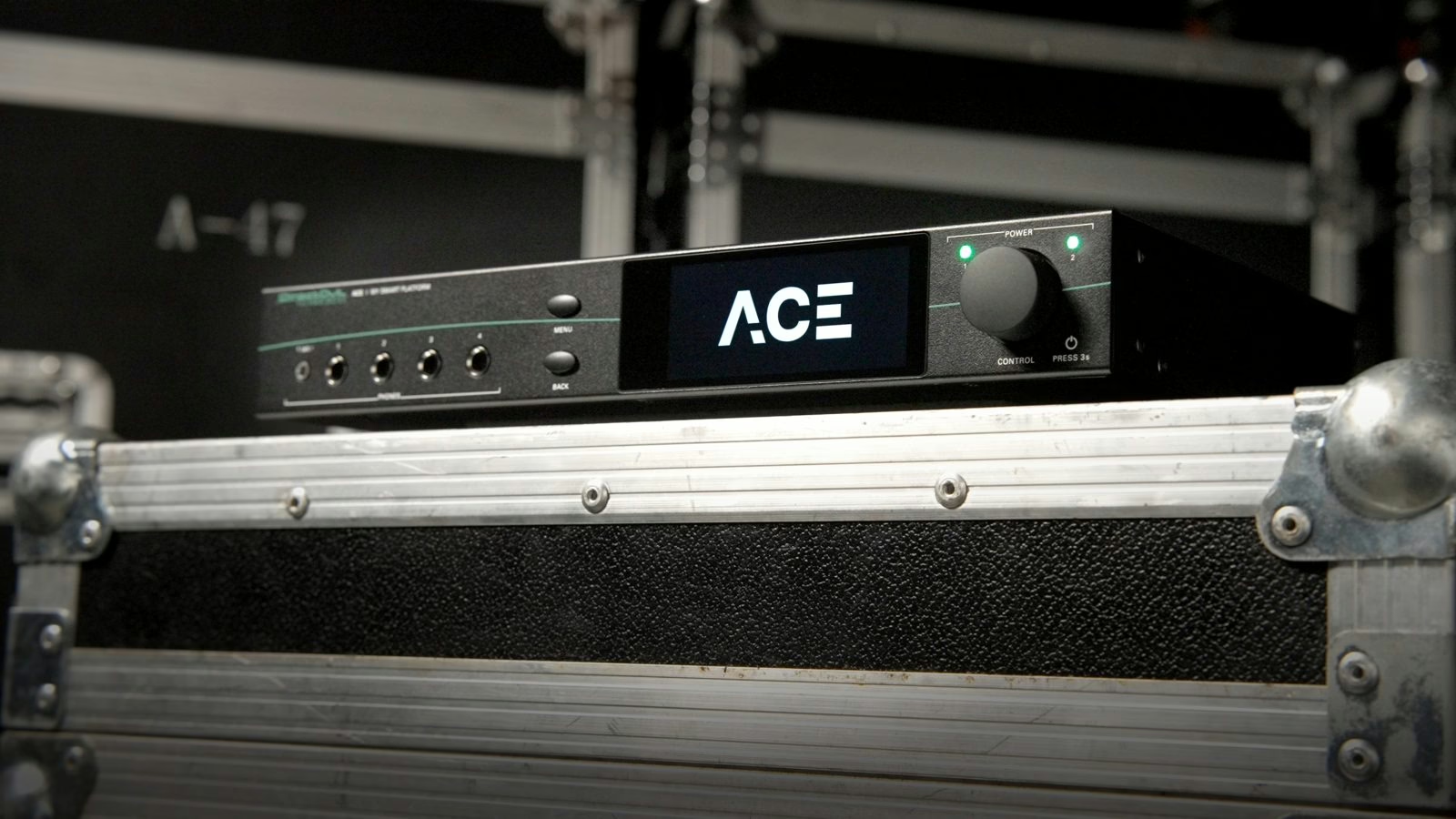
Announced from Mittweida, Germany, ACE takes the FPGA architecture that made DirectOut’s PRODIGY series a reference and drops it into a half-rack chassis. The pitch is simple: the reliability and processing muscle of the company’s flagship boxes, in a format you can carry in a backpack. Two power supplies sit on the front panel, a clear sign that redundancy wasn’t traded away for size.
Every major network on one box
ACE gathers the protocols that define professional audio today on a single unit: MADI, audio over IP, Dante, Milan for those who use it, AES3 and high-quality analog I/O. The front panel adds a display, a control encoder and four headphone outputs, so you can grab a monitor point without opening a laptop. It’s exactly the kind of box that replaces three converters and a gateway in a rack or an OB van.
Three modes, one per job
The clever part is the ACE Modes: globcon interfaces built for a specific task, from guided setup to a fully open environment.
| Mode | What it does |
|---|---|
| Playback | Primary/backup computer switching, vocal processing inserts, streamlined output routing, with EARS redundancy built in. |
| PA | A complete drive rack: EQ, dynamics, delays and native Smaart integration for system tuning. |
| PRODIGY | The full globcon environment, as on the PRODIGY and MAVEN series: routing, mixing, summing, snapshots and redundancy, no guardrails. |
EARS, globcon and licensing on demand
EARS redundancy watches the signal paths and switches over with no audible drop — a decisive argument the moment a live show or a broadcast feed is on the line. Control runs through globcon, the same software as on the high end, so there’s no new interface to learn when you move between machines. Commercially, DirectOut went with a granular perpetual licensing model: you enable the modes and features you actually need, and grow the unit later. An assistant, Ask.DirectOut, helps with configuration and system design.
Why it matters
For a festival rig, a broadcast OB van or a touring playback setup, ACE offers one unit to carry where several used to be needed. It follows the same logic as the recent Calrec Apex M6 modular I/O platform: tie the audio networks together without stacking up extra links. If the Dante / AES67 / ST 2110 mix still feels murky, our audio-over-IP primer clears it up. Full details are on the DirectOut product page.
My take
It’s a smart bet: take a proven processing engine and make it portable without cutting corners on redundancy. The three modes dodge the usual trap of these Swiss-army boxes, where power comes with a discouraging learning curve — here you start in guided mode and lift the hood when you’re ready. The à la carte licensing deserves a careful read before you buy, since that’s what sets the real price of your rig. But for anyone living on the road or in an OB van, a single box that speaks every network and fails over cleanly is exactly the kind of tool that makes a get-in day shorter.
Frequently asked questions
Which audio networks does ACE support?
MADI, Dante, Milan, AES3 and audio over IP, plus analog I/O. That spread is what lets it act as a bridge between infrastructures that otherwise wouldn’t talk to each other.
How is it different from a PRODIGY?
It shares the same FPGA core and the same globcon software, but in a travel-ready half-rack format, with an I/O count and capacity suited to mobile work rather than a large fixed install.
Is redundancy really built in?
Yes. ACE carries dual power supplies and EARS technology, which watches the signal paths and switches over with no audible drop if something fails — a must for live and broadcast.
How do you buy it?
Through a granular perpetual licensing model: you only enable the modes and features you need, and can add more later. The cost depends on your configuration rather than a single list price.