The Roland Space Echo RE-201 is one of those boxes whose sound shaped entire genres: dub, reggae, krautrock, dream-pop — a whole swath of production was built on its tape delay paired with a spring reverb. Dusk Audio, a developer that has made free and open source its trademark, offers a full model of it with Tape Echo 2, from the record head all the way to the output amplifier.
Three playback heads, one strip of tape
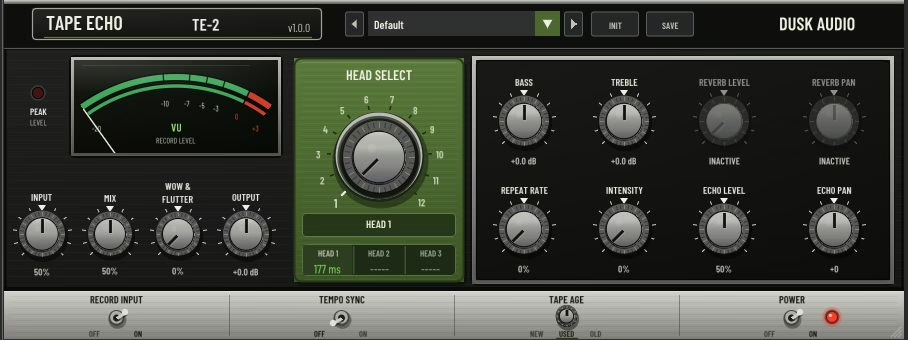
The concept is followed to the letter: one record head and three playback heads driven by a single “motor”, their positions set by fixed mechanical ratios. Changing the Repeat Rate therefore shifts all active heads together, and motor inertia produces a glide between speeds — that signature pitch skid when you turn the knob mid-note. Head 1 spans roughly 70 to 178 ms, while heads 2 and 3 reach around 490 ms.
The tape, modeled end to end
This is where the exercise earns its credibility. Tape Echo 2 models wow and flutter coupled to tape age, band-limited scrape flutter, hiss, saturation in the record chain, splice dropouts and self-oscillation through magnetic-flux saturation. It’s that pile of controlled imperfections that separates a clean digital delay from a real tape echo: the grain isn’t in the repeats, it’s in how the tape degrades them on every pass.
Spring reverb and twelve modes
Alongside the delay sits a three-unequal-spring reverb, rounded out by two allpass diffusers to spread the tail. Twelve modes combine playback heads and reverb: single head, heads 2 and 3 together, head-plus-reverb variations, and a reverb-only mode — enough to move from a dry slapback to a saturated cloud without leaving the plugin.
Controls, formats and price
The panel stays readable: a tempo-syncable Repeat Rate (11 detents), Intensity for regeneration (0 to 100%, self-oscillating at the top), Bass and Treble on the echo return, independent echo and reverb levels with panning, output volume (-20 to +20 dB), a dry/wet Mix, and a VU meter with a peak lamp on the record path. Thirteen factory presets come with it. The plugin is entirely free and open source under the GPL-3.0 license, in AU, VST3, CLAP and LV2 depending on the platform (macOS, Windows, Linux).
My take: in-the-box holds up perfectly here. A Space Echo’s charm isn’t the magic of some unobtainium component — it’s the behavior of the tape: the wow, the flutter, the saturation that creeps in as you push regeneration. A model that nails that mechanic, and for free, makes the real RE-201 nearly redundant for the vast majority of uses. What’s left is the pleasure of turning a real knob and the smell of tape… but no plugin will ever sell you that.
Tape Echo 2 joins the wave of software reissues of cult effects: the benchmark delay Strymon TimeLine MX, the Universal Audio EMT 250 and EMT 140 reverbs, or the five classic plugins Steinberg gave away for VST’s 30th birthday. In the same free, open-source vein from the same developer, give Dusk Audio Sunset Circuits a listen. Tape Echo 2 is a free download from Dusk Audio’s website.